Establishing Strategies for Industrial Transformation by Institutionalizing Civil Proposals
[Asia Economy Reporter Park Sun-mi] To achieve a major transformation of Korea's industry, which has been trapped in the "Lost 20 Years," the government and the private sector have launched a 200-day project. The government plans to policyize private sector proposals and establish an industrial transformation strategy within the first half of the year.
On the 26th, the Ministry of Trade, Industry and Energy held the "1st Industrial Transformation Forum Chairpersons' Meeting" at the Korea Chamber of Commerce and Industry. This was the first full meeting involving six private sector chairpersons and the government, where in-depth discussions on the necessity of industrial transformation and response measures took place.
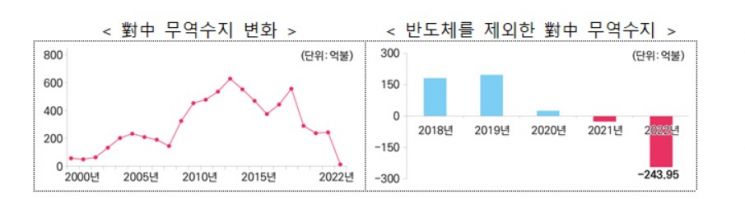
Our industry has failed to create new growth engines over the past 20 years. The export and production structure remains fixed around the top 10 items such as semiconductors, automobiles, petroleum products, and shipbuilding. Most of the main products, except for semiconductors, displays, and batteries, face competition from latecomer China, and especially in China, the main export market, only a few products like memory semiconductors barely maintain competitiveness. As a result, the trade balance with China has been continuously decreasing since 2018. Excluding semiconductors, it shifted from a $18 billion surplus in 2018 to a $24 billion deficit in 2022.
The members participating in the forum evaluated that if structural problems in Korea's economy and society are not improved from now on, it will be difficult to overcome the crisis that will come in 10 years. They judged that Korea's industry has been in crisis since the 2000s, trapped in the "Lost 20 Years." Accordingly, based on discussions conducted in six subcommittees?investment, workforce, productivity, corporate environment, global strategy, and new business?the Ministry of Trade, Industry and Energy plans to policyize private proposals and prepare an industrial transformation strategy within the first half of the year.
On that day, the investment subcommittee discussed designating competing countries by industry for advanced investments and guaranteeing total investment incentives exceeding those of competing countries, establishing a national investment holding company (K-Temasek), and introducing an industrial impact assessment system for regulations. The workforce subcommittee proposed measures such as reforming education regulations and expanding corporate participation for nurturing future talent, establishing a national industrial talent bank to professionally manage workforce demand forecasting and supply, and the Excellent Talent Red Carpet Project, which offers exceptional incentives to attract and settle global top talent.
The productivity subcommittee presented plans for discovering and supporting critical technologies to secure a super-gap in technology, strengthening the role of government-funded research institutes in supporting companies, and the Mother Factory Project, which aims to intelligentize the entire value chain through an AI supply chain. The corporate ecosystem subcommittee discussed revising textbooks and introducing student education programs linked to corporate sites (Korean-style Oslo Agenda) to cultivate future national core talents with entrepreneurial spirit, as well as reforming corporate support systems proportional to corporate growth and innovation.
Additionally, the global strategy subcommittee announced plans to expand and sophisticate cooperation areas such as high-end consumer goods, services, and hydrogen with China, which still holds a significant share in the global economy, along with strategies to pioneer new export and investment markets in ASEAN, India, and the Middle East. The new business subcommittee focused on closely analyzing business trends of global leading companies and future trends such as carbon neutrality, health, and quality of life to discover promising businesses that could become Korea's future growth engines and discussed ways to commercialize them.
Lee Chang-yang, Minister of Trade, Industry and Energy, stated, “Our economy faces many difficulties externally due to protectionism, US-China conflicts, and competition to attract advanced industries, and internally due to declines in investment and workforce and stagnation in innovation," adding “We must overcome the current crisis through industrial innovation and place our industry on a stable foundation of competitiveness.”
© The Asia Business Daily(www.asiae.co.kr). All rights reserved.
![Clutching a Stolen Dior Bag, Saying "I Hate Being Poor but Real"... The Grotesque Con of a "Human Knockoff" [Slate]](https://cwcontent.asiae.co.kr/asiaresize/183/2026021902243444107_1771435474.jpg)











