Choi Sang-mok, Chief Economic Secretary, Announces Heating Cost Reduction Measures
Energy Voucher Support and Double Gas Fee Discounts
Gas Fees Frozen in Q1 Considering Winter Heating Demand
[Asia Economy Reporter Baek Kyunghwan] In response to the 'heating bill bomb' crisis triggered by the gas price hike, the government has announced a plan to significantly expand heating cost support for vulnerable groups. The core of the plan is to double both the energy voucher support and the gas price discount provided by the Korea Gas Corporation. However, acknowledging the inevitability of energy price normalization amid difficult external conditions, the government stated that it will "comprehensively review" the expansion of the support target.
Choi Sang-mok, Chief Economic Secretary to the President, announced these support measures during a briefing at the Yongsan Presidential Office on the morning of the 26th, saying, "To expand heating cost support for vulnerable groups in winter, we have decided to significantly increase energy voucher support and gas price discounts."
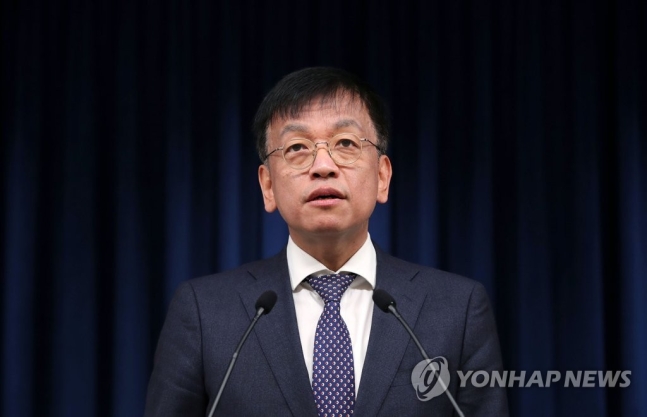 Choi Sang-mok, Senior Secretary for Economic Affairs at the Presidential Office, is explaining the heating cost support measures for vulnerable groups on the 26th at the Presidential Office building in Yongsan, Seoul.
 [Photo by Yonhap News]
First, to expand support for vulnerable groups, the energy voucher support amount will be doubled from 152,000 KRW to 304,000 KRW. The target includes 1,176,000 households among recipients of livelihood, medical, housing, and education benefits, as well as basic livelihood security households with elderly patients and other heat- and cold-sensitive groups. The Korea Gas Corporation’s social consideration target households total 1.6 million. The discount on gas bills they receive this year will be adjusted from the previous 9,000 KRW to 36,000 KRW range to 18,000 KRW to 72,000 KRW.
Regarding the energy voucher support target, Chief Secretary Choi explained, "It is inevitable that all citizens face increased difficulties due to heating cost burdens, and there are external conditions that must be endured," adding, "The more vulnerable the household, the more help is needed." He further stated, "The expansion of additional targets will be comprehensively reviewed considering the effectiveness of this measure, which groups actually need more support, and the overall fiscal situation."
Considering the concentration of heating demand in winter, gas prices will be frozen for the first quarter of this year. Chief Secretary Choi said, "The recent sharp rise in heating costs is due to price increase factors over the past few years, but price hikes were suppressed," and explained, "Since the second half of 2021, international natural gas prices have surged more than tenfold compared to the first quarter of 2021." He added, "The gas price increase last year was inevitable, reflecting some of the 2022 price increase factors," and stated, "Considering the concentration of heating demand in winter, the first quarter prices have been frozen to ease the burden on citizens."
The cause of the heating cost increase was attributed to the surge in international energy prices. Chief Secretary Choi explained, "Although there were price increase factors over the past few years, price hikes were suppressed," and noted, "This is due to international natural gas prices rising more than tenfold compared to the first quarter of 2021." According to the Presidential Office’s analysis, major countries worldwide such as the United States, the United Kingdom, and Germany have also seen residential gas prices rise by two to four times in 2022 compared to the previous year. Chief Secretary Choi added, "Compared to 2021, residential gas prices in 2022 increased by 3.3 times in the U.S., 2.6 times in the U.K., and 3.6 times in Germany, but Korea’s gas price level remains at 23% to 60% of those countries."
Regarding the ruling party’s judgment that the current heating cost surge is due to the previous administration’s nuclear phase-out policy, he said, "The focus is on how to improve structural factors such as Korea’s various industries, energy supply and demand structure, and usage efficiency." Currently, the Democratic Party of Korea is emphasizing the 'responsibility of the administration' by claiming that public utility fees have surged under the Yoon Seok-yeol government, while the People Power Party is counterattacking by blaming the Moon Jae-in administration for suppressing gas price increases and implementing the nuclear phase-out policy.
Additionally, Chief Secretary Choi responded to the possibility of gas price hikes after the first quarter by saying, "It is too early to say what will happen after the second quarter," and added, "We will decide considering various factors such as the burden on citizens and the financial status of KEPCO and the Korea Gas Corporation." However, he emphasized, "There is an overall task to change the energy consumption structure," and said, "Although it is a difficult task, we will strive to balance it and minimize the burden on citizens."
© The Asia Business Daily(www.asiae.co.kr). All rights reserved.
![Clutching a Stolen Dior Bag, Saying "I Hate Being Poor but Real"... The Grotesque Con of a "Human Knockoff" [Slate]](https://cwcontent.asiae.co.kr/asiaresize/183/2026021902243444107_1771435474.jpg)
















