Ministry of Economy and Finance, 144th External Economic Cooperation Fund Management Committee Meeting
[Asia Economy Sejong=Reporter Song Seungseop] The government announced that it will expand and operate the development aid fund for developing countries to 11.7 trillion KRW over the next three years. The actual amount to be disbursed reaches 5 trillion KRW. In particular, support in the green and digital sectors will increase, with more than half of the funds directed to the Asia region.
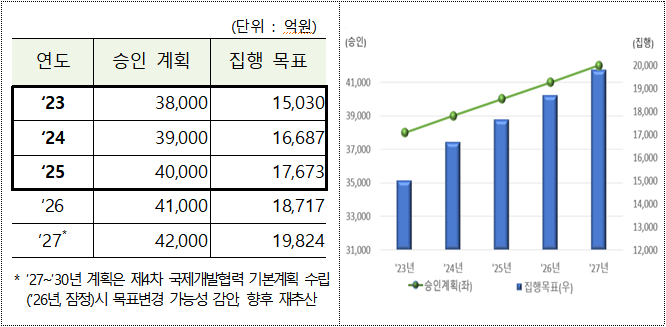
On the 26th, the Ministry of Economy and Finance announced at the 144th External Economic Cooperation Fund (EDCF) Management Committee meeting that it will push for approval of new projects totaling 11.7 trillion KRW from this year through 2025 under the ‘Medium-term Operation Direction.’ The fund size will be continuously expanded by 100 billion KRW annually, preparing 3.8 trillion KRW this year, 3.9 trillion KRW next year, and 4 trillion KRW in 2025.
The EDCF was established in 1987 to support industrial development and economic stability in developing countries and to enhance economic cooperation with these nations. The government aims to raise the scale of aid to developing countries from the world’s 15th rank to the 10th. The amount is planned to more than double by 2030 compared to 2019 (3.2 trillion KRW).
Support will place the greatest emphasis on the ‘green’ sector, considering excellent fund management performance and the importance of responding to climate change. The target, which was 1.4 billion USD in 2025, has been expanded to 1.7 billion USD. During the same period, the health sector target shrank from 1 billion USD to 700 million USD, reflecting the surge in health resource inflows following the COVID-19 outbreak. The digital sector maintained its existing goal of operating 900 million USD.
Focus on ‘Green’ and ‘Asia’ in Development Aid
By region, the focus is on Asia, where infrastructure demand is high, due to the need to expand economic cooperation. Considering the abundant infrastructure investment in recipient countries and the demand for Korean companies to enter the market, a share of 60-70% will be maintained. Africa’s investment share will be expanded to 20-30% based on growth potential, aiming to cultivate it as a second-tier major partner country. The Latin America region is set at 10-20%.
The four key tasks are strategic project implementation, responding to changes in the development environment, strengthening crisis management and improving the implementation system, and enhancing EDCF awareness and strengthening internal and external cooperation. First, the government will expand the ‘Framework Agreement (F/A),’ which comprehensively sets limits and periods for SME support between governments, and will also discover new partner countries. Through this, a total of 1.5 billion USD will be invested in large landmark projects by 2025, and at least two approvals will be decided for single projects exceeding 300 million USD. The fund will also enter countries where direct EDCF project discovery is difficult.
Additionally, ‘non-binding’ aid without any conditions will continue to target 60% of the total, while candidate projects will be intensively discovered in areas where Korean companies have technological competitiveness. Non-binding aid will be expanded to allow companies from recipient countries to bid on small-scale projects with low actual profits. The introduction of a program loan system will be considered for some countries, and climate risk management and performance evaluation systems will be fully implemented.
Furthermore, economic and social crisis monitoring will be conducted in recipient countries. Economic trends such as external debt increases will be regularly checked, and participation in international debt restructuring discussions will be ensured. If an emergency occurs in a recipient country, immediate support through emergency loans is also included. Feasibility studies will be improved to ensure thorough project preparation, and the evaluation results after project completion will be reflected in the approval of new projects through a refined system.
In addition, to raise awareness of the EDCF, performance-sharing conferences will be regularized, and new local workshops in developing countries will be held.
© The Asia Business Daily(www.asiae.co.kr). All rights reserved.

















