[Asia Economy Reporter Seo So-jeong] The Korean economy recorded negative growth for the first time in two years and six months since the COVID-19 pandemic, as exports and private consumption declined in the fourth quarter of last year.
On the 26th, the Bank of Korea announced that the real gross domestic product (GDP) growth rate for the fourth quarter of last year (preliminary figure, quarter-on-quarter) was -0.4%. This marks the first time in 10 quarters that Korea's quarterly growth rate has been negative since the second quarter of 2020 (-3.0%), when the impact of COVID-19 began to intensify.
The quarterly growth rates were negative in the first quarter (-1.3%) and second quarter (-3.0%) of 2020 during the spread of COVID-19, followed by growth in the third quarter (2.3%), fourth quarter (1.2%), first quarter of 2021 (1.7%), second quarter (0.8%), third quarter (0.2%), fourth quarter (1.3%), first quarter of last year (0.6%), second quarter (0.7%), and third quarter (0.3%). However, in the fourth quarter of last year, the economy shifted to negative growth.
Looking at the growth rate by sector in the fourth quarter, government consumption, construction, and facility investment increased, but exports and private consumption decreased.
Private consumption fell by 0.4% due to reduced spending on goods such as home appliances, clothing, and footwear, as well as services like accommodation, food, and entertainment culture.
Government consumption increased by 3.2%, mainly driven by expenditures on goods and health insurance benefits. Construction investment rose by 0.7%, centered on non-residential building construction.
Facility investment increased by 2.3%, mainly in machinery.
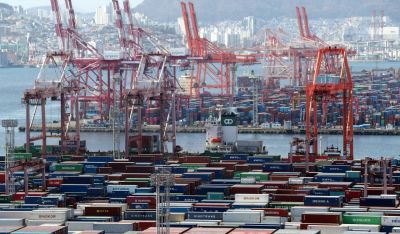
Exports decreased by 5.8%, led by semiconductors and chemical products, while imports fell by 4.6%, due to reductions in crude oil and primary metal products.
By industry, manufacturing declined as in the previous quarter, whereas the service sector showed growth.
Agriculture, forestry, and fisheries increased by 1.5%, mainly in crop farming, while manufacturing decreased by 4.1%, centered on computers, electronics and optical equipment, and chemical products.
Electricity, gas, and water supply increased by 1.0%, driven by gas, steam, and air conditioning supply. Construction grew by 1.9%, mainly in building construction.
The service sector grew by 0.8%, led by transportation, finance, and insurance industries.
Despite the decline in real GDP (-0.4%) in the fourth quarter, real gross domestic income (GDI) increased by 0.1% due to improved terms of trade. This marked a positive figure for the first time in three quarters since the first quarter of last year (0.5%).
Real GDP for last year increased by 2.6% compared to the previous year, aligning with the Bank of Korea's forecast.
However, due to the deterioration of terms of trade caused by rising oil prices, the annual real GDI for last year decreased by 1.1% compared to the previous year, falling short of the real GDP growth rate.
© The Asia Business Daily(www.asiae.co.kr). All rights reserved.

















