49 Mira Amulets Discovered
Significance of Protecting the Body in the Afterlife
Computerized tomography (CT) scans of an Egyptian boy mummy who died about 2,300 years ago revealed 49 amulets. Most of the amulets were found to be made of gold.
According to foreign media including the US CNN on the 24th (local time), this mummy, called the "Golden Boy," was first discovered in 1916 at the southern Egyptian communal cemetery "Nag el-Hassay," which is estimated to have been used between 332 BC and 30 BC.
Since then, the mummy was stored in a museum basement for a long time. To closely examine the mummy, it would have to be unwrapped, which would damage the body itself, so no investigation had been conducted until now.
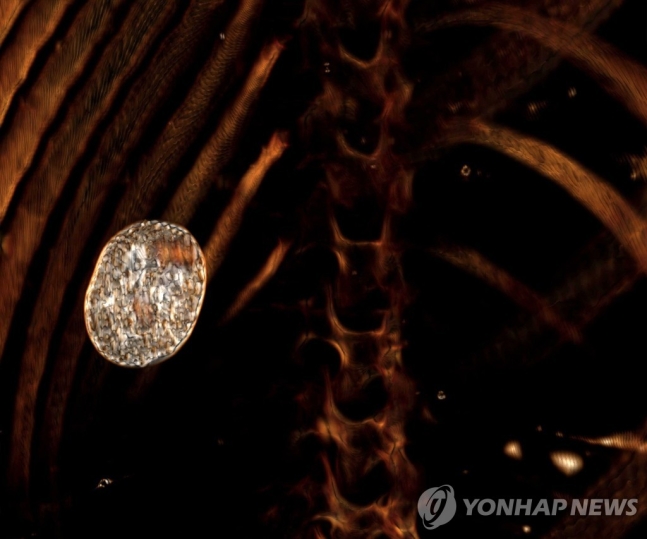 The CT scan images of a 2,300-year-old Golden Boy mummy were released on the 24th (local time). [Image source=EPA Yonhap News]
However, recently, with the introduction of CT scanning, which allows internal examination without direct contact with the mummy, the appearance of the "Golden Boy" was revealed to the world.
The investigation concluded that the mummy was a boy between 14 and 15 years old, approximately 128 cm tall, with a small nose, narrow jaw, and an oval-shaped face.
Notably, during the investigation, 49 amulets placed in the boy’s mouth and chest were discovered. Most of the amulets were gold, while some were made of semi-precious stones, baked clay, and ceramics.
Although the boy’s exact identity remains unknown, CNN reported that considering the condition of his teeth, the mummification technique, and the amulets, it is presumed he held a high social status.
Professor Sahar Salim of Cairo University explained that the amulets found on the boy’s body were meant to "protect the body in the afterlife and grant vitality."
In particular, Egyptians believed that the "golden tongue" amulet helped the deceased to speak in the afterlife. The mummy also contained a golden scarab heart ornament and ostrich feathers.
Additionally, the mummy’s feet were adorned with white sandals, and plants presumed to be ferns were wrapped around the body. Professor Salim explained, "Ancient Egyptians believed that wearing white sandals allowed the deceased to maintain a reverent and pure state, and that certain plants possessed 'sacred protective power.'"
Meanwhile, the mummy is scheduled to be moved to a major exhibition hall at the Egyptian National Museum along with the newly taken CT images.
© The Asia Business Daily(www.asiae.co.kr). All rights reserved.

















