Good Cash Flow 'Golden Stocks' in Focus
Surplus Cash Flow of Listed Companies Decreases to 21 Trillion Won Range
[Asia Economy Reporter Lee Seon-ae] As the business environment deteriorates due to the economic downturn, companies with excellent cash generation capabilities are emerging as investment alternatives. Companies with strong cash flow can withstand recessions well and increase investments during economic recovery periods to boost market share. Additionally, they can enhance shareholder value by gaining stock price momentum through share buybacks or dividends when stock prices fall. Accordingly, securities firms advise that although the cash flow of listed companies has been deteriorating recently, attention should be paid to companies that have secured a large amount of ammunition (cash) and have well-stocked warehouses.
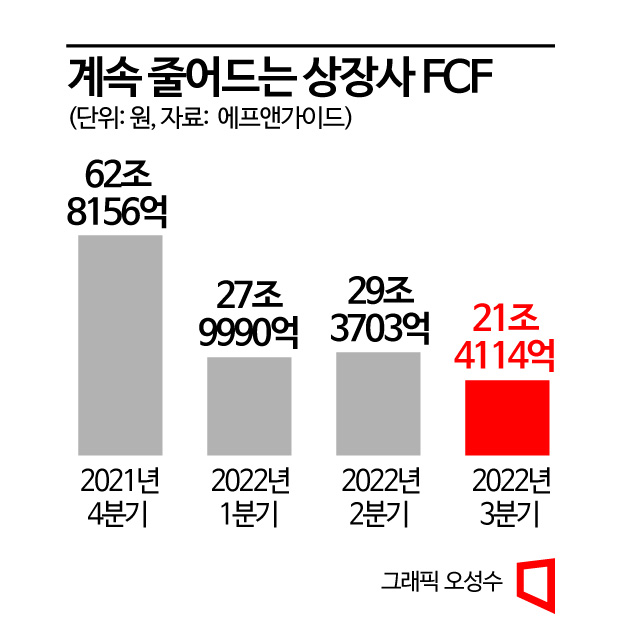
On the 26th, Asia Economy commissioned the financial information company FnGuide to compile data showing that the free cash flow (FCF) of domestic listed companies has sharply declined for consecutive recent quarters. Based on companies with December fiscal year-end, the FCF for the third quarter of last year was recorded at KRW 21.4114 trillion. It slightly increased from KRW 27.999 trillion in the first quarter of 2022 to KRW 29.3703 trillion in the second quarter but decreased again in the third quarter. Especially compared to 2021, there was a significant difference. In the fourth quarter of 2021, the FCF of listed companies reached KRW 62.8156 trillion (some small companies and those with negative cash flow figures were excluded from the statistics).
FCF is the remaining funds after deducting a company's capital expenditures (CAPEX). It is the money left after subtracting various costs, taxes, and facility investments from the profits earned through business operations. It can be used to increase shareholder value through share buybacks or dividend payments, or for investments such as expanding production facilities, developing new products, and mergers and acquisitions (M&A).
There is also a possibility that the CAPEX of domestic listed companies has exceeded operating cash flow (OCF). Kyobo Securities analyzed that excluding Samsung Electronics, the FCF of all companies in the third quarter of last year reached negative KRW 12.1 trillion. This means that the investment costs companies spend to generate profits and secure future growth exceed cash outflows and inflows from sales and profits, increasing cost burdens. Researcher Kang Min-seok of Kyobo Securities pointed out, "CAPEX has been steadily increasing, but operating cash flow has declined, causing companies' surplus funds to disappear. More than 55% of domestic companies have negative FCF, and profit improvement will not be easy."
Companies also raise funds externally through bond issuance and other means besides business operations, but recently, rising interest rates have increased financing costs, causing difficulties. Regardless of industry or credit rating, there have been repeated cases of failed corporate bond issuances due to lack of demand. As external financing becomes difficult, securities firms expect companies with good cash flow to secure differentiated momentum going forward.
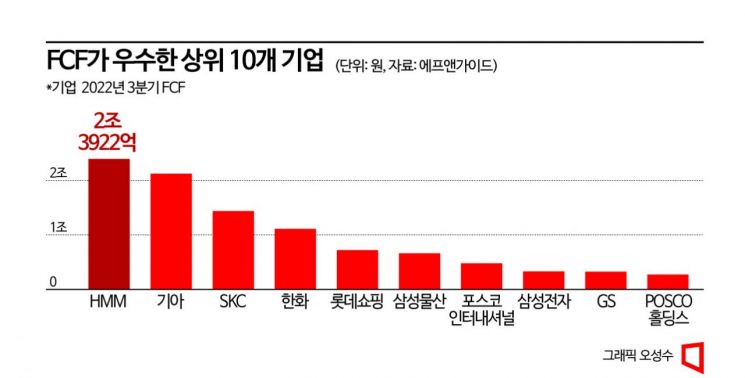
As the cash flow of most companies deteriorates, there is a growing call to properly select 'golden stocks.' According to an analysis of FnGuide data, the companies with the best FCF as of the third quarter of last year were HMM (KRW 2.3922 trillion) and Kia (KRW 2.1228 trillion). They were followed by SKC (KRW 1.4387 trillion), Hanwha (KRW 1.1106 trillion), Lotte Shopping (KRW 720.9 billion), Samsung C&T (KRW 661.1 billion), POSCO International (KRW 480.1 billion), Samsung Electronics (KRW 331.2 billion), GS (KRW 325.6 billion), and POSCO Holdings (KRW 270.9 billion).
Researcher Lee Chang-hwan of Hyundai Motor Securities emphasized, "In a rising interest rate environment, massive expenditures and excessive future financing will negatively affect shareholder returns. Attention should be paid to companies that have good cash flow, possess quality assets, and can increase investments based on this to gain an advantage over competitors."
Mirae Asset Securities identified companies expected to see significant increases in operating profit this year among those with improving cash flow, including Hansol Chemical, Hyundai Mobis, Mando, Hotel Shilla, JYP Entertainment, YG Entertainment, Daeduck Electronics, and Haesung DS. Researcher Yoo Myung-gan of Mirae Asset Securities noted, "Companies with good cash flow in the mature stage use cash earned from operations for investments, repay borrowings to improve financial structure, or expand shareholder returns through dividends or share buybacks."
NH Investment & Securities highlighted Samsung Electronics, SK Bioscience, DB HiTek, Eugene Technology, Jusung Engineering, Koyoung, Park Systems, LX Semicon, NCSoft, Hyundai Mobis, Amorepacific, Aekyung Industrial, and SK Chemicals as stocks of interest. Researcher Kim Jae-eun of NH Investment & Securities said, "Attention is needed for companies expected to have large investment proportions this year and that have no significant issues with cash procurement for these investments."
© The Asia Business Daily(www.asiae.co.kr). All rights reserved.
![Clutching a Stolen Dior Bag, Saying "I Hate Being Poor but Real"... The Grotesque Con of a "Human Knockoff" [Slate]](https://cwcontent.asiae.co.kr/asiaresize/183/2026021902243444107_1771435474.jpg)












