516 Cases of Honeybee Disease Diagnosed... Triple Compared to Last Year
Impact of Abnormal Weather... 7.8 Billion Bees Missing Compared to a Year Ago
US Government Approves 'Honeybee Vaccine'... Korea Still in Early Stages
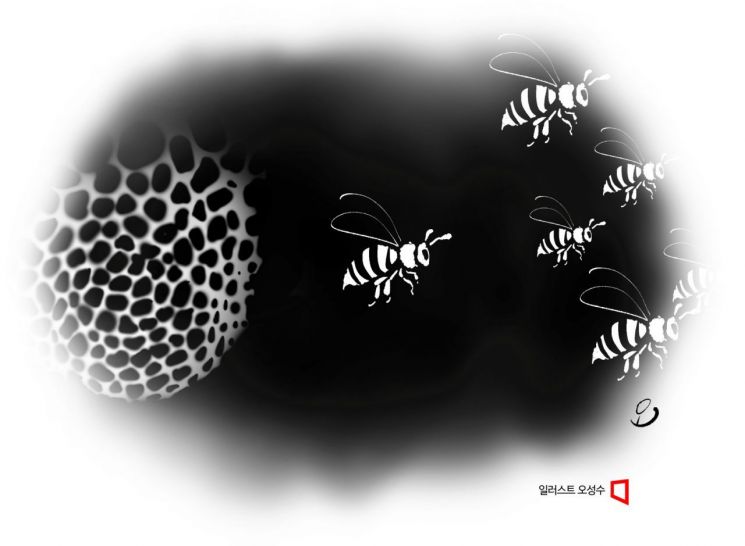
[Asia Economy Sejong=Reporter Lee Junhyung] Honeybees are disappearing. During last year's overwintering period alone, about 16% of the honeybees raised domestically died. It is analyzed that abnormal weather is beginning to significantly affect the temperature-sensitive honeybee ecology. There are concerns that the sharp decline in the number of honeybees responsible for pollinating major crops could lead to a food crisis.
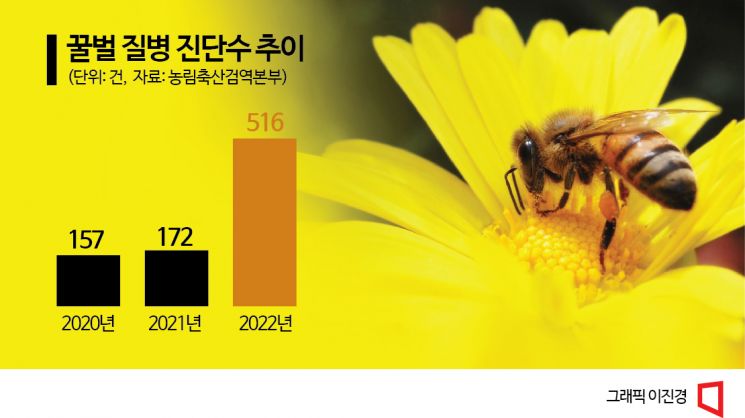
According to a compilation of reports from this paper on the 26th, the Animal and Plant Quarantine Agency under the Ministry of Agriculture, Food and Rural Affairs received 516 requests for honeybee disease diagnosis last year. This is a 200% increase compared to the previous year (172 cases). Compared to two years ago in 2020 (157 cases), it increased by 229%. This means that suspected cases of honeybee diseases have been rapidly occurring in beekeeping farms nationwide.
Disruption of Honeybee Ecology
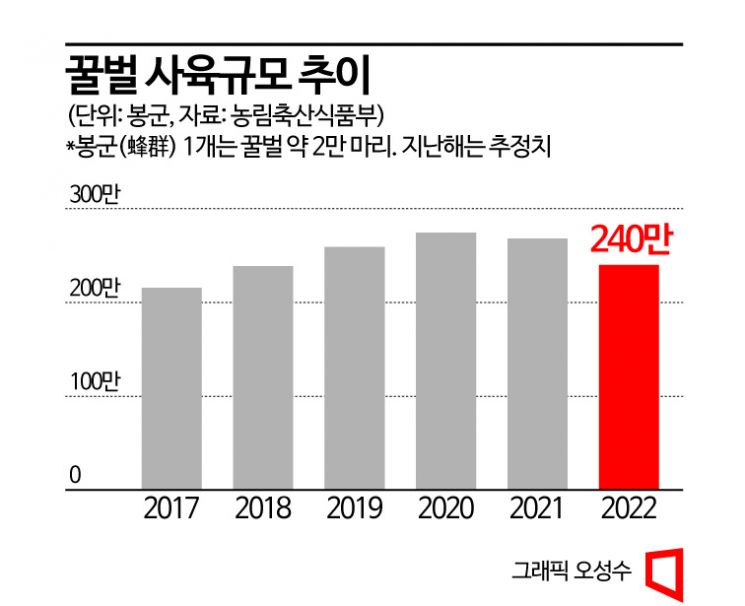
The increase in suspected honeybee disease cases is due to multiple factors. However, experts strongly point to ‘climate change’ as the main background. The explanation is that the winter temperatures, when honeybees enter overwintering, have become warmer than before, disrupting the ‘beehive ecosystem.’ In fact, it is estimated that about 7.8 billion honeybees disappeared nationwide during the overwintering period one year ago, when abnormal high and low temperatures were repeated. This accounts for about 16% of the honeybees raised in domestic beekeeping farms.
As temperatures rise, the incidence of diseases inevitably increases. This is because the reproduction rate of parasites fatal to honeybees increases in hot and humid environments. Last year, when nearly 8 billion honeybees ‘went missing,’ there were 76 diagnosed cases of ‘Varroa mite disease,’ a type of honeybee parasite. The previous year had only one case. Diagnosed cases of another honeybee parasite, ‘Tropilaelaps mite infection,’ increased from zero in 2021 to nine last year. A representative from the Animal and Plant Quarantine Agency explained, “In January and February last year, when massive honeybee losses during overwintering were confirmed, many cases of Varroa mite disease and Tropilaelaps mite infection were diagnosed,” adding, “From the fourth quarter of last year, the preparation period for overwintering, Varroa mite diagnoses increased again.”
Even without disease, if winter temperatures drop below average, the number of honeybees decreases. Abnormal temperatures adversely affect the queen bee’s egg-laying ability, and there are many cases where honeybees, mistaking winter for spring, go outside and fail to return to the hive. When honeybees start external activities during overwintering, the energy they will use in spring decreases, which is also a cause of shortened lifespan. Professor Park Jeongjun of the Department of Plant Medicine at Gyeongsang National University said, “Climate change has disrupted the timing when honeybees enter overwintering and come outside,” adding, “There is a high possibility that abnormal phenomena different from the past will appear this year as well.”
Could Trigger a Food Crisis
The phenomenon of mass honeybee deaths is not unique to Korea. In the United States, the ‘Colony Collapse Disorder (CCD)’ was first reported in 2006. It is a phenomenon where worker bees that leave the hive to collect honey do not return, causing the queen bee and larvae to die en masse. Since then, cases of honeybee disappearance have continued in major countries. The British weekly magazine The Economist described this phenomenon as ‘Insectgeddon’ in 2019, a coined term combining ‘Insect’ and ‘Armageddon,’ meaning the end.
The problem is that if the ‘honeybee disappearance’ phenomenon repeats, it could trigger instability in the food supply chain. According to the United Nations Food and Agriculture Organization (FAO), honeybees assist in pollination for 70% of the top 100 major crops. This is why some fruit farms in Korea experienced production difficulties last year. At that time, affected fruit farms employed manual pollination. Because natural pollination was difficult, additional labor costs were incurred, causing prices of fruits such as watermelons to soar.
‘Honeybee Vaccine’ Emerges
In response, a ‘honeybee vaccine’ has also appeared in the United States. Earlier this month, the U.S. Department of Agriculture (USDA) conditionally approved the use of a vaccine to prevent ‘American foulbrood,’ a bacterial infectious disease in honeybees. The U.S. already relies on honeybees raised by beekeepers for pollination of most crops due to a sharp decline in wild bee populations caused by abnormal weather and infectious diseases.
However, the development of honeybee vaccines in Korea is still in its infancy. Professor Park said, “Research on honeybee vaccines in Korea is still at the laboratory level,” adding, “Since the honeybee diseases problematic in Korea are viral, it will be difficult to utilize the vaccines approved in the U.S.”
The government plans to announce a ‘honeybee countermeasure’ next month. This is based on the judgment that there is a high possibility of mass honeybee deaths again this winter. At the end of last year, the Ministry of Agriculture, Food and Rural Affairs formed a ‘Winter Honeybee Damage Task Force’ together with related agencies such as the Rural Development Administration and the Animal and Plant Quarantine Agency. A ministry official said, “We will release countermeasures timed with the end of overwintering,” adding, “The focus will likely be on restoring the reduced honeybee population.”
© The Asia Business Daily(www.asiae.co.kr). All rights reserved.
![Clutching a Stolen Dior Bag, Saying "I Hate Being Poor but Real"... The Grotesque Con of a "Human Knockoff" [Slate]](https://cwcontent.asiae.co.kr/asiaresize/183/2026021902243444107_1771435474.jpg)


















