The Bank of Korea pointed out that amid the ongoing high interest rate environment, if monthly rent declines lead to further drops in jeonse prices, uncertainty surrounding the real estate market could increase.
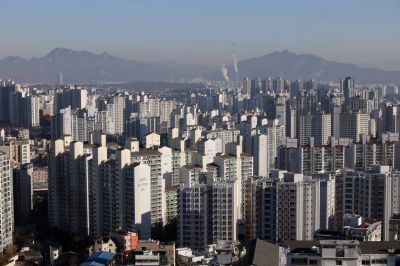
In its 'Financial and Economic Issue Analysis' report on the 25th, the Bank of Korea made this assessment regarding the recent chain decline in housing sale and jeonse prices. According to the Bank, domestic housing prices have started to decline relatively early compared to major countries, and the pace of decline is also relatively fast.
Steep interest rate hikes have acted as a downward factor in both the sales and jeonse markets, and recently, the chain reaction between sales and jeonse prices has further deepened the housing market slump.
The decline in sales prices and contraction in transactions have led to accumulated sales inventory being converted into jeonse and monthly rental listings, which acts as a factor lowering jeonse prices. Conversely, the sharp drop in jeonse prices reduces the incentive for gap investment (purchasing with jeonse), increasing low-priced sales inventory and further lowering sales prices.
The Bank of Korea explained, "Empirical analysis shows that the 'jeonse → sales' pathway operates at a similar level regardless of the phase, but the 'sales → jeonse' pathway has a greater effect during housing price adjustment periods."
The Bank pointed out concerns that, with the likelihood of continued high interest rates, an increase in new housing supply in areas such as Gangnam in Seoul and the expiration of gap investment lease contracts could delay stabilization in the jeonse market.
However, since the government has recently significantly eased regulations to stabilize the real estate market, it is also expected that sales transactions will be revitalized and the supply of jeonse listings will decrease, potentially leading to some stabilization in jeonse prices.
The Bank of Korea forecasted that domestic consumption capacity may weaken somewhat due to the poor real estate market.
Rapid declines in housing prices restrict the borrowing capacity of financially distressed households, negatively impacting consumption. Although household savings accumulated since COVID-19 can support consumption, increased interest burdens and reduced real purchasing power are factors weakening consumption.
The Bank explained, "Private consumption is expected to regain a moderate growth trend as temporary factors are resolved, but considering the recent decline in household consumption capacity and housing prices, the recovery momentum is judged to fall short of initial expectations."
© The Asia Business Daily(www.asiae.co.kr). All rights reserved.
![Clutching a Stolen Dior Bag, Saying "I Hate Being Poor but Real"... The Grotesque Con of a "Human Knockoff" [Slate]](https://cwcontent.asiae.co.kr/asiaresize/183/2026021902243444107_1771435474.jpg)
















