If Global Financial Tightening Continues, Debt Bomb Explodes in 'Weak Link' Emerging Markets
Post-COVID Major Countries' Expansionary Fiscal Policies and Corporate Debt Surge
Interest Burden Increased by $3 Trillion Last Year Due to Rate Hikes
60% of Low-Income Developing Countries Face Debt Crisis... Concerns Over Global Crisis Spillover
S&P "Major Reset Needed"
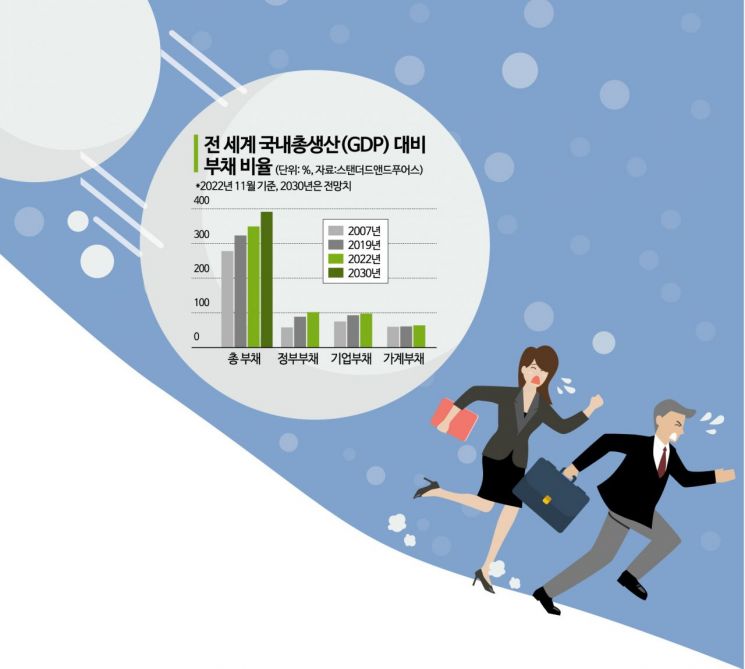
[Asia Economy Reporter Kwon Haeyoung] The global debt, which surpassed $300 trillion (approximately 37,260 trillion KRW) last year, is currently at about 349% of the global Gross Domestic Product (GDP) and is projected to approach 400% by 2030, seven years from now. Due to interest rate hikes by major countries, the additional interest burden worldwide reached $3 trillion (3,700 trillion KRW) last year, and some forecasts suggest that the annual interest burden could reach $8.6 trillion (16,150 trillion KRW) in the coming years. There are urgent calls for debt restructuring among governments, corporations, and households burdened with this "debt bomb."
According to global credit rating agency Standard & Poor's (S&P) on the 25th, global debt was $300 trillion as of June last year based on the Institute of International Finance (IIF) data, accounting for about 349% of the world's GDP. The GDP per capita worldwide is $12,000 (14.8 million KRW), but the debt burden per person is more than three times that amount at $37,500 (46.3 million KRW).
Global debt was 278% of GDP just before the global financial crisis in 2007 but has steadily increased since then. It rose to 323% in 2019 and nearly 350% in 2022. S&P analyzed that this increase was due to expanded fiscal spending by governments worldwide after COVID-19 and Chinese state-owned enterprises supporting government policies, which significantly increased debt.
S&P forecasts that as governments, corporations, and households worldwide rapidly increase their debt, the global debt-to-GDP ratio could expand to 391% by 2030. It warned that if governments continue to increase debt through populist policies or if lending institutions such as banks aggressively expand loans, increasing "bad debt" that harms corporate productivity, the world could fall into a hell of a debt crisis.
The biggest reasons for the global increase in debt since the global financial crisis are expansionary fiscal policies by major governments and a surge in corporate debt.
Rapid Increase in Government and Corporate Debt
First, government debt surged. The government debt-to-GDP ratio rose from 58% in 2007 before the financial crisis to 89% just before the COVID-19 outbreak in 2019, and further to 102% in 2022 after the pandemic began. Advanced countries had particularly high government debt ratios. Japan’s government debt ratio reached 251% of GDP, followed by Italy (154%), France (123%), Spain (123%), the United States (122%), and the United Kingdom (110%). South Korea’s government debt was relatively low at 48% of GDP, but the rapid increase in debt was noted as a concern.
Corporate debt also rose significantly from 75% of GDP in 2007 to 98% in 2022. The biggest cause was the increase in debt ratios of Chinese companies. Chinese corporate debt accounts for one-third of the total debt held by companies worldwide. The average debt ratio of Chinese companies was six times higher than in 2021 and about twice the global average. Last year, Chinese corporate debt reached 157% of GDP. South Korea (118%), Japan (117%), and Canada (116%) also had relatively high corporate debt ratios. One reason for the increase in corporate debt is the rise in the proportion of speculative-grade corporate bonds. In the U.S., the issuance ratio of speculative-grade bonds rated 'B-' or lower was 36% as of September last year, double that of 2007.
On the other hand, household debt globally showed little change, remaining at 60% of GDP in 2007 and 64% in 2022, and financial corporate debt stayed around 85% during the same period. However, South Korea’s household debt reached 102% of GDP, making it one of the countries at risk for household debt along with Australia (117%) and Canada (106%).
Rapid Increase in Interest Burden Due to Rate Hikes... Will the Debt Bomb Explode?
As global debt piles up, concerns about repayment are also growing. Especially last year, with rapid interest rate hikes led by the U.S. Federal Reserve (Fed) and other major countries, the repayment burden on governments, corporations, and households that have increased debt has intensified. The Fed raised its benchmark interest rate by 4.25 percentage points last year, and the European Central Bank (ECB) raised it by 2.5 percentage points. Contrary to market expectations, if the monetary tightening trend continues, fiscal crises and corporate credit crises could occur, especially in countries that have excessively relied on debt.
If financial tightening continues, the biggest impact is expected to occur in emerging markets, which are the "weak links." The International Monetary Fund (IMF) and the Organisation for Economic Co-operation and Development (OECD) have expressed concerns that 60% of low-income developing countries are either already in debt crises or at high risk of falling into one. Given the contagious nature of financial crises, if some advanced and emerging countries with high debt ratios fail to manage their debt, the risk could spread to a global economic crisis.
According to S&P estimates, the annual global interest burden increased by an additional $3 trillion last year due to the interest rate hikes that began in earnest. Of the $300 trillion global debt, 65% is fixed-rate and 35% is variable-rate, assuming an average interest rate increase of about 3%. S&P expects that as fixed-rate loans gradually convert to variable-rate loans, the additional interest burden could increase to $8.6 trillion annually over the next few years. This means the additional interest burden per capita worldwide could nearly triple from $380 (470,000 KRW) to $1,080 (1.33 million KRW) annually.
S&P predicts that if governments, corporations, and households continue to rely on debt, the global debt-to-GDP ratio could rise to 391% by 2030, warning that a debt crisis will erupt if debt is not reduced. Conversely, if global debt grows by 5% annually, the debt ratio would reach 366% by 2030, and if governments and regulators worldwide take steps to reduce debt to pre-COVID-19 levels, this ratio could fall to 321%, presenting an optimistic scenario.
S&P advised, "To avoid the hell of a debt crisis, productive debt must be increased and unproductive debt reduced," adding, "Excessive spending must be restrained, and restructuring of marginal companies is also necessary." It emphasized, "Although these policies may be unpopular, a 'major reset' involving prudence from policymakers regarding spending and debt is needed," and stressed, "There is no easy way out of this crisis."
© The Asia Business Daily(www.asiae.co.kr). All rights reserved.

















