Pharmacist Staffing Rate at 24.2%, Most Critical
Nursing Academy Applicants Halved
Shortened Service Period Preferred by Soldiers
[Asia Economy Yang Nak-gyu, Military Specialist Reporter] It has been confirmed that the personnel maintaining the military medical system are severely insufficient. Not only military doctors and nursing officers but also pharmacists are lacking, raising concerns that unqualified medical assistance within the military will be difficult to eradicate.
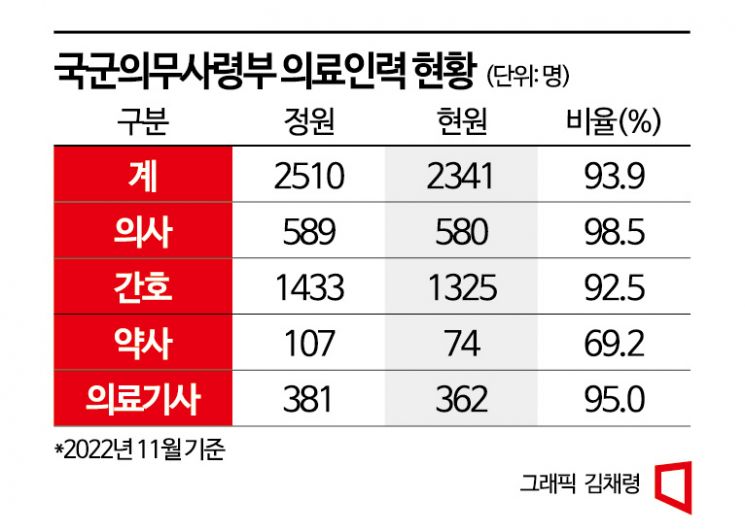
According to the military on the 25th, there are a total of 13 military hospitals under the Armed Forces Medical Command. The medical staff, including medical officers and nursing officers working at these hospitals, total 2,341 personnel (authorized strength 2,510), resulting in a staffing rate of 93.9%.
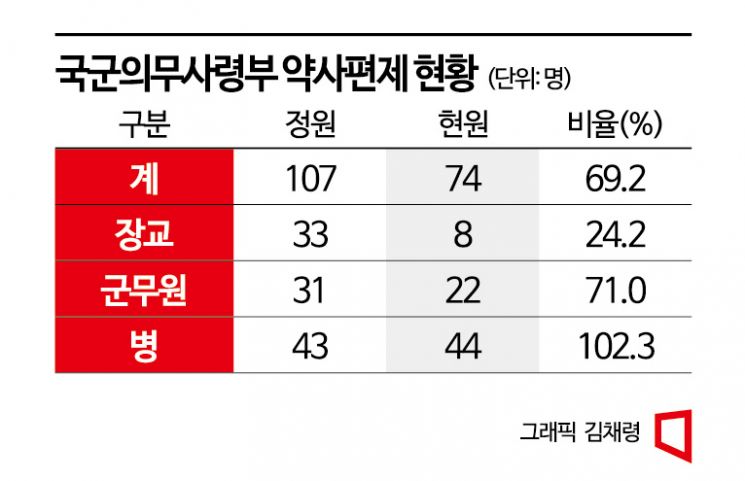
By position, the shortage of pharmacists is the most severe. Only 8 officers (authorized strength 33) hold pharmacist licenses within the military. The staffing rate is only 24.2%. There are also 22 civilian employees (authorized strength 31). The vacant pharmacist positions are being filled by medical soldiers. The staffing rate for medical soldiers is 102.3%, exceeding the authorized number. Starting this year, the military raised the rank of civilian pharmacists from grade 6 to grade 5 and began recruiting pharmacists, but the application rate was extremely low. In the Navy’s recruitment of 11 civilian pharmacists last year, only 2 applicants applied.
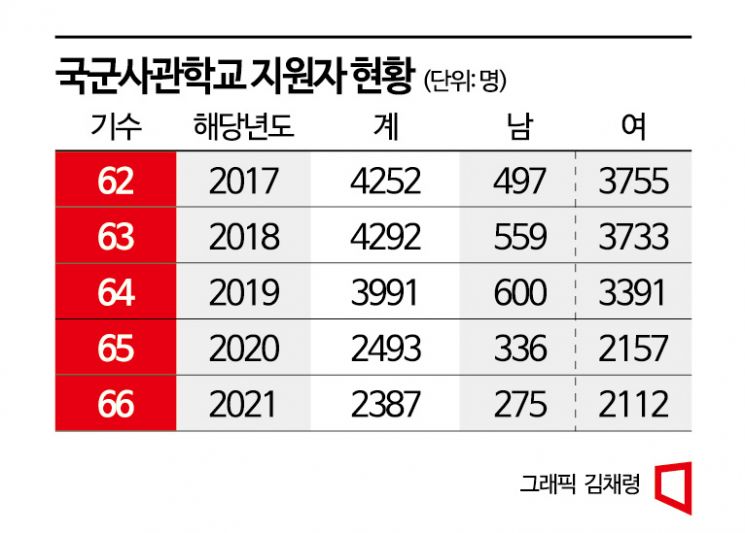
Applicants to the Nursing Officer Academy have also nearly halved. In 2017, when 85 candidates were selected, 4,252 applicants (497 men, 3,755 women) applied to the Nursing Officer Academy. The following year, 4,292 applicants (559 men, 3,733 women) applied, pushing the competition ratio well beyond 50 to 1, marking the highest competition rate since the academy’s establishment. Although the recruitment quota was increased to 90 from 2019, the number of applicants has been decreasing every year. In 2021, the number of applicants was 2,387 (275 men, 2,112 women), about 2,000 fewer than five years earlier.
There are 580 doctors (authorized strength 589), with a staffing rate of 98.5%. At first glance, the staffing rate seems adequate. However, the situation differs by rank. There are 544 officers (authorized strength 548), with a staffing rate of 99.3%, but only 36 civilian contract doctors (authorized strength 41), with a staffing rate of 87.8%. Considering that military doctors who are officers do not apply for long-term service, resulting in a shortage of specialists within the military, more civilian contract doctors need to be hired. However, most military hospitals are located in frontline areas, and civilian contract doctors are reluctant to renew their contracts.
The shortage of military medical personnel is analyzed to be due to soldiers preferring soldier service over medical officer roles as their service periods shorten and salaries increase. Because of this, if the budget for the military medical system does not increase significantly, the shortage of medical personnel will continue, and unqualified medical assistance will not be eradicated.
The military medical budget increased from 237.8 billion KRW in 2016 to 329.6 billion KRW in 2020, a 72% increase in amount. However, during this period, the proportion of the military medical budget within the defense budget rose only from 0.61% to 0.66%, still less than 1%. The annual budget for all 13 military hospitals (308.3 billion KRW) is less than that of a single large hospital in Seoul (Seoul National University Hospital: 1.3911 trillion KRW). It is incomparable to the U.S. military’s medical budget ratio (7.12%, approximately 54.3 trillion KRW). A military official said, "We plan to resolve the shortage of medical personnel through various measures, including consultations with related associations to ensure that military service experience is recognized in the civilian sector."
© The Asia Business Daily(www.asiae.co.kr). All rights reserved.
![Clutching a Stolen Dior Bag, Saying "I Hate Being Poor but Real"... The Grotesque Con of a "Human Knockoff" [Slate]](https://cwcontent.asiae.co.kr/asiaresize/183/2026021902243444107_1771435474.jpg)


















