[Asia Economy Reporter Kim Hyung-min] Lee Jae-myung, leader of the Democratic Party of Korea, will undergo a second investigation at the Seoul Central District Prosecutors' Office on the 10th regarding the Wirye and Daejang-dong development corruption cases. As the investigation approaches, attention is focused on whether the prosecution will request an arrest warrant for Lee. The prosecution is expected to make a decision after the second investigation.
From the prosecution's perspective, requesting an arrest warrant for Lee is a difficult issue that cannot be decided hastily. If an arrest warrant is requested, it could shake the political sphere through a series of processes. For Lee to be detained during a parliamentary session, a motion for consent to arrest must be voted on in the National Assembly, accompanied by an explanation from the Minister of Justice on the necessity of detention and Lee's defense. If the motion is rejected in the National Assembly, there is a risk of backlash. The prosecution must carefully consider the "possible scenarios" and play the most certain card.
The Supreme Prosecutors' Office is coordinating opinions on how to handle Lee's custody with the Criminal Division 3 of the Seongnam Branch of the Suwon District Prosecutors' Office (Chief Prosecutor Yoo Min-jong), which investigated the 'Seongnam FC sponsorship fund' allegations, and the Anti-Corruption Investigation Division 1 (Chief Prosecutor Eom Hee-jun) and Division 3 (Chief Prosecutor Kang Baek-shin) of the Seoul Central District Prosecutors' Office, which are in charge of the Wirye and Daejang-dong development corruption cases. Although they have settled on requesting an arrest warrant by combining the Seongnam FC and Wirye-Daejang-dong cases, the location for filing the warrant has not yet been decided. The final decision is expected immediately after Lee's second investigation.
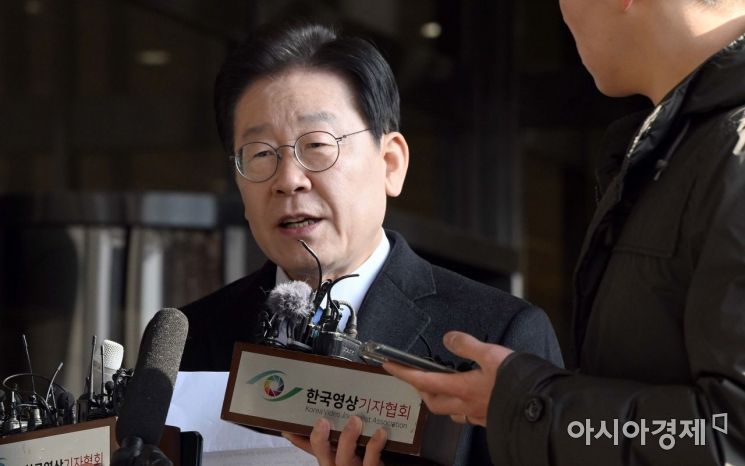 Lee Jae-myung, leader of the Democratic Party of Korea, is speaking as he appears at the Seoul Central District Prosecutors' Office in Seocho-gu, Seoul on the 28th of last month to undergo prosecution investigation related to the Daejang-dong development preferential treatment suspicion case. Lee is accused of leaking internal secrets of Seongnam City or Seongnam Urban Development Corporation to private developers as the final decision-maker of the Wirye and Daejang-dong development projects during his tenure as mayor of Seongnam, enabling them to gain enormous profits. Photo by Kim Hyun-min kimhyun81@
If requested by the central office, it carries 'weight'; close aides also all detained centrally
The subject requesting the warrant?whether the Central District Prosecutors' Office or the Seongnam Branch?carries different implications. The likelihood of request is higher from the central office than from Seongnam. The central office would take over the Seongnam FC case from Seongnam and combine it with the Wirye-Daejang-dong development corruption case to request Lee's arrest warrant. The central office's request definitely carries more weight. The Wirye-Daejang-dong case is the most representative among the various allegations against Lee, and the prosecution has been investigating it for over a year. It is also known within the prosecution that the case should be prominently cited at the top of the arrest warrant for it to have significance.
There is also analysis that the court is likely to grant the warrant. The Seoul Central District Court has previously issued arrest warrants for most suspects related to the Wirye-Daejang-dong case. If the central office requests Lee's arrest warrant, the pre-arrest detention hearing (warrant substantive examination) will be held at the Seoul Central District Court, provided that the National Assembly passes the motion for consent to arrest. Previously, the Seoul Central District Court issued arrest warrants for Lee's close aides involved in the Wirye-Daejang-dong development corruption case, including Jeong Jin-sang, former Chief of Political Coordination at the Party Leader's Office, and Yoo Dong-gyu, former Planning Director of Seongnam Urban Development Corporation.
Seongnam has 'symbolism'... Third-party bribery charges are also clear
If the warrant is requested in Seongnam, it carries strong symbolism. The prosecution believes that Lee abused various powers while serving as mayor of Seongnam from July 2010 to March 2018. It is possible for Seongnam to take over the central case and request the arrest warrant on the grounds of jurisdiction over the area where the incident occurred. Seongnam is also Lee's political hometown. Both in substance and appearance, this carries significant implications. The fact that Minister of Justice Han Dong-hoon and the prosecution have emphasized that the investigation against Lee has been a "routine investigation of local endemic corruption crimes occurring in local governments" also supports Seongnam.
Another reason is that Lee's third-party bribery charges are clear. Compared to the Wirye-Daejang-dong development corruption case, the prosecution views the Seongnam FC sponsorship fund case as easier to substantiate Lee's charges during the warrant examination. The prosecution is reported to have secured numerous related pieces of evidence. They have obtained most of the documents approved by Lee related to the large sponsorship funds for Seongnam FC and have long reviewed precedents related to third-party bribery charges.
Possibility remains of direct indictment without requesting an arrest warrant
There is also a possibility that the prosecution may indict Lee directly without requesting an arrest warrant. Non-custodial indictment can avoid unnecessary conflicts and controversies with the political sphere. Given the uncertainty of the National Assembly passing the motion for consent to arrest, the prosecution may decide to avoid unnecessary exhaustion and prove Lee's guilt in court.
The prosecution is well aware that Lee's detention is realistically difficult. Even if the National Assembly hurdle is overcome, if the court dismisses the warrant, the prosecution's ongoing investigation could suffer a significant blow. Many in the legal community analyze that the prosecution is unlikely to boldly request an arrest warrant while bearing all these risks.
© The Asia Business Daily(www.asiae.co.kr). All rights reserved.

















