On January 22, 2001, Fell from Lift
Disability Mobility Rights Struggle Has Begun
Low-Floor Bus Adoption Rate Only in the 30% Range
Jeonjangyeon Urges "Attention to Mobility Rights" at Oido
[Asia Economy Reporter Gong Byung-sun] It was Lunar New Year’s Day 22 years ago. An elderly couple arrived at Oido Station on Seoul Metropolitan Subway Line 4 on January 22, 2001, to visit their youngest son for the Lunar New Year. The grandmother, who was a level 3 disabled person at the time, and the grandfather who was assisting her, boarded the lift for the disabled to move to the second-floor station. The lift carrying the elderly couple moved slowly. However, just before reaching the second floor, the steel cable supporting the lift snapped. The elderly couple fell 7 meters down. They were immediately transported to the hospital, but the grandmother lost her life.
The issue was not due to the aging of the lift. Oido Station had opened in 2000, and the lift had been installed for less than a year. It was pointed out that the problem was with the design itself. During this process, the Korea Railroad Authority at the time failed to report the accident for 9 hours until the grandmother passed away, showing a tendency to conceal the problem. Enraged disabled people and citizens formed the "Oido Station Disabled Vertical Lift Fall Disaster Countermeasures Committee." This marked the beginning of the struggle for disabled people’s mobility rights.
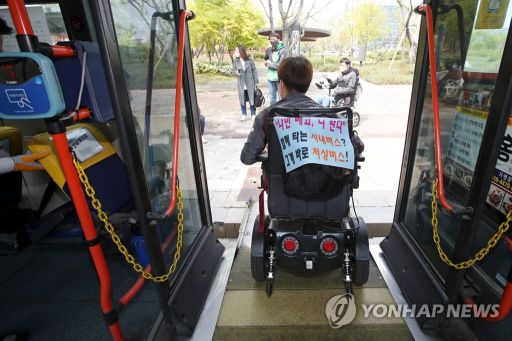
After continuous protests, the issue of mobility rights for the disabled began to improve little by little. In 2003, Seoul City introduced low-floor buses for the first time. The Act on the Promotion of Convenience for Transportation Vulnerable Persons was enacted in 2005, bringing institutional improvements. In 2019, an elevator was installed at Gwanghwamun Station to allow disabled people to move directly to the station. This was the result of 16 years of struggle. As of 2021, out of 275 stations on Seoul Subway Lines 1 to 8, elevators were installed in 254 stations, showing some improvement in mobility rights.
However, there is still a long way to go. Among nationwide express buses traveling outside the city, only 10 buses, accounting for 0.57% of the total, can accommodate wheelchairs. During holidays like Lunar New Year, it is almost as if disabled people’s mobility is completely restricted. It is still inconvenient to move around within the city as well. The introduction rate of low-floor buses, which are also used by elderly people with mobility difficulties, was 30.6% as of last year. The government has promised to raise the introduction rate of low-floor buses to about 62% by 2026. The average waiting time for the most preferred transportation for wheelchair users, the "disabled call taxi," was 38.9 minutes last year. Disabled people complained that they do not know when the call taxi will arrive, so they have to call it well in advance before leaving their homes, causing inconvenience.
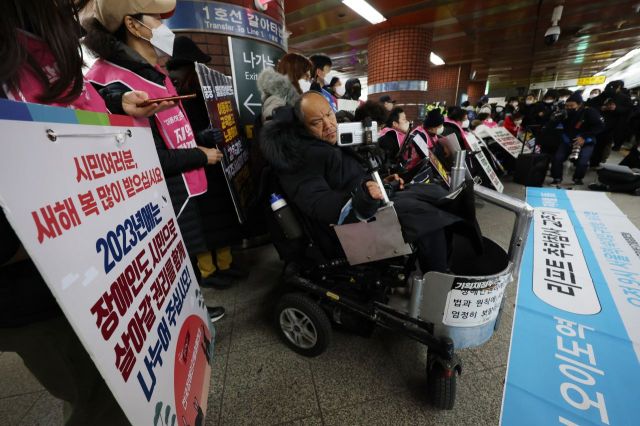 On the 20th, members of the National Solidarity for the Elimination of Discrimination against Persons with Disabilities held a '22nd Anniversary Rally of the Oido Station Lift Fall Disaster' at the Seoul Station platform of Subway Line 4.
 [Image source=Yonhap News]
On the 20th, the National Solidarity Against Disability Discrimination (Jeonjangyeon) gathered again at Oido Station. They resumed protests after failing to narrow the gap in positions with Seoul Mayor Oh Se-hoon. Jeonjangyeon insisted on a one-on-one meeting, but Seoul City demanded a joint meeting with other disability organizations regarding the deinstitutionalization agenda. Since there are also pending lawsuits for damages, it is expected that dialogue will be difficult to achieve. Seoul City stated that the social loss caused by Jeonjangyeon’s protests amounts to 445 billion won and announced that it will continue a zero-tolerance policy going forward.
At Oido Station, Jeonjangyeon urged attention to the mobility rights issues of disabled people. Jeonjangyeon stated, "From 1999 to 2017, there have been 17 accidents related to lifts in the metropolitan subway," and "Disabled people still cannot safely and equally use transportation means such as subways, buses, trains, taxis, and airplanes." They also added, "We again urge the enactment of the Disabled Rights Budget," and "Officials from the Ministry of Strategy and Finance should also attend meetings with Seoul City and engage in dialogue."
© The Asia Business Daily(www.asiae.co.kr). All rights reserved.
![Clutching a Stolen Dior Bag, Saying "I Hate Being Poor but Real"... The Grotesque Con of a "Human Knockoff" [Slate]](https://cwcontent.asiae.co.kr/asiaresize/183/2026021902243444107_1771435474.jpg)












