[Asia Economy Sejong=Reporter Kim Hyewon] Amid the continued decline in Hanwoo prices, the Korea Hanwoo Association has appealed for a reduction in feed prices, which account for more than 50% of Hanwoo production costs. The government has expressed its intention to expand financial support for feed purchases to ease the management cost burden on Hanwoo farms.
On the 21st, the Hanwoo Association stated, "Without a reduction in feed prices, it is difficult for farms to resolve their management difficulties on their own," and urged, "For the minimum livelihood stability of farms, the feed industry should also take a cooperative and mutually beneficial stance and implement feed price cuts."
Nonghyup Feed lowered feed prices by 20 KRW per kg (500 KRW per 25 kg) in December last year, but the Hanwoo Association is demanding that Nonghyup Feed further reduce prices and especially that private feed companies join in. The Hanwoo Association emphasized, "Some private feed companies still remain indifferent even as farms are dying out," and added, "A magnanimous reduction in feed prices by the feed industry can be a lifeline of hope that promises a future for Hanwoo farms."
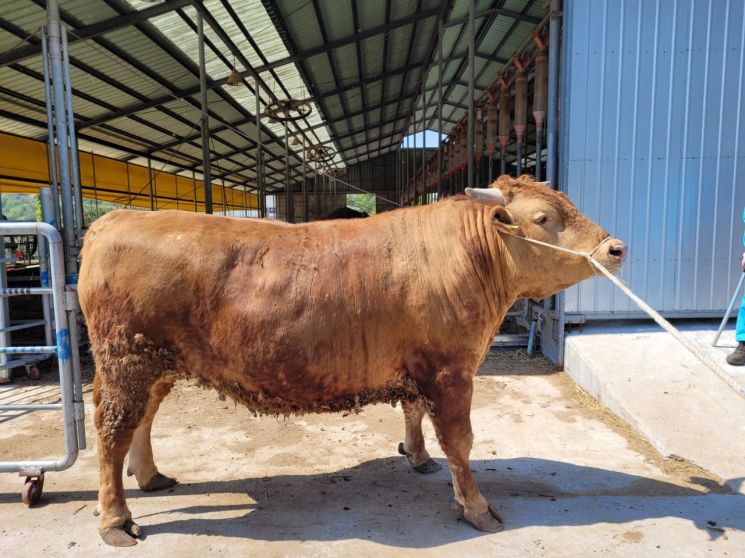
Currently, feed prices account for more than 50% of farm management costs. Feed prices began rising from early 2020 and have increased by more than 60%. However, since October last year, the prices of overseas grain ingredients (corn, wheat, soybean meal, protein feed, etc.) that make up the feed have fallen, and the exchange rate has dropped by about 15%, creating factors for price reductions, according to the Hanwoo Association.
Without the usual Lunar New Year demand, Hanwoo prices are on a downward trend. From the 1st to the 19th of this month, the wholesale price of Hanwoo averaged 15,917 KRW per kg, down 21.5% compared to the same period last year. The farm gate price for a 6-7 month-old calf was 2.94 million KRW, down 24.6% from 3.9 million KRW a year ago. This is because while cattle farming has increased, consumption has decreased.
During the same period (1st to 19th), the consumer price of Hanwoo, based on 1st grade sirloin, averaged 9,774 KRW per 100g, down 12.6% from the same period last year. The consumer price for 1st grade seol-do (for bulgogi) averaged 4,268 KRW per 100g, down 11.2% compared to the same period last year.
Although wholesale prices have fallen by over 20%, consumer prices have dropped by about 10%. Livestock farmers are experiencing management difficulties due to the collapse of farm gate and wholesale prices, but this is somewhat disconnected from consumers' perception of price changes. The Ministry of Agriculture, Food and Rural Affairs explained, "Consumer prices are the sum of wholesale prices and distribution costs, so consumer prices do not decrease in proportion to the decline in wholesale prices alone." The Hanwoo Association also said, "Wholesale price declines have not yet been reflected in retail distribution," adding, "Retailers have no particular reason to drastically lower prices." Even if wholesale prices fall sharply, retailers find it difficult to fully reflect this due to fixed costs such as store labor and management expenses.
The government is consulting with producer organizations on multifaceted measures such as creating additional demand and adjusting supply. Plans include discovering new consumption channels by replacing imported raw meat used in school meals and processing companies with Hanwoo meat, and strengthening the linkage between wholesale and retail prices centered on Nonghyup Mart. Additionally, to ease the management cost burden on Hanwoo farms, the government intends to expand financial support for feed purchases.
© The Asia Business Daily(www.asiae.co.kr). All rights reserved.
![Clutching a Stolen Dior Bag, Saying "I Hate Being Poor but Real"... The Grotesque Con of a "Human Knockoff" [Slate]](https://cwcontent.asiae.co.kr/asiaresize/183/2026021902243444107_1771435474.jpg)
















