Persistent Energy Crisis Situation
Oil Prices Stabilize
Limited Increase in Gasoline and Diesel Prices Despite Reduced Fuel Tax Cut Measures
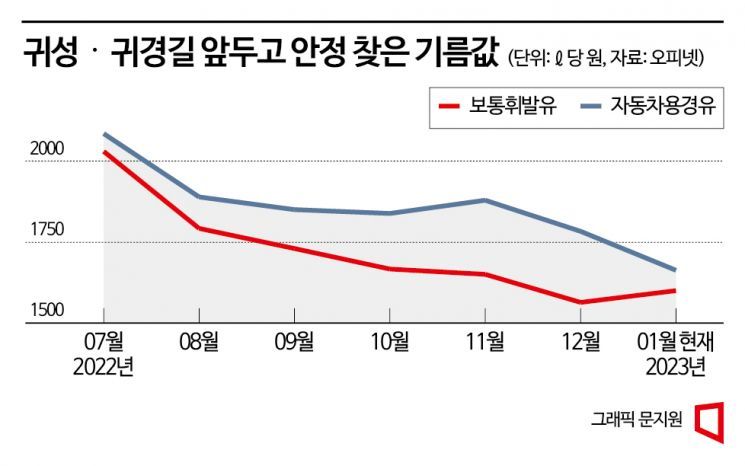
[Asia Economy Reporter Jeong Dong-hoon] Although the fuel tax reduction was scaled back starting January this year, domestic gasoline and diesel prices have stabilized. The fuel prices, which had risen due to the Russia-Ukraine war since February last year, have returned to pre-war levels, easing the burden on travelers returning home for the Lunar New Year holiday.
On the 21st, the average nationwide gasoline price at gas stations was 1,563.21 KRW per liter, and diesel was 1,654.48 KRW per liter (data from Korea National Oil Corporation's oil price information system OPINET). Compared to September 8 last year, before Chuseok, when gasoline was 1,740.56 KRW per liter and diesel was 1,854.03 KRW, gasoline has dropped by 199.55 KRW per liter and diesel by 191.18 KRW. For a mid-sized car with a 70-liter tank, filling up gasoline costs 13,968 KRW, and diesel also costs 13,968 KRW, making it cheaper than refueling on the way home for last Chuseok.
Breaking down nationwide gasoline prices by region, Jeju had the highest gasoline price at 1,656 KRW per liter among the 17 cities and provinces, followed by Seoul (1,646 KRW), Chungbuk (1,573 KRW), and Jeonnam (1,570 KRW). For diesel, Seoul was the most expensive at 1,745 KRW per liter nationwide, followed by Gangwon (1,683 KRW), Jeju (1,680 KRW), and Jeonnam (1,677 KRW).
Although the fuel tax reduction on gasoline purchases was reduced from 37% to 25% starting January 1 this year, the increase in fuel prices was limited. From January 1, the gasoline fuel tax rose from 516 KRW per liter to 615 KRW per liter, an increase of 99 KRW. Compared to the nationwide average gasoline price of about 1,531 KRW per liter on December 31 last year, the price only increased by 32 KRW. Diesel prices, which were excluded from the fuel tax reduction due to their already high price level, currently stand at about 1,662.85 KRW per liter, which is about 59 KRW lower. The price gap between gasoline and diesel, which once differed by about 200 KRW per liter, is also narrowing.
International oil prices are showing a downward stabilization trend. This is due to reduced energy demand caused by global demand contraction and a "warm winter" in Europe. The WTI (West Texas Intermediate) crude oil price per barrel was 92.81 USD on February 24 last year when the war broke out, then surged to 130.5 USD within two weeks. Oil prices, which had maintained around 100 USD until August last year, declined in the second half of last year due to concerns about a global economic slowdown, returning to pre-war levels.
Recently, Europe has experienced warmer weather than usual, reducing energy demand compared to previous years. Northern Spain and various parts of Switzerland saw temperatures exceed 20 degrees Celsius in early January, and Warsaw, Poland, where the average January temperature is minus 2 degrees Celsius, recorded 18.9 degrees Celsius on New Year's Day. Currently, international oil prices are maintaining a level of 75 to 80 USD per barrel.
© The Asia Business Daily(www.asiae.co.kr). All rights reserved.

















