RFA Report... "Huge Pit Spotted at Tunnel Entrance"
[Asia Economy Reporter Jang Hee-jun] It has been suggested that part of the tunnel at the Pyongsan uranium mine in Hwanghaebuk-do, North Korea, recently collapsed. The Pyongsan mine is a major production site for enriched uranium used in nuclear weapons.
According to Radio Free Asia (RFA) on the 20th, Jacob Bogle, a private North Korea analyst in the United States, recently posted satellite images of the Pyongsan mine on his website and observed scenes of collapse occurring at the tunnel entrance.
He stated that in the satellite images he analyzed on the 14th, two large pits that appear to be subsidence were confirmed at the entrance of the uranium mine tunnel, interpreting this as a collapse of the mine entrance.
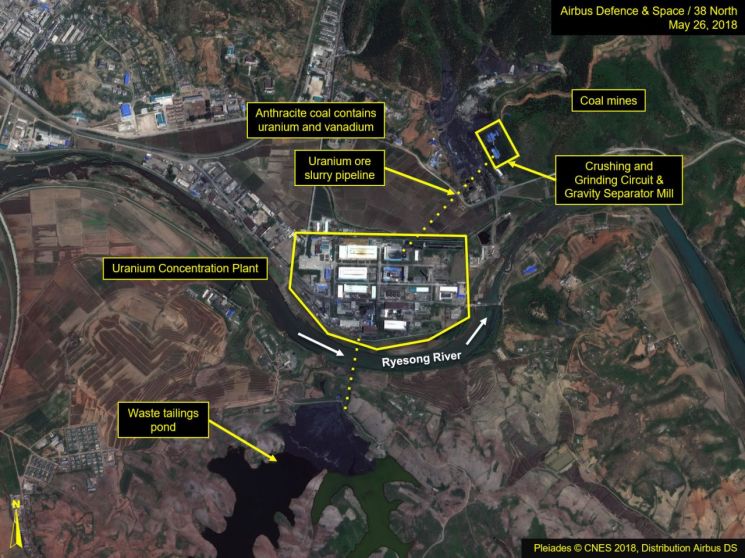 Satellite image of the Pyeongsan uranium mine facility in North Korea taken in 2016 [Image source=Yonhap News]
Bogle explained, "Two pits over 100 meters in size were found in the photos," adding, "This seems to be gradually expanding westward from continuous subsidence that occurred between 2019 and 2021." He further elaborated, "The mine tunnel has lost its structural support, and water seeping in has further weakened the support structure, causing the subsidence." He added, "Although no casualties have been reported, it is said that workers are still working at this mine."
Bogle presented satellite images taken over recent years as evidence for his claims. Waste materials accumulated from uranium extraction have been periodically observed around the Pyongsan mine, and expansion construction is underway at the nearby Pyongsan uranium plant.
Regarding this, Joseph Bermudez, a senior researcher at the U.S. think tank Center for Strategic and International Studies (CSIS) and an expert in satellite image analysis of North Korean nuclear facilities, expressed the opinion that the analysis of subsidence seems somewhat valid when looking at the recent satellite images showing depressions around two tunnels.
The uranium ore mined from the Pyongsan mine undergoes refining at the nearby Pyongsan uranium plant to produce uranium concentrate, the raw material for nuclear substances. Uranium concentrate is used to produce highly enriched uranium (HEU) necessary for nuclear weapons manufacturing and, after impurities are removed, takes the form of a yellow powder called "yellowcake."
Meanwhile, Beyond Parallel, CSIS’s North Korea-focused site, analyzed satellite images identified from April to October 2021 and concluded that the Pyongsan plant has been continuously operating. On the 11th, Jeong Seong-hak, deputy director of the Land Satellite Information Research Institute at Kyungpook National University, also observed that North Korea is continuously expanding the Pyongsan uranium plant.
© The Asia Business Daily(www.asiae.co.kr). All rights reserved.
![Clutching a Stolen Dior Bag, Saying "I Hate Being Poor but Real"... The Grotesque Con of a "Human Knockoff" [Slate]](https://cwcontent.asiae.co.kr/asiaresize/183/2026021902243444107_1771435474.jpg)
















