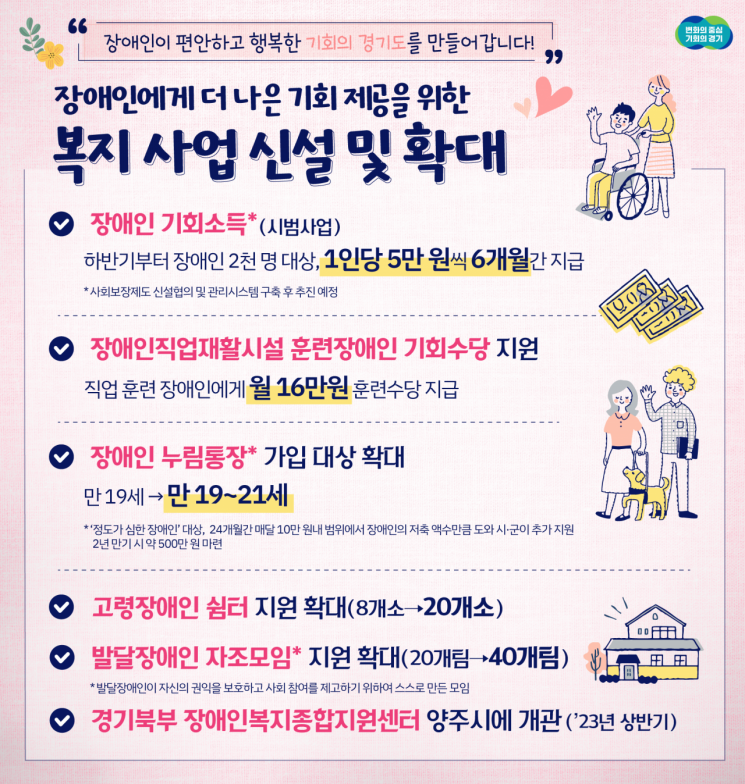
 Status of Disability Support Projects in Gyeonggi Province for 2023 Graphic provided by Gyeonggi Provincial Government
[Asia Economy (Suwon) = Reporter Lee Young-gyu] Gyeonggi Province will introduce a pilot project for opportunity income for people with disabilities this year. It will also expand the eligibility for the Disabled Nurim Account and conduct a survey on 24-hour care for people with severe developmental disabilities.
First, the province will provide opportunity income to people with disabilities who have difficulty engaging in social activities to promote health and social activities and create social value. A budget of 1 billion KRW has been allocated for this year. The province plans to pay about 50,000 KRW per month in opportunity income to 2,000 people with disabilities in the province. The goal is to implement this in the second half of the year through consultations on establishing a new social security system and building a management system.
Currently, as an opportunity allowance for people with disabilities engaged in economic activities, the province pays a training allowance of 160,000 KRW per month to people with disabilities undergoing vocational training.
In addition, the province plans to gradually expand public jobs for people with disabilities and customized, rights-centered jobs by type every year.
To support the economic independence of people with disabilities, the province will also expand the eligibility for the Disabled Nurim Account from age 19 to ages 19 to 21. The Disabled Nurim Account is a project that supports people with "severe disabilities" under the Disabled Welfare Act by matching the amount saved by the disabled person up to 100,000 KRW per month for 24 months, with additional support from the city or county. At maturity after two years, the principal and interest can total up to 5 million KRW.
Regarding care services for people with disabilities, the province will jointly conduct a "24-hour Care Survey for People with Severe Developmental Disabilities" with 31 cities and counties in the province to establish standards and assess the scale of care.
Based on the survey results, the province will strengthen care support. It will also expand support for self-help groups for people with developmental disabilities from 20 teams to 40 teams.
The number of "senior disability shelters" will also be significantly expanded from 8 to 20 to address the increase in elderly people with disabilities.
Additionally, in the first half of this year, the province will open the "Gyeonggi Northern Disabled Welfare Comprehensive Support Center" in Yangju City to improve welfare services for people with disabilities in the northern region.
The province will also relax subsidy support standards for "newly established disabled welfare facilities." Subsidies will be provided starting one year after the installation report is completed, and the placement standard for social rehabilitation teachers in day care facilities for people with disabilities has been adjusted from one teacher per four users to one teacher per three users.
The province will also increase wages for workers at "corporation-operated, locally transferred residential facilities for people with disabilities (group homes, short-term residences)" starting this year by applying the Ministry of Health and Welfare’s wage guidelines for social welfare facility workers.
Kim Neung-sik, Director of the Welfare Bureau of the province, emphasized, "We will strive to create a Gyeonggi Province full of more opportunities, fairer opportunities, and better opportunities for all residents, regardless of disability, by promoting various welfare policies for people with disabilities so that people with disabilities can live happily in Gyeonggi Province."
© The Asia Business Daily(www.asiae.co.kr). All rights reserved.

















