Governor Kim Dong-yeon, "The Budget Allocation Criteria for Local Currency Must Be Reconsidered"
Government, "Projects Burdened by Local Governments... Reverse Discrimination May Occur Among Local Governments"
[Asia Economy Reporter Ra Young-cheol] Gyeonggi Province has officially requested the Ministry of the Interior and Safety to change the criteria and expand support, arguing that "the government's national subsidy allocation criteria for local currency are unfair."
On the 20th, Gyeonggi Province stated, "The national subsidy budget for 2023 local love gift certificates (local currency) is 352.5 billion won, about 50% less than last year's 705 billion won."
Gyeonggi Province accounts for 26.5% of the national population (as of December 2022) and 25.9% of small business workers (as of 2021), but last year's national subsidy allocation for local currency was only 17.6%.
Through the proposal, the province emphasized ▲ revising the national subsidy allocation criteria to revitalize the local economy and overcome the economic crisis of small business owners ▲ expanding the allocation amount considering Gyeonggi Province’s population and proportion of small business owners ▲ providing equal national subsidy support without discrimination against municipalities that do not receive ordinary local allocation tax.
According to the province, among 80 other population-decreasing cities and counties, the discount rate is maintained at 10%, and half of that is supported by national subsidies, but only Gapyeong and Yeoncheon counties in Gyeonggi Province fall under this category.
Gyeonggi Province, classified as a general local government that autonomously sets the discount rate at 7% or higher and receives national subsidies equivalent to 2% of the discount rate, includes 27 cities and counties such as Suwon. Gyeonggi Province, Seongnam, Hwaseong, and Seoul, which are municipalities that do not receive ordinary local allocation tax, receive no national subsidy support at all.
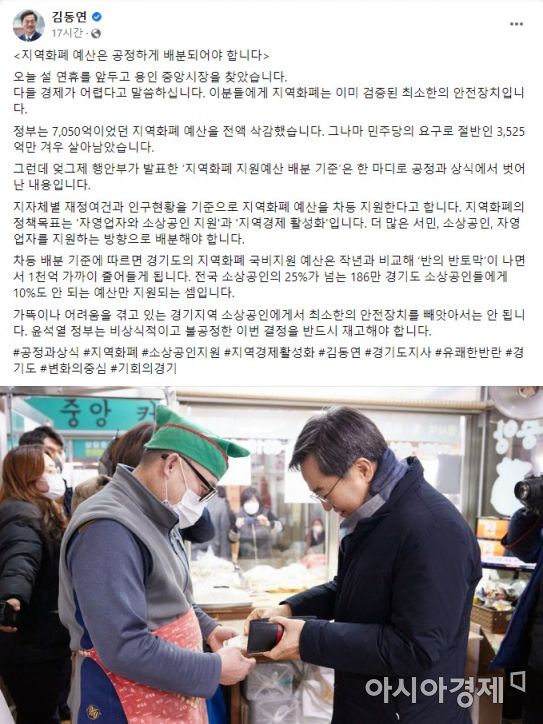
Gyeonggi Province Governor Kim Dong-yeon pointed out on his social media, "The policy goal of local currency is to support 'self-employed and small business owners' and 'revitalize the local economy,' and the allocation should be directed to support more ordinary people, small business owners, and self-employed."
He added, "We must not take away the minimum safety net from small business owners in the Gyeonggi area who are experiencing difficulties," and emphasized, "The government must reconsider this unreasonable and unfair decision."
Earlier, on the 15th, the Ministry of the Interior and Safety announced that "this year, the national subsidy rate for local currency will be applied differently according to three types: population-decreasing areas, general local governments, and municipalities that do not receive ordinary local allocation tax."
In August last year, the Ministry of Economy and Finance announced the 2023 budget plan, stating its intention to terminate national subsidy support for local currency.
Given the nature of the local currency project, which should be borne by local governments, and the fact that local governments with relatively good financial conditions such as Seoul, Gyeonggi, and Incheon increase issuance scale, the government's logic is that the scale of government support also increases, potentially causing reverse discrimination issues among local governments.
© The Asia Business Daily(www.asiae.co.kr). All rights reserved.

















