Martial Arts Industry Holds Relay Meetings by Sector to Restore Exports
Bio, Petrochemical, and Textile Sectors Confer on 19th
[Asia Economy Reporter Moon Chaeseok] The industry has criticized that the introduction of new Korean bio technologies and exports are sluggish due to regulations. There is an urgent need for the government to establish a comprehensive plan to foster the bio industry.
On the 20th, the Korea International Trade Association (KITA) announced that such matters were discussed at an emergency export countermeasure meeting for the bio, petrochemical, and textile industries held the previous day at the Trade Center in Samseong-dong, Gangnam-gu, Seoul, chaired by Vice Chairman Jeong Manki. About 20 people, including representatives from industry associations, companies, and government officials, attended the meeting.
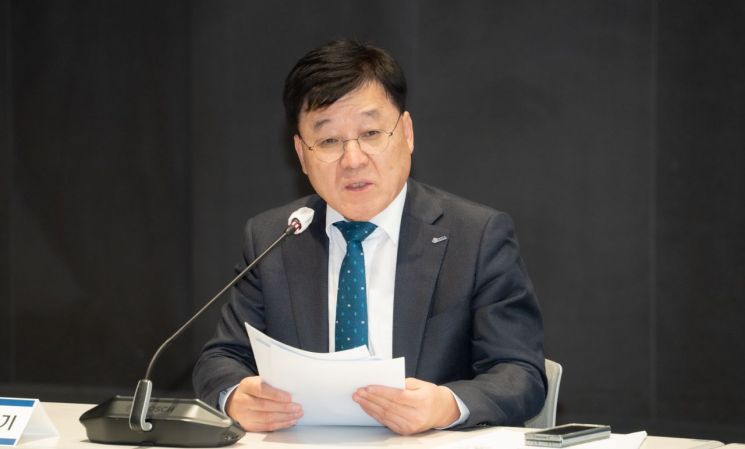 Jung Manki, Vice Chairman of the Korea International Trade Association, speaks at the '5th Emergency Export Measures Meeting by Industry' held on the 19th at the Trade Center in Samseong-dong, Gangnam-gu, Seoul.
 [Photo by Korea International Trade Association]
Vice Chairman Jeong argued that the government should promptly prepare a comprehensive plan to foster chemical bio and medical bio industries. According to him, this industry is estimated to have an average annual growth rate of 7.7% until 2027. The Korean market size was only 21 trillion won in 2021, accounting for just 3% of the global market. He pointed out issues such as labor shortages and strict regulations.
He emphasized, "The problem is that due to various regulations and delays in licensing procedures, it is difficult for emerging bio companies to enter the market and secure competitiveness," and added, "Domestic bio-related regulations must be aligned with international standards."
Regarding petrochemicals, he mentioned issues such as the introduction of the U.S. Inflation Reduction Act and the European Union (EU) Carbon Border Adjustment Mechanism (CBAM). Vice Chairman Jeong urged, "Government research and development (R&D) support should be expanded in areas such as investment in eco-friendly facilities." For textiles, he diagnosed that due to severe labor shortages, efforts should be made to expand foreign labor and implement intelligent automation using IT.
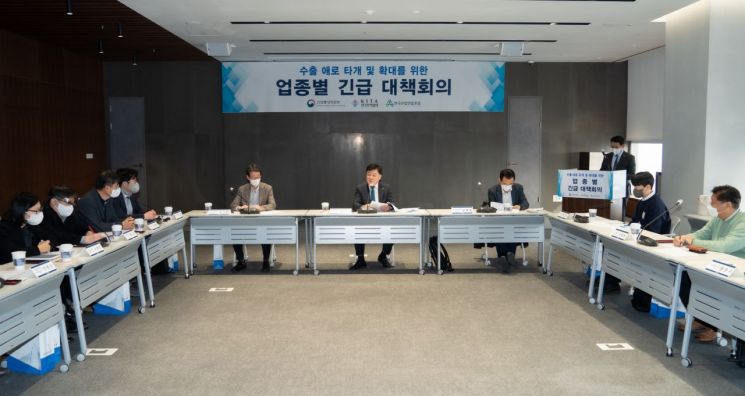 Emergency export countermeasure meeting by industry sector, 5th session.
 [Photo by Korea International Trade Association]
The industry also appealed to the government for regulatory relaxation. Oh Ki-hwan, Executive Director of the Korea Bio Association, predicted that exports this year would slightly decrease or remain similar to last year. Although bio-similars (biopharmaceutical generics) and CMO (contract manufacturing organizations for biopharmaceuticals) are expected to increase, diagnostic kit performance is projected to decline due to the easing of COVID-19. He pointed out that structural improvement is more urgent than short-term export performance.
Executive Director Oh stated, "Obtaining local licenses for pharmaceutical and medical device exports is difficult, and regulations vary by country, so inter-ministerial cooperation is important," and suggested, "The Ministry of Food and Drug Safety and others should participate in export discussions to actively promote the expansion of review personnel and the conclusion of Mutual Recognition Agreements (MRA) between countries." He added, "Export support organizations such as KITA and KOTRA should also secure bio-specialized personnel to establish a system that supports continuous exchanges between overseas partners and domestic companies."
Kim Pyeongjung, Head of the Korea Petrochemical Industry Association, reported that regulations on securing green spaces in industrial complexes pose significant difficulties for companies' eco-friendly investments. He argued that support should be provided through reducing green space ratios or securing alternative green spaces. He also suggested developing new shipping routes, tax support, and constructing new ports necessary for large vessel calls to increase the utilization of Ulsan Port, a production hub.
Kim Doyeop, Director of the Korea Federation of Textile Industries, forecasted that exports of industrial materials such as aramid and carbon fiber would perform well this year. He mentioned that some small and medium-sized enterprises give up exports due to foreign import regulations such as anti-dumping measures. He emphasized the need for government support tailored to the industry's characteristics, where face-to-face marketing is important.
A KITA official said, "We plan to prepare specific policy alternatives and propose them to relevant ministries such as the Ministry of Trade, Industry and Energy, the Ministry of Oceans and Fisheries, and the Ministry of Food and Drug Safety."
© The Asia Business Daily(www.asiae.co.kr). All rights reserved.
![Clutching a Stolen Dior Bag, Saying "I Hate Being Poor but Real"... The Grotesque Con of a "Human Knockoff" [Slate]](https://cwcontent.asiae.co.kr/asiaresize/183/2026021902243444107_1771435474.jpg)












