[Asia Economy Reporter Suyeon Oh] Samsung Electronics announced on the 20th that it has successfully verified the 'network slicing' technology in a 5G standalone mode (SA) commercial network environment with Japanese mobile carrier KDDI.
5G network slicing is a technology that divides a physical mobile communication network into multiple independent virtual networks. Through this, customized communication tailored to various services such as ultra-low latency and ultra-high speed can be provided.
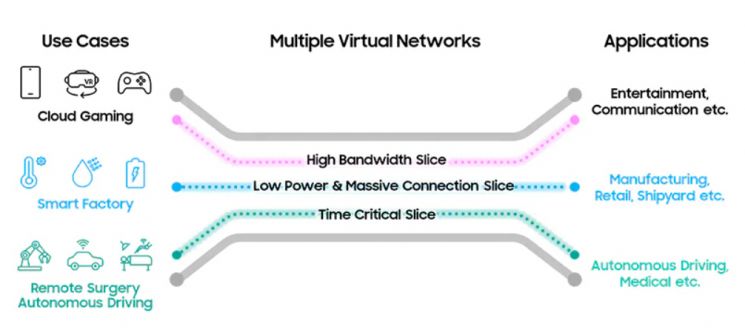
This technology verification was conducted for about three months starting from September 2022. The test was performed by linking Samsung Electronics' supplied 5G SA base stations and 5G SA core equipment with smartphones currently sold in Japan.
In particular, it succeeded in verifying network slicing using a base station intelligent controller (RIC) in a commercial network for the first time in the world.
The base station intelligent controller is a 5G software technology that effectively allocates and controls base station resources according to the service situation used by the user.
Samsung Electronics first succeeded in demonstrating 5G network slicing technology at the KDDI research institute in 2020, and this time succeeded in technology verification in a 5G commercial network in downtown Tokyo, Japan. This marks a step closer to full commercialization.
Above all, this verification is significant in that it successfully demonstrated the technology requirements (SLA) needed for each service in various real-life environments of users such as walking and driving.
Once network slicing technology is fully commercialized in the future, it will be possible to provide multiple services requiring different technical characteristics simultaneously on a single network. It is expected to greatly contribute to the expansion of 5G services.
For example, it can simultaneously provide services that require ultra-low latency and high reliability such as autonomous driving and cloud gaming, and services that require high communication speed such as augmented reality (AR), virtual reality (VR) streaming, and high-definition sports live broadcasts, while guaranteeing the quality of each.
Junhee Lee, Vice President and Head of Strategy Marketing Team at Samsung Electronics’ Network Business Division, said, "Network slicing is a core technology that will enable diverse and innovative services in 5G and next-generation communication networks, and its importance will gradually increase," adding, "Samsung Electronics will continue to cooperate with global operators to discover and expand new 5G services."
Toshikazu Yokai, Head of Mobile Technology Division at KDDI, said, "Applying network slicing technology to the 5G commercial network and succeeding in verifying services for general customers and enterprises is an important advancement in KDDI’s 5G journey," and added, "KDDI will continue to cooperate with Samsung Electronics to provide customers with the latest 5G services based on more advanced communication technologies."
© The Asia Business Daily(www.asiae.co.kr). All rights reserved.
![Clutching a Stolen Dior Bag, Saying "I Hate Being Poor but Real"... The Grotesque Con of a "Human Knockoff" [Slate]](https://cwcontent.asiae.co.kr/asiaresize/183/2026021902243444107_1771435474.jpg)
















