Recruitment of 4,423 Elderly in One Month Falls Short by 1,218
Public-Type Participation Soars, Some Market-Type Projects Have '0' Participants
"Improving Job Quality Is Key to Solving Mismatch Issues"
[Asia Economy Sejong=Reporter Song Seungseop] The government has changed its plan for distributing jobs for the elderly. The budget is limited, but while public-type jobs are overwhelmingly popular, market-type jobs are frequently failing to meet their planned quotas. The government plans to increase market-type jobs going forward, but there are concerns that simply increasing the quantity without developing quality jobs could worsen the 'job mismatch' problem.
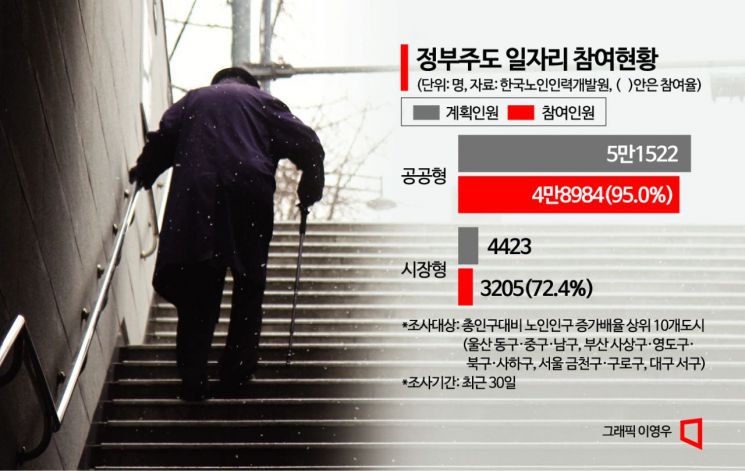
On the 20th, Asia Economy conducted a full survey of 55,945 government-led jobs supplied to the elderly over the past month and found that the 'mismatch' phenomenon was particularly noticeable in market-type jobs. The survey areas were the top 10 aging risk regions with a high elderly population growth rate relative to the total population (Ulsan Dong-gu, Jung-gu, Nam-gu; Busan Sasang-gu, Yeongdo-gu, Buk-gu, Saha-gu; Seoul Geumcheon-gu, Guro-gu; Daegu Seo-gu).
Public-Type Participation Surges, Market-Type Frequently Underfilled
There were a total of 4,423 market-type jobs, with 1,218 positions unfilled. The participation rate compared to the announcement was 72.4%, resulting in about a 30% shortfall. The local government with the lowest participation rate was Daegu Seo-gu. Although 332 market-type elderly jobs were offered, only 182 people applied, a participation rate of 54.6%. Ulsan Nam-gu also had a participation rate of only 57.5%, with 233 out of 405 planned positions filled. The only local government without any shortfall was Ulsan Dong-gu, which had only six market-type job projects (158 planned positions).
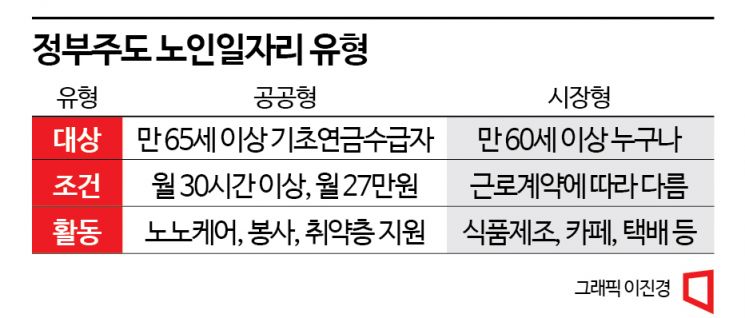
There were even projects with zero participants. In these 10 cities alone, 272 jobs recorded a 0% participation rate. 'Gilgaon Welfare Association' located in Seoul Guro-gu announced 60 elderly workers for the Elderly Social Activity Support Project this year but failed to recruit any participants. In Ulsan Nam-gu, the cooperative 'Haengbok Neutinamu' offered work three times a week with a monthly activity allowance of 363,000 KRW but failed to fill all 30 planned positions.
On the other hand, despite supplying 51,522 public-type jobs, the participation rate was a high 95.0%. In some projects, due to an overwhelming number of applicants, several more people than originally planned were selected. In Seoul Geumcheon-gu, the market-type job participation rate was about 58.9%, but 4,731 out of 4,932 public-type job positions were filled, showing a 95.9% participation rate. Even Ulsan Dong-gu, which had the lowest participation rate, recorded 74.3%, higher than the average market-type participation rate.
Poor Elderly Struggle with Market-Type Jobs That Require Experience
The frequent mismatch in market-type jobs is due to differing needs between employers and job seekers. Elderly people seeking government jobs typically have low income or low educational attainment. However, market-type jobs require participating companies to ask for resumes, education, and work experience. While the selection criterion for public-type jobs is 'income,' for market-type jobs, the top priority is 'qualifications and experience.' It is difficult for elderly people with low education and no experience to apply for market-type jobs.
Companies say they have no choice but to consider experience when participating in market-type job projects. Although the government subsidizes wages when employing elderly workers, reducing labor costs, the work often requires a certain level of expertise. They must also enroll workers in industrial accident insurance, and if an elderly worker is injured on the job, they must worry about the Serious Accident Punishment Act, making them reluctant to hire inexperienced elderly workers.
As a result, despite market-type jobs offering higher wages, low-education and low-income elderly people struggling to make a living flock to public-type jobs. According to the Korea Senior Citizens Association's '2021 Elderly Job Project Policy Effect Analysis Study,' as of 2020, 46.9% of elderly participants in public-type jobs were elementary school graduates, and 19.6% were illiterate. Only 2% held a university degree. In contrast, market-type jobs had a lower proportion of elementary school graduates at 34.6%, and university graduates accounted for 6.8%, more than three times higher.
"If Increasing Market-Type Jobs, Quality Must Be Improved"
The problem is that if the government expands private-led jobs while demand for market-type jobs among the elderly is low, the mismatch problem could worsen significantly. The government increased private and social service-type jobs by 38,000 to 275,000 this year, aiming to provide better jobs. A Ministry of Health and Welfare official explained, "With the baby boomer generation aging and the speed of aging accelerating, limited budgets mean we have no choice but to increase private cooperative jobs to provide more jobs for the elderly."
Experts advise that qualitative improvement is needed rather than just quantitative expansion of elderly jobs. Although the number of elderly qualified to apply for market-type jobs is increasing, the jobs are not attractive enough to participate in. Professor Jeong Jaehoon of the Department of Social Welfare at Seoul Women's University emphasized, "Public-type jobs may be suitable for elderly people in their 70s and 80s, and maintaining the current policy is acceptable. However, the new generation entering old age has different employment experience and expertise, so efforts should be made to diversify market-type jobs."
© The Asia Business Daily(www.asiae.co.kr). All rights reserved.



















