[Asia Economy Reporter Jeong Hyunjin] As expectations grow that consumption in China will expand following the relaxation of the 'Zero COVID' policy, the stock prices of global luxury brands are soaring. With the revival of Chinese consumers' spending sentiment, who have been the main drivers of global luxury market sales, forecasts suggest significant improvements in performance.
World's No.1 Luxury Company LVMH Surpasses 400 Billion Euros in Market Capitalization
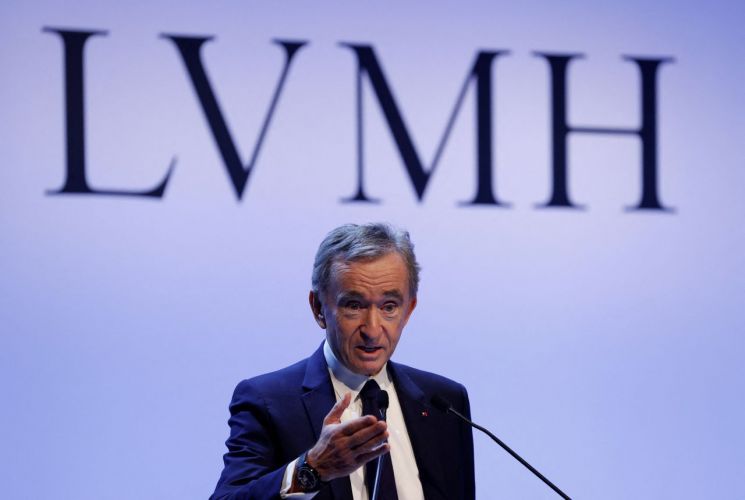
According to Bloomberg and other sources on the 18th (local time), the market capitalization of the French luxury brand Louis Vuitton Mo?t Hennessy (LVMH) reached 403.5 billion euros (approximately 538 trillion KRW), surpassing 400 billion euros for the first time the previous day and continuing its upward trend. The stock closed at 801.9 euros on the Euronext Paris stock exchange.
LVMH is the largest luxury group, owning brands such as Louis Vuitton, Christian Dior, and Tiffany. LVMH's stock price fell from the $750 range (about 920,000 KRW) in January last year to the $530 range in June of the same year but has been soaring this year, supported by global COVID-19 containment and the easing of China's quarantine measures. The stock price surged more than 15% this month alone.
Due to the rise in LVMH's stock price and the decline in Tesla's stock price, Bernard Arnault, chairman of LVMH, surpassed Elon Musk, CEO of Tesla, in December last year to become the world's richest person.
Not only LVMH but also other luxury brands have seen their stock prices rise. The market capitalization of Swiss Richemont, which owns the Cartier brand, increased by more than 11% in January alone to 79.1822 billion Swiss francs (approximately 107 trillion KRW). The stock prices of Kering Group, which owns the Gucci brand, and Burberry Group rose more than 12% this month. Burberry Group's stock price reached its highest level in over three years since January 2020, just before the COVID-19 pandemic.
China's Quarantine Easing... "Early Signs Are Positive"
The reason for the sharp rise in luxury brand stock prices is China's relaxation of COVID-19 quarantine measures. According to consulting firm Bain & Company, by 2030, 40% of all luxury consumers will be Chinese shoppers. Foreign media reported that Chinese luxury consumption accounted for 33% of the global market in 2019 but sharply dropped to 17% last year due to China's zero-COVID quarantine measures.
Bain & Company expects the personal luxury market to grow by 3-8% this year despite the global economic downturn. Foreign media foresee that amid the cooling economies of the US and Europe this year, the influence of Chinese consumers in the luxury market will grow even stronger.
According to Bloomberg's data, LVMH's sales proportion in the Asia region (excluding Japan) rapidly increased from 29.0% in fiscal year 2018 to 30.2% in fiscal year 2019, 34.4% in fiscal year 2020, and 34.8% in fiscal year 2021. This is interpreted as a sharp increase in Asia's share of total sales due to significant growth in Chinese sales. Conversely, the share in the European region (excluding France) decreased from 19.0% in fiscal year 2018 to 15.4% in fiscal year 2021.
Industry evaluations also indicate signs of luxury consumption revival in China from the beginning of the year. Julie Brown, CFO of Burberry, said on the day, "We have witnessed promising signs as doors reopen," noting that Chinese consumers are shopping in Hong Kong, Macau, and other places. She added, "We are seeing early signs as Chinese consumers travel to other Asian countries. Although still very small, we have definitely seen it (signs of rebound). We are very positive about these early signs and confident from a long-term opportunity perspective."
Richemont stated, "Stores have reopened, traffic has increased again, and we are seeing a strong retail rebound before the Lunar New Year."
Luxury brand companies have been strengthening their business foundations by investing in China ahead of the easing of quarantine measures. Foreign media reported that Herm?s expanded and reopened its existing store in Nanjing earlier this month. Herm?s currently has 27 stores in mainland China and expanded its Wuhan store last year while opening a new store in Zhengzhou, Henan Province. Kering Group, which owns the Gucci brand, appointed Laurent Catala, a former Tiffany & Co. executive, as CEO in charge of China in April last year.
© The Asia Business Daily(www.asiae.co.kr). All rights reserved.



















