Conflict Over Daegu Islamic Mosque Construction Continues for Over 2 Years
"Buk-gu Office Exacerbated Resident-Muslim Conflict"
Support Group for Construction Submits Petition to UN
[Asia Economy Reporter Park Hyun-joo] The blame for the ongoing conflict over the construction of the Islamic temple in Daehyeon-dong, Buk-gu, Daegu, which has lasted for over two years, is being directed at Daegu Metropolitan City and Buk-gu Office. After initially granting construction permission for the temple, they reversed their stance due to strong opposition from residents and issued a construction halt notice to the builder. Despite a Supreme Court ruling, they have been criticized for failing to mediate the conflict between the two sides.
The conflict began in September 2020 when Buk-gu Office approved the construction of the temple as a religious assembly hall under the category of a type 2 neighborhood living facility. There were no issues at the early stages of construction, but when the mosque's exterior, different from typical residential houses, was established, about 350 residents opposed the temple's construction citing infringement on their living area and property rights, as well as noise concerns. In response, Buk-gu Office reversed its position and issued an administrative order to stop construction.
The builder and civic groups filed a lawsuit to revoke the administrative order, bringing the matter to court. In September last year, the Supreme Court confirmed that the temple construction was lawful, and accordingly, the builder resumed construction.
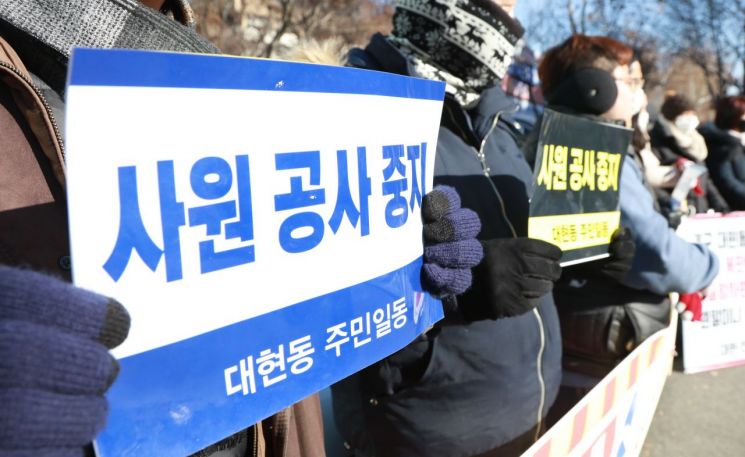 On the morning of the 15th of last month, the 'Daehyeon-dong Islamic Temple Construction Opposition Committee' held a press conference in front of the west gate of Kyungpook National University in Buk-gu, Daegu. [Image source=Yonhap News]
However, residents continue to strongly oppose the construction by displaying pig heads near the construction site and holding barbecue events timed with prayer hours. In Islamic culture, pork is not consumed.
The temple construction site is located in a densely populated residential area, so close that it is adjacent to houses separated by only a single wall. Muslims pray five times a day, and the noise from many people coming and going to pray is claimed to infringe on the living environment of nearby residents. For the same reason, there are concerns that property values will decline.
Supporters of the temple construction advocate resolving the conflict through dialogue. The site has been used as a prayer room by Muslim international students studying at Kyungpook National University since 2014. They find it difficult to understand the residents who suddenly strongly oppose the temple construction despite no complaints during the period it was used as a prayer room. They also believe that building a new temple with soundproof walls and windows will resolve the noise issues that residents worry about.
The responsibility has shifted to Daegu City and Buk-gu Office. Despite the deepening conflict between the two sides, they are criticized for neglecting the situation without presenting appropriate solutions. Members of civic groups supporting the temple construction, including the Coalition for the Enactment of the Anti-Discrimination Act, held a press conference on the 18th, demanding that Buk-gu Office devise countermeasures. They argue that Buk-gu Office worsened the situation by issuing incorrect administrative measures during a time when the conflict could have been resolved through dialogue.
In particular, as the issue has gained international attention, it has become difficult to avoid criticism. The temple construction support group submitted a petition to the United Nations (UN) Special Rapporteur on Freedom of Religion or Belief on the 23rd of last month.
They claim, "Daegu City, Buk-gu Office, and the police have not only neglected but effectively condoned residents' racially hateful acts of obstructing construction, constituting human rights violations that breach international treaties ratified by Korea, such as the UN International Convention on the Elimination of All Forms of Racial Discrimination and the International Covenant on Civil and Political Rights." Additionally, foreign media such as the French daily Le Monde and the British BBC have covered the conflict multiple times.
In response, the Ministry of Culture, Sports and Tourism (MCST) has stepped in to assess the situation. On the same day, MCST held a meeting with Daegu City and Buk-gu Office to discuss possible solutions. Buk-gu Office is currently considering purchasing land near the temple or residential houses, but it is reported that further coordination with residents is necessary.
© The Asia Business Daily(www.asiae.co.kr). All rights reserved.

















