[Asia Economy Beijing=Special Correspondent Kim Hyunjung] Ahead of the Spring Festival (Chunje, the Chinese Lunar New Year), one of China's biggest holidays, sales of imported goods within China have been increasing. Chinese state-run media have praised China's consumption recovery for contributing to the global economy.
China's state-run Global Times reported on the 18th that "China, the world's second-largest economy, is showing rapid consumption recovery following the government's optimization of epidemic prevention measures," adding that "this is providing substantial help to the world." Citing sales data from the e-commerce platform JD.com, the Global Times reported that sales of Greenland shrimp surged by 500% compared to last year, while sales of Thailand's Black Tiger shrimp and Argentine beef rose by 100% and 300%, respectively.
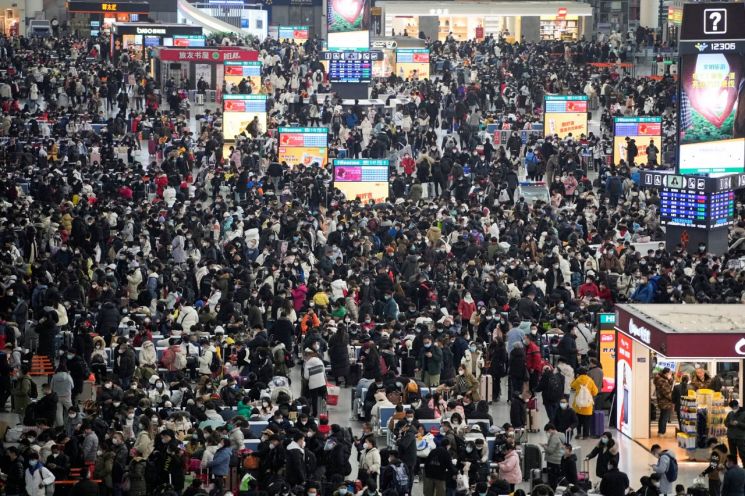
The Spring Festival, when 1.4 billion Chinese people return to their hometowns or travel, is considered the biggest consumption season locally. Traditionally, Chinese people exchange red envelopes called 'hongbao (紅包)' containing cash and gifts, and families and relatives gather to enjoy abundant meals. Some younger generations travel across the country, opening their wallets wide. Especially this year, with the zero-COVID policy being abandoned for the first time in three years, there are high expectations that previously suppressed consumption will explode.
A representative from the fruit brand Dole told the media, "We feel consumption reviving as each household actively prepares for the holiday." On Tmall, operated by Alibaba, sales of Chilean cherries increased by 85% compared to the previous year. Imported cherries are popular among Chinese consumers who favor red-colored fruits. The Chilean Fruit Exporters Association (ASOEX) has stated that logistics networks and customs clearance procedures have improved since China reopened its borders. Additionally, French wine, Belgian chocolate, and Malaysian durian are known to be highly preferred.
The Global Times explained, "In southwestern China, freight trains passing through the Western Land-Sea New Corridor are busily transporting tropical fruits into China," adding, "Foods such as Indonesian shortening and Vietnamese dried bananas are arriving one after another." The Western Land-Sea New Corridor operates across 60 cities and 113 stations in 17 provinces within China. This is an increase of 21 stations compared to 2021, connecting all 12 provinces in western China. The number of train operations on the Western Land-Sea New Corridor increased 49-fold from 178 in 2017 to 8,800 last year.
Especially since the Regional Comprehensive Economic Partnership (RCEP) came into effect in January last year, Southeast Asian countries have been exporting tropical fruits to China in large quantities. An industry official told the Global Times, "We expect Philippine durian to be imported starting after the Spring Festival and are actively preparing for it."
According to Chinese customs authorities, China imported agricultural products worth 1.57 trillion yuan last year, a 10.8% increase compared to the previous year. Zhang Yi, CEO of iMedia Research, evaluated, "From the perspective of consumption upgrading, the proportion of imported goods consumption should further increase."
© The Asia Business Daily(www.asiae.co.kr). All rights reserved.

![User Who Sold Erroneously Deposited Bitcoins to Repay Debt and Fund Entertainment... What Did the Supreme Court Decide in 2021? [Legal Issue Check]](https://cwcontent.asiae.co.kr/asiaresize/183/2026020910431234020_1770601391.png)