GIST Research Team Presents Physical Interpretation of Yi Sang's Serial Poems
"'Diagnosis 0:1' Is a Poem About Periodically Repeating Spacetime"
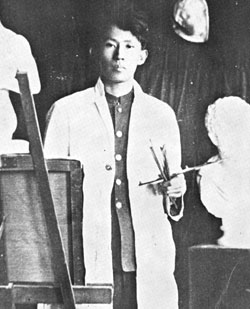
[Asia Economy Reporter Kim Bong-su] A paper interpreting the difficult poem "Diagnosis 0 : 1," one of the works in the series poem "Infinite Hexahedral Architecture" by the genius poet Yi Sang (1910?1937), from a physics perspective has been published in the academic journal issued by the Yi Sang Literary Society.
The Gwangju Institute of Science and Technology (GIST) announced on the 19th that Professor Lee Soo-jung of the Department of Basic Education and Mr. Oh Sang-hyun, a physics doctoral student at the University of California, Merced (UC Merced), published a paper clarifying that Yi Sang's poem "Diagnosis 0 : 1" is about periodically repeating spacetime and providing an explanation for it.
The research team had previously attracted attention in 2021 by analyzing Yi Sang's representative difficult poems "Three-Dimensional Angle Blueprint" and "Infinite Hexahedral Architecture" from the perspectives of four-dimensional geometry and physics.
The poem "Diagnosis 0 : 1," the subject of this analysis, is a short poem featuring an 11-row by 11-column number table with a central dot (?), and the expression "Diagnosis 0 : 1." Previous interpretations included views such as it being a geometric sequence multiplied by one-tenth each time the row changes, or a depiction of opposition across the diagonal.
The research team proposed a new interpretation from a physics perspective. They viewed the numbers in the number table as spacetime coordinates and explained that "Diagnosis 0 : 1" is a statement that connects and repeats the boundaries of spacetime, like rolling a sheet of paper into a cylinder by joining its ends. They also stated that it is a poem setting the spacetime background of "Infinite Hexahedral Architecture," and that the theme of connection and repetition of spacetime (the periodic boundary condition motif) is closely related to other motifs appearing in Yi Sang's literature, such as repetition, infinity, fear, boredom, and self-splitting.
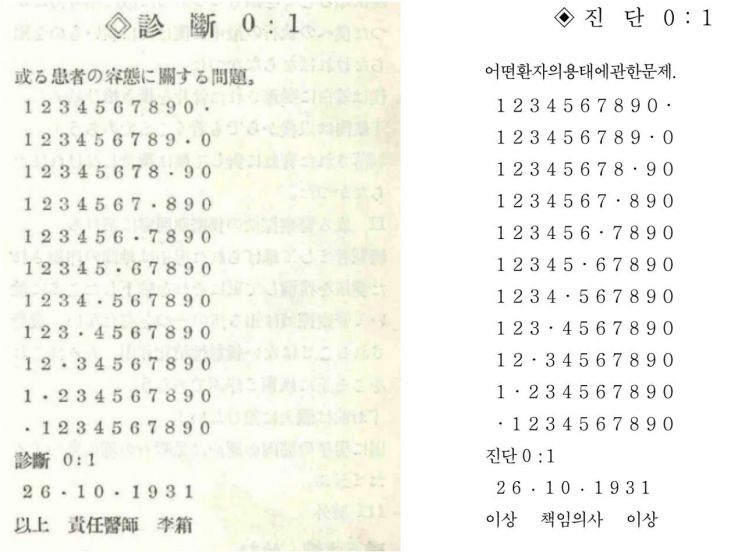
Based on another work by Yi Sang, "Three-Dimensional Angle Blueprint ? Memorandum on Lines 6," the research team interpreted the sequence "1234567890" appearing in the number table as the cyclic unit of an infinitely repeating sequence and as implying periodically repeating spacetime coordinates. They named this idea the "periodic boundary condition motif." Based on the "periodic boundary condition motif," when the number tables of "Diagnosis 0 : 1" are connected, discontinuities in the number arrangement at the boundaries of the number tables can be observed. This indicates that spacetime has inappropriate periodicity, which can be resolved by shifting and overlapping the upper half of the connected number table one unit to the left and one unit downward. The "0 : 1" signifies this "shift and overlap" operation. When shifting and overlapping the upper half of the number table, attention to the central part reveals that 0, 1, and the central dot (?) move as follows.
First, in "0 : 1," the colon ":" corresponds to the first step of moving the upper "0 ? 1" to the left to align the two central dots (??), which were previously arranged diagonally, into a line (:). Next, "0" and "1" correspond to the second step of moving the upper "0 ? 1" downward to overlap the vertically arranged pairs of 0 and 1 (, ) into a single 0 and 1. In a narrow interpretation, "Diagnosis 0 : 1" is a diagnosis that the operation expressed as "0 : 1" is necessary for the given number table. In a broader interpretation, it can be seen as an insightful judgment through examination of spacetime (or the world and society) that it is pathologically repeating.
This study was published as a paper titled "Periodic Boundary Condition 1 in Yi Sang's Poetry - Decoding 'Infinite Hexahedral Architecture ? Diagnosis 0:1'" in issue 18 of
© The Asia Business Daily(www.asiae.co.kr). All rights reserved.
![Clutching a Stolen Dior Bag, Saying "I Hate Being Poor but Real"... The Grotesque Con of a "Human Knockoff" [Slate]](https://cwcontent.asiae.co.kr/asiaresize/183/2026021902243444107_1771435474.jpg)











