LS Cable & System Maintains Global 'Top 4' with New Technology Development
Daehan Cable Invests 100 Billion Won to Expand Factory
Submarine Cable Market to Grow to 50 Trillion Won by 2025
[Asia Economy Reporter Han Ye-ju] The domestic cable industry is rapidly increasing investments in the submarine cable business. This is due to the expansion of offshore wind farm construction driven by the global spread of carbon neutrality policies. Supported by the implementation of the U.S. Inflation Reduction Act (IRA) and the renewable energy transition in Middle Eastern countries, related businesses are expected to expand further.
Submarine cables are facility cables installed to supply power and communication between two points separated by the sea, such as between continents, or between land and islands. They connect tens to hundreds of kilometers at a time and must operate flawlessly in the unique underwater environment, requiring the highest level of technology in the cable field. This is why submarine cables have earned the nickname "the flower of cables."
The submarine cable market is currently dominated by a few companies worldwide due to high entry barriers. These include foreign companies such as France's Nexans, Italy's Prysmian, and Sweden's ABB.
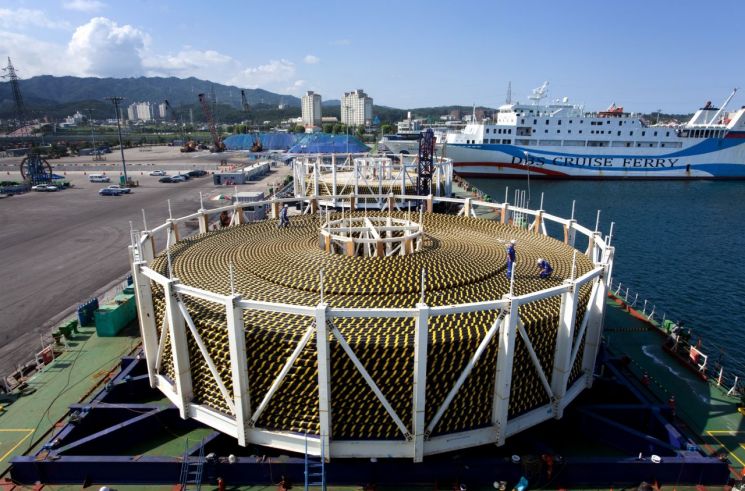
Following the traditional leaders in the cable industry, the domestic cable manufacturer LS Cable & System is closely pursuing. LS Cable & System ranks 4th in the global submarine cable market. Since building Korea's first submarine cable factory in Donghae City in 2008, LS Cable & System has been pushing forward with the construction of a second plant with an investment of 185.9 billion KRW in 2021. Upon completion in April this year, LS Cable & System's submarine cable production capacity will increase by more than 1.5 times.
They are also accelerating new technology development. Last year, LS Cable & System successfully completed a demonstration test of a 525 kV HVDC (High Voltage Direct Current) cable. Globally, only a few companies have succeeded in developing voltage source converter (VSC) HVDC cables, and LS Cable & System is the only domestic company with this technology. This has enabled LS Cable & System to participate in bidding for multi-trillion KRW HVDC projects underway in Europe and North America. The large-scale orders secured last year amounted to about 1.2 trillion KRW.
In October last year, LS Cable & System also became the second-largest shareholder by acquiring a 16% stake through a third-party paid-in capital increase in KT Submarine, a company specialized in submarine optical cable business. They plan to enhance global order competitiveness by utilizing KT Submarine's submarine construction technology, ship operation technology, and ship management capabilities.
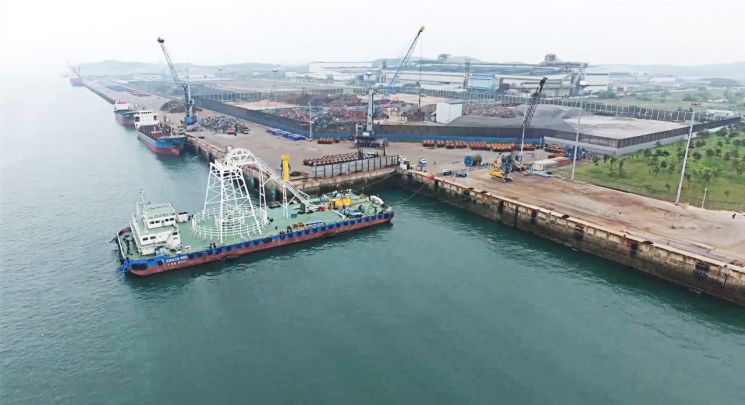 Overhead view of the new submarine cable factory site and Godeok Pier of Daehan Electric Wire.
 [Photo by Daehan Electric Wire]
The latecomer, Daehan Cable, is also actively moving forward. In December last year, they held a groundbreaking ceremony for a large-scale submarine cable coastal factory in Dangjin, Chungnam Province. The investment scale is about 100 billion KRW, located on a 44,800㎡ (approximately 13,500 pyeong) site behind the Godeok Pier in the Asan National Industrial Complex. Completion is scheduled for the second half of this year. Daehan Cable plans to establish facilities capable of producing internal and external network cables used in offshore wind farms and gradually expand its product lineup.
Additionally, in June last year, Daehan Cable signed a joint venture agreement with Saudi EPC company Al Ojaimi Group to produce ultra-high voltage cables and is currently promoting the establishment of a local factory. Daehan Cable plans to gradually expand its product lineup to include 345 kV external network and HVDC submarine cables.
Competition in the submarine cable market is expected to heat up further. The global submarine cable market is projected to grow from $2.3 billion (approximately 2.69 trillion KRW) in 2021 to $4.5 billion (approximately 5.26 trillion KRW) by 2025, nearly doubling. This is because the global eco-friendly trend is drawing attention to methods that preserve ecosystems by transmitting electricity from existing power facilities rather than building power plants on islands.
In particular, the implementation of the IRA in the U.S., which aims to expand renewable energy supply, is considered a positive factor accelerating the global submarine cable business. The IRA applies relatively relaxed regulations to the offshore wind industry. While other renewable energy industries require that at least 40% of components and raw materials be U.S.-made, offshore wind only requires over 20%. The Middle Eastern countries' willingness to foster renewable energy transition as a new business is also seen as a green light for expanding the submarine cable market. Policies aimed at reducing power generation costs through inter-country power grid connections are expected to further drive demand for submarine cables.
© The Asia Business Daily(www.asiae.co.kr). All rights reserved.
![User Who Sold Erroneously Deposited Bitcoins to Repay Debt and Fund Entertainment... What Did the Supreme Court Decide in 2021? [Legal Issue Check]](https://cwcontent.asiae.co.kr/asiaresize/183/2026020910431234020_1770601391.png)