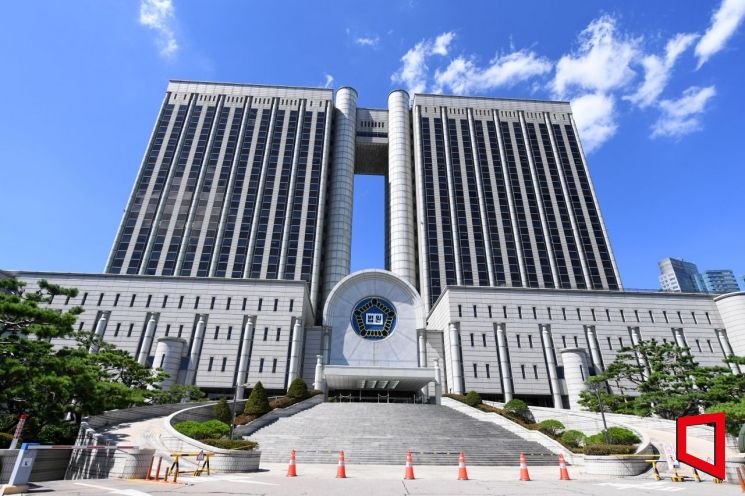
[Asia Economy Reporter Kim Daehyun] Workers lost again in the second trial regarding the validity of KT's "retirement age extension-type wage peak system," introduced in 2015.
On the afternoon of the 18th, the Seoul High Court Civil Division 1 (Presiding Judges Jeon Ji-won, Lee Jae-chan, Kim Young-jin) dismissed all appeals in the wage claim lawsuit filed by approximately 700 current and former KT employees, ruling, "All appeals by the plaintiffs are dismissed. The plaintiffs shall bear the appeal costs," thereby upholding the first trial's decision against the plaintiffs.
The court stated, "Considering the various pieces of evidence properly examined in the first trial and relevant legal principles, it was judged difficult to accept the plaintiffs' grounds for appeal."
The KT wage peak system at issue corresponds to the retirement age extension-type wage peak system, which most companies adopted following the 2016 amendment of the Elderly Employment Act, extending the retirement age to 60 and restructuring the wage system. This system reduces wages from a certain age while extending the retirement age. Although wages are cut from a certain age, the method guaranteeing employment until retirement age is called the "retirement guarantee type," and the method of reemployment for a certain period after retirement is called the "employment extension type."
In 2015, KT decided through labor-management agreement to implement a wage peak system that extends the retirement age but reduces wages by 10% annually starting at age 56. KT workers filed a lawsuit demanding the return of wages cut due to the system, claiming, "Because the wage peak system was concluded behind closed doors, wages were forcibly cut by 10-40%."
The first trial did not accept all claims by the workers. It ruled, "The labor-management agreement cannot be invalidated simply because it did not go through a union general meeting resolution," and "Since the wage peak system was implemented in connection with the retirement age extension, the extension itself is the most important compensation against wage reduction."
Displeased, the workers argued in the appeal trial that the wage peak system was "not intended for wage adjustment for the elderly but for dismissal." They pointed out that contrary to the company's explanation that the system was introduced due to urgent management reasons, executives received high salaries in advisory roles. This suggests it was unfair to call it a 'pain-sharing' measure.
On the other hand, the company countered, "It is a system that went through internal procedures as compensation and courtesy for the length of service," and argued that it is a common system among leading domestic companies. They added, "KT's management situation at the time was different from other companies. Please consider the pain-sharing between the company and workers," and requested, "Please also review subsequent measures related to workers' welfare."
Regarding the workers' claim that "the wage peak system concluded behind closed doors by a very small number of union executives with the company is invalid in itself," the company rebutted, "Because the number of union members was too large, opinions were received from executives legitimately elected through proper procedures," stating they were unaware of any procedural violations during the agreement process and that it is wrong to hold the company responsible for problems occurring within the union.
Initially, about 1,300 workers participated as plaintiffs in this case, but after losing the first trial in June last year, hundreds gave up their appeals. Also, while one trial division handled all these cases in the first trial, in the appeal trial, two divisions are handling the cases separately by filing time: about 700 people (judgment on this day) and about 130 people. The appeal trial for the 130 people has also concluded its argument procedures, and the Seoul High Court Civil Division 15 (Presiding Judge Yoon Kang-yeol) is scheduled to deliver a verdict on the 10th of next month.
Meanwhile, in May last year, the Supreme Court ruled the retirement guarantee-type (maintenance type) wage peak system of the former Electronics and Telecommunications Research Institute (now Korea Electronics Technology Institute) as "invalid." The Korea Electronics Technology Institute's system did not extend the existing retirement age, and it was found that neither the nature of the work changed nor the workload decreased. The court presented criteria for judging the validity of wage peak systems, including ▲the legitimacy and necessity of the introduction purpose ▲the extent and duration of actual wage reduction ▲appropriateness of the target (compensation) measures ▲whether the reduced funds were used for the intended purpose.
© The Asia Business Daily(www.asiae.co.kr). All rights reserved.

















