Negative Interest Rates and Interest Rate Volatility Maintained
Inflation Revised Upward, Economic Growth Rate Revised Downward
Market Anticipates Tightening, Sells Large Amount of Government Bonds
[Asia Economy Reporter Lee Ji-eun] The Bank of Japan (BOJ), which initiated a shift in its long-standing monetary policy by raising the fluctuation range of long-term interest rates last month, decided on the 18th at its monetary easing policy meeting to maintain the existing policy. However, it raised its inflation forecast and lowered its economic growth rate, leaving open the possibility of tightening due to the high inflation trend.
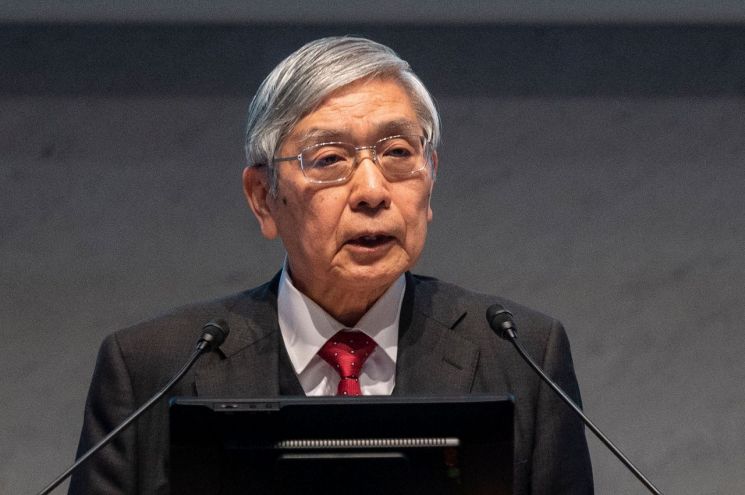
After concluding the two-day monetary policy meeting held from the 17th, the BOJ announced it would continue its accommodative monetary policy. Accordingly, the short-term interest rate remains fixed at -0.1%, and the allowable fluctuation range for the 10-year government bond yield, a long-term interest rate indicator, is maintained at ±0.5%. The BOJ also decided to continue purchasing index-linked exchange-traded funds (ETFs) to increase the money supply in the market.
Nihon Keizai reported that despite the BOJ's stance, market speculation continues that the monetary policy will shift toward tightening. Japan's 10-year long-term government bond yield exceeded the BOJ's allowable fluctuation range of 0.5% for four consecutive trading days up to that day. This is analyzed as a result of overseas investors betting on the possibility of changes in Japan's monetary policy and selling large volumes of government bonds.
Previously, at last month's monetary policy meeting, the BOJ expanded the allowable fluctuation range of long-term interest rates from ±0.25% to ±0.5%. BOJ Governor Haruhiko Kuroda explained that this was a measure to resolve distortions in the bond market. However, the market views the increase in the upper limit of long-term interest rates to 0.5% as effectively a rate hike, raising expectations for a possible shift in monetary policy direction.
On this day, the BOJ also revised its inflation forecast upward. According to the "Economic and Price Outlook Report" released after the monetary policy meeting, the forecasted consumer price inflation rate (excluding fresh food) for fiscal year 2022 was raised to 3.0%, up 0.1 percentage points from the previous forecast of 2.9% announced three months earlier. The inflation forecast for 2023 was maintained at 1.6%, while the forecast for 2024 was raised from 1.6% to 1.8%.
The rising inflation fuels the possibility of tightening by the BOJ, Japan's inflation firefighter. Nihon Keizai explained, "By revising upward the inflation forecasts for 2022 and 2024, the BOJ is likely to raise expectations for policy adjustments by the next meeting," adding, "The tug-of-war between the market and the BOJ is expected to continue beyond this day."
The BOJ also forecasted lower economic growth than expected. The BOJ lowered its fiscal year 2022 gross domestic product (GDP) growth forecast by 0.1 percentage points from 2.0% to 1.9%. The GDP growth forecast for fiscal year 2023 was revised down from 1.9% to 1.7%, and the 2024 forecast was lowered from 1.5% to 1.1%. The BOJ explained that it revised down the economic growth forecast due to risks of further contraction in global financial markets and instability in overseas economies as the U.S. continues to raise interest rates.
© The Asia Business Daily(www.asiae.co.kr). All rights reserved.

















