[Asia Economy (Daejeon) Reporter Jeong Il-woong] The Korean Intellectual Property Office (KIPO) supports companies in gaining a technological super-gap by securing core patents in the semiconductor field. The ultimate goal is to enable intellectual property to be used as a strategic tool for national economic security.
On the 19th, KIPO announced its "2023 Work Plan" reflecting this vision. The work plan, under the vision of "Realizing Dynamic Economic Growth through Intellectual Property," includes 12 key tasks across three major strategies: ▲ Innovation of the intellectual property administrative system ▲ Securing future growth engines in advanced industry sectors ▲ Creating an intellectual property-based growth ecosystem for innovative companies.
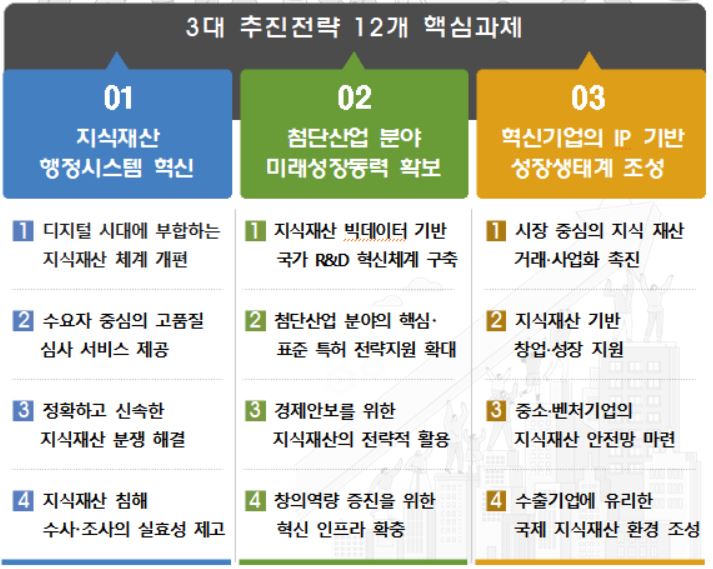
The most notable points in this year's work plan are the establishment of a dedicated semiconductor examination organization and the creation of a Technology Crime Investigation Support Center.
As part of innovating the intellectual property administrative system, KIPO will establish a dedicated semiconductor examination organization this year. This organization will be composed of retired private-sector experts in the semiconductor field and will play a role in supporting early acquisition of core patents and securing a technological super-gap for companies.
Previously, in December last year, KIPO accepted applications for specialized term patent examiners in the semiconductor field and is currently conducting the hiring process. The number of hires is 30, with final candidates to be selected next month. KIPO plans to deploy these specialized term patent examiners early in the field to enable rapid patent acquisition in the semiconductor sector, thereby enhancing the competitiveness of domestic semiconductor technology.
KIPO is also promoting the establishment of a Technology Crime Investigation Support Center to enhance the effectiveness of intellectual property infringement investigations and prosecutions. The purpose of this new organization is to prevent national damage caused by the leakage of core technology patents to competing companies or overseas.
This center, to be newly established within the Intellectual Property Protection Agency this year, is expected to serve as a cornerstone for strengthening the investigative capabilities of technology police. To this end, KIPO plans to expand cooperative relationships with domestic and international investigative agencies for technology crime investigations, including building a cooperative system with the Prosecutor's Office and establishing international cooperation with the U.S. Homeland Security Investigations (HSI).
KIPO will also focus its institutional capabilities on enabling the rapid acquisition and protection of core patents in advanced industries such as semiconductors, which can lead to strengthening national technological competitiveness.
First, based on the world's patent big data of 530 million cases, promising technologies in nine advanced industry sectors including semiconductors and secondary batteries will be identified. Through cooperation with related ministries such as the Ministry of Science and ICT, KIPO will assist in securing excellent patents related to national strategic technologies.
Additionally, by conducting patent-export-import linkage analysis, KIPO will identify key items in supply chains with high external dependence and perform in-depth patent analysis on 11 major items, supporting the establishment of technology localization strategies and securing alternative technologies through supply source diversification.
In particular, to prevent the overseas leakage of national strategic technologies, KIPO plans to expand the application of the secret patent system to inventions important for economic security to a level comparable to advanced countries when necessary.
The secret patent system allows inventions important for economic security to be pre-notified before overseas filing and kept confidential if necessary. Currently, South Korea limits the scope of secret patents to defense-related inventions. In contrast, major countries such as the United States, China, Germany, and Japan broadly define the scope as related to "national security."
Furthermore, KIPO will implement tasks this year to promote market-centered intellectual property transactions and commercialization, support startups and growth based on intellectual property, establish an intellectual property safety net for small and venture companies, and create an international intellectual property environment favorable to export companies. Through these efforts, KIPO aims to create an intellectual property-based growth ecosystem for innovative companies and help them strengthen their competitiveness.
KIPO Commissioner Lee In-sil defines intellectual property as "the driving force necessary to overcome the crisis South Korea faces in the global hegemony competition."
He added, "This year, KIPO will support the domestic semiconductor industry's early acquisition of core patents through the formation of a dedicated semiconductor examination organization and help companies maintain a technological super-gap by preventing the overseas leakage of core technologies. Ultimately, we will strive to ensure that intellectual property is used as a strategic tool for economic security, strengthening national technological competitiveness and supporting economic growth realization."
© The Asia Business Daily(www.asiae.co.kr). All rights reserved.
![Clutching a Stolen Dior Bag, Saying "I Hate Being Poor but Real"... The Grotesque Con of a "Human Knockoff" [Slate]](https://cwcontent.asiae.co.kr/asiaresize/183/2026021902243444107_1771435474.jpg)
















