Bank of Korea, Survey on Financial Institutions' Lending Practices
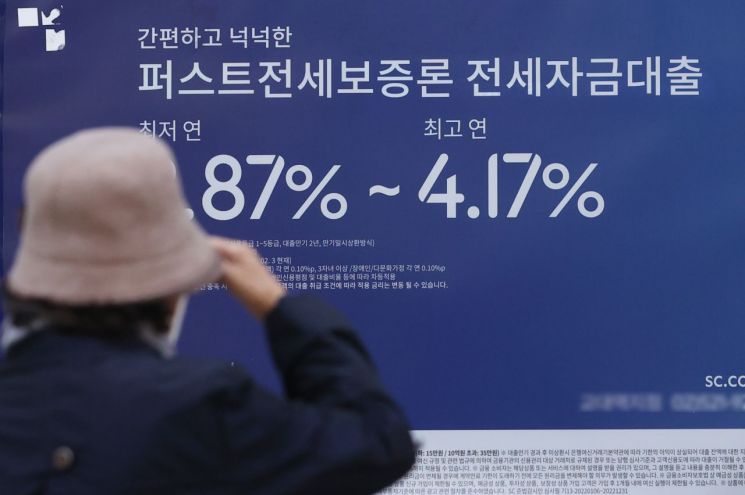
In the first quarter of this year, the lending standards for household and corporate loans at banks are expected to ease. This is due to regulatory relaxation and intensified competition among financial institutions, which are likely to lead to a more lenient lending attitude. However, given the significant domestic and international economic uncertainties, the credit risk for households and corporations is expected to continue rising.
According to the results of the "Financial Institution Lending Behavior Survey" announced by the Bank of Korea on the 18th, lending attitudes of domestic banks toward corporations and households are both expected to ease in the first quarter.
The Bank of Korea explained, "In the case of corporate loans, lending capacity is expected to ease due to the relaxation of regulations such as the loan-to-deposit ratio, and intensified competition among financial institutions," adding, "for households, a lenient attitude is expected to be maintained, especially for housing fund loans, due to the easing of household loan regulations and intensified competition among financial institutions following a slowdown in loan growth."
During the first quarter, corporate credit risk is likely to increase due to expanded uncertainties in domestic and international economic conditions and the increased interest burden caused by rising loan interest rates. In particular, small and medium-sized enterprises (SMEs) are expected to show high levels of credit risk due to deteriorating profitability and reduced debt repayment capacity. According to the Financial Supervisory Service's regular credit risk assessment, among the 185 companies identified as showing signs of insolvency last year, 183 were SMEs, an increase of 26 companies compared to the previous year.
Household credit risk is also expected to continue rising from the previous quarter due to the deterioration of financial soundness among some vulnerable borrowers and increased interest burdens caused by rising loan interest rates.
Corporate loan demand in the first quarter is expected to maintain an upward trend for both large corporations and SMEs, driven by increased liquidity demand amid concerns over economic slowdown and deteriorating financing conditions in the corporate bond market.
On the other hand, household loan demand is likely to continue declining for both housing funds and general funds due to the sluggish housing market and rising loan interest rates.
Meanwhile, lending attitudes of non-bank financial institutions are expected to continue tightening across all sectors. The Bank of Korea explained, "amid ongoing uncertainties in domestic and international economic conditions, lending attitudes are expected to tighten due to increased repayment burdens on borrowers caused by rising interest rates and slowing growth, as well as the need to manage loan soundness."
© The Asia Business Daily(www.asiae.co.kr). All rights reserved.
![Clutching a Stolen Dior Bag, Saying "I Hate Being Poor but Real"... The Grotesque Con of a "Human Knockoff" [Slate]](https://cwcontent.asiae.co.kr/asiaresize/183/2026021902243444107_1771435474.jpg)











