Used Toyota SUV priced 10% higher than new cars
Mass export of used passenger cars excluded from Russia sanctions
[Asia Economy Reporter Jeon Jinyoung] It has been reported that used car prices in Japan reached an all-time high last year. Some models were traded at prices higher than new cars, which seems to be influenced by the fact that most of the used cars on the market, amid a sharp decline in new car sales due to a shortage of automotive semiconductors, were imported from Russia. Russia is known to be purchasing a large number of Japanese used passenger cars, which are exempt from sanctions against Russia.
On the 18th, Nihon Keizai Shimbun (Nikkei) cited a report from USS, a major Japanese used car auction company, stating that the average bid price at used car auctions last year was 1,048,000 yen (approximately 10.11 million KRW), up 21% from the previous year, marking an all-time high. In December last year, the price was 997,000 yen, a 7% increase compared to the same month the previous year, continuing a rising trend for 31 consecutive months.
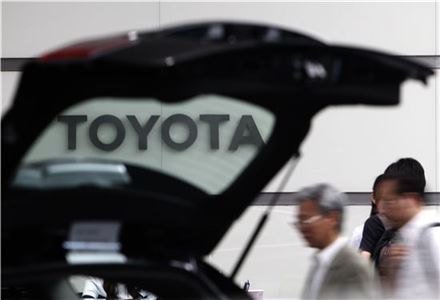 People passing by cars displayed in front of Toyota's Tokyo headquarters.
 [Image source=AP·Yonhap News]
Popular sport utility vehicles (SUVs) even saw used car prices surpassing new car prices. Some hybrid models of the Toyota Harrier recorded an average price of 5,199,000 yen as of mid-January, which, despite differences in options, is more than 10% higher than the usual new car price of 4,628,000 yen. Nikkei analyzed, "In the case of the Harrier, customers have to wait a year to receive a new car, and orders for the highest-spec model, the 'Z Grade,' have been suspended, causing customers to turn to used cars."
Similar phenomena were observed in other brands as well. Suzuki's Jimny, known as a four-wheel-drive compact car, has a used car price for the 'XC Grade' at 2,399,000 yen (23.15 million KRW), about 30% higher than the new car price of 1,903,000 yen (18.36 million KRW). Some hybrid models of Honda's small SUV Vezel also recorded used car prices 20% higher than new car prices, at 3,499,000 yen (33.77 million KRW).
The fundamental reason for this reversal, where used car prices exceed new car prices, is attributed to the drop in new car sales volume due to the shortage of automotive semiconductors. The prolonged semiconductor supply shortage, which began in 2020, caused new car sales in Japan last year to fall to about 4.2 million units, a level not seen in 45 years.
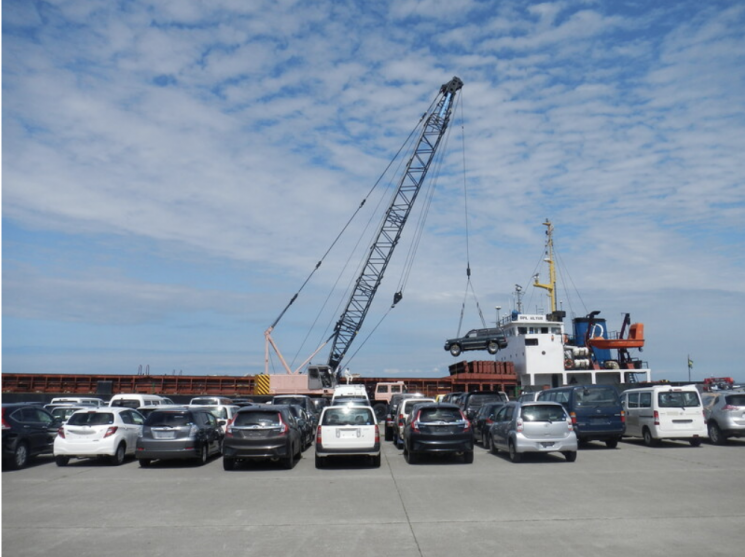 Used Japanese cars exported to Russia are lined up at Otaru Port. [Image source=Official website of Otaru City, Japan]
Moreover, all the used cars that do appear on the Japanese market are being exported to Russia. Due to the war in Ukraine, Japanese automakers such as Toyota have suspended local operations in Russia citing difficulties in procuring parts, resulting in no new cars being available and naturally increasing demand for used cars.
The exemption of used passenger cars from sanctions against Russia has also fueled the surge in exports. Under current sanctions, cars priced above 6 million yen (approximately 57.91 million KRW) are considered luxury goods and cannot be exported to Russia, but used passenger cars priced below 6 million yen are excluded from the ban and can be freely traded.
Additionally, used cars can be traded through regional banks that are not subject to regulations by the international payment system SWIFT (Society for Worldwide Interbank Financial Telecommunication), further expanding exports to Russia. Currently, major Russian banks have been expelled from SWIFT, blocking trade remittance channels. Combined with the strong ruble and weak yen, demand for Japanese used car prices has increased even more.
Public broadcaster NHK reported that in Toyama Prefecture, Japan, which handles more than half of the used car exports to Russia, used car dealers receive over 200 inquiries daily from Russia, about six times the number of orders in March last year when orders had dropped due to the war.
Satoshi Ohata, Executive Director of Japanese used car auction company Oaknet, told Nikkei, "Even if new car production in Japan recovers, it will take 1 to 3 years for the used car market to be affected. This trend is expected to ease by this summer."
© The Asia Business Daily(www.asiae.co.kr). All rights reserved.
![Clutching a Stolen Dior Bag, Saying "I Hate Being Poor but Real"... The Grotesque Con of a "Human Knockoff" [Slate]](https://cwcontent.asiae.co.kr/asiaresize/183/2026021902243444107_1771435474.jpg)
















