Seoul City, Nationwide First Survey on Isolated and Reclusive Youth
Comprehensive Results to Promote Integrated Support Measures in March
[Asia Economy Reporter Kiho Sung] The Seoul Metropolitan Government recently conducted the nation's first-ever survey on the actual conditions of isolated and reclusive youth from May to December last year, in response to growing social interest in this issue, and announced the results on the 18th.
This survey was conducted online and divided into a household survey (targeting households with resident youth) to estimate the scale of isolated and reclusive youth, and a youth survey (targeting general youth in Seoul) to understand their overall living conditions. Additionally, in-depth surveys (FGI, IDI) were conducted with the actual isolated and reclusive individuals and support agency practitioners to enhance the accuracy of the results.
According to the survey results, the proportion of isolated and reclusive youth in Seoul is estimated at 4.5%, which, when applied to Seoul's population, amounts to up to 129,000 individuals. Meanwhile, if the scope is expanded to nationwide youth (aged 19 to 39), the number of isolated and reclusive youth in South Korea could be approximately 610,000.
During the survey process, Seoul defined the concepts of isolation and reclusion to set precise criteria. ‘Isolation’ refers to individuals currently in an emotional or physical state of isolation lasting at least six months, while ‘reclusion’ is defined as those who rarely leave their homes, live exclusively at home for at least six months, and have had no job or job-seeking activities within the past month.
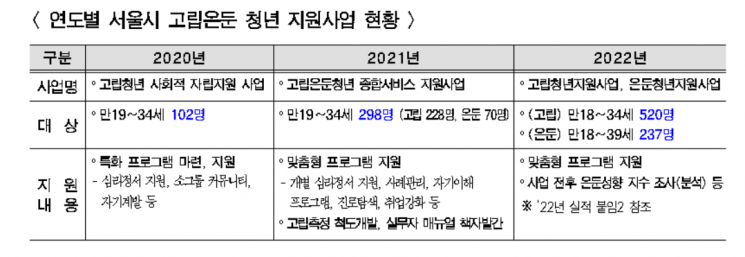
The main reasons for becoming isolated or reclusive were most frequently ‘job loss or difficulty finding employment (45.5%)’, followed by ‘psychological or mental difficulties (40.9%)’, and ‘difficulty in forming human relationships such as talking or engaging in activities with others (40.3%)’.
In particular, isolated and reclusive youth experienced more negative events around adulthood compared to the average Seoul youth. Before adulthood, experiences included ‘someone in the family having emotional difficulties (62.1%)’, ‘sudden worsening of family financial situation (57.8%)’, and ‘being bullied or ostracized by acquaintances (57.2%)’. After adulthood, they mainly faced experiences related to employment failure, such as ‘not getting a job at the desired time (64.6%)’ and ‘not entering the desired workplace (60.7%)’.
Meanwhile, 55.6% of isolated and reclusive youth were found to rarely go out and mainly live at home. The duration of such lifestyle was reported as ‘1 year to less than 3 years (28.1%)’, ‘3 years to less than 5 years (16.7%)’, and ‘10 years or more (11.5%)’, indicating that the proportion of youth with reclusive lifestyles lasting over 5 years is also very high at 28.5%.
Among isolated·reclusive youth, 64.7% responded that their household’s socioeconomic status was lower than average, which is more than twice the 31.4% response rate among general youth. Additionally, their personal economic status was reported as ‘very insufficient (51.6%)’ and ‘somewhat insufficient (33.5%)’, showing a significant difference compared to general youth (15.2% and 35.6%, respectively).
Isolated·reclusive youth reported poor physical health at a rate of 43.2%, more than three times higher than the 14.2% among general youth. Furthermore, 18.5% of isolated and reclusive youth reported taking medication related to mental health, more than twice the 8.6% among general youth. Among isolated and reclusive youth, 8 out of 10 experienced ‘depression at a mild level or higher (with 57.6% at moderate or severe levels)’, confirming the need for support policies linked to depression prevention, diagnosis, and treatment.
Regarding whether they have ever felt the desire to escape from isolation·reclusion, more than half (55.7%) answered ‘yes’, and over 43% reported having actually attempted to escape. The attempts included ‘hobby activities (31.1%)’, ‘work or study (22.0%)’, ‘hospital diagnosis and treatment (15.4%)’, and ‘psychological counseling (10.2%)’ in that order.
As for the support measures needed by isolated and reclusive youth, ‘financial support (57.2%)’ was the highest, followed by ‘activities such as hobbies and exercise (44.7%)’, ‘job or study opportunities (42.0%)’, and ‘psychological counseling (36.8%)’.
Additionally, for families with isolated·reclusive youth children, the most needed support measures were ‘programs to understand isolation and reclusion (22.4%)’ and ‘family counseling between parents and children (22.1%)’, indicating that families mainly hope for counseling or education to understand and communicate with their isolated and reclusive youth children.
Meanwhile, based on these survey results, Seoul plans to design and implement support policies with practical programs for isolated and reclusive youth. First, Seoul intends to sign a business agreement with a top-tier university hospital in the country, which will provide a foundation to transform the previously counseling-dependent isolation and reclusion projects into scientific and systematic programs. Second, based on this, the projects will be integrated and advanced within youth mental health policies. Third, Seoul plans to operate a comprehensive control tower, tentatively named the Mental Health Vision Center, to provide total care for isolated and reclusive youth. The center will offer continuous follow-up management, project performance evaluation, and expert consultation in a one-stop service.
Under this direction, Seoul will design projects incorporating the survey results and prepare and implement a comprehensive support plan by March.
Kim Cheol-hee, head of Seoul’s Future Youth Planning Group, stated, “As social problems related to isolated and reclusive youth have become serious, delicate policy design centered on the affected individuals has become necessary. Accordingly, Seoul conducted the nation’s first actual condition survey and secured meaningful results.” He added, “Now, we will prepare support measures that can provide real help to isolated and reclusive youth, enabling them to return to society and enjoy a safe and comfortable life by offering concrete projects.”
© The Asia Business Daily(www.asiae.co.kr). All rights reserved.
![Clutching a Stolen Dior Bag, Saying "I Hate Being Poor but Real"... The Grotesque Con of a "Human Knockoff" [Slate]](https://cwcontent.asiae.co.kr/asiaresize/183/2026021902243444107_1771435474.jpg)
















