Promotion of Local Brand Commercial Area Development Project
[Asia Economy Reporter Kiho Sung] The Seoul Credit Guarantee Foundation presented comprehensive policy guidelines for revitalizing commercial districts through the study "Directions for Fostering and Developing Local Brand Commercial Districts for Alley Economy Revitalization" on the 18th. The study outlined the basic directions, specific implementation strategies, and evaluation model construction for Seoul's local brand commercial districts.
This study was conducted to propose desirable policy directions and specific implementation strategy guidelines for the "Local Brand Commercial District Fostering Project," jointly promoted by the Foundation and Seoul City. The Local Brand Commercial District Fostering Project is a key initiative of the "Seoul Alley Economy Revival Project," aimed at developing promising alley commercial districts into representative commercial districts of Seoul. As value- and experience-based consumption culture takes root across society, the project supports alley commercial districts in Seoul with unique content and distinctive brands to become more competitive commercial districts through a three-year support program involving networks among commercial districts, Seoul City, autonomous districts, and the Foundation. Last year, the Foundation successfully carried out the first phase of the foundational project and won the grand prize in the "Alley Economy Recovery Support Project Best Practice Contest" hosted by the Ministry of the Interior and Safety.
This study established the basic directions for creating local brand commercial districts that embody the values of neighborhood, relationships, and consumption, and derived 24 detailed strategies to provide a systematic guideline for revitalizing local brand commercial districts. First, the basic directions for fostering local brand commercial districts were set as ▲ rediscovering neighborhood commercial districts through local content-based branding (value of the neighborhood), ▲ forming a creative small business ecosystem by strengthening networks (value of relationships), and ▲ increasing citizens' local consumption value (value of consumption).
The first detailed strategy for "rediscovering neighborhood commercial districts" includes building brand stories through local resource surveys and encouraging industry specialization based on commercial district characteristics. The second, "forming a creative small business ecosystem," proposes supporting local content projects through collaboration among small business owners, assisting new small business owners in settling in commercial districts, and establishing continuous communication bases by forming sector-specific committees of stakeholders within the commercial district. Lastly, to "increase citizens' consumption value," detailed strategies include marketing events that encourage the use of small business stores, hosting unique events utilizing stay spaces within commercial districts, and creating shared parking space programs.
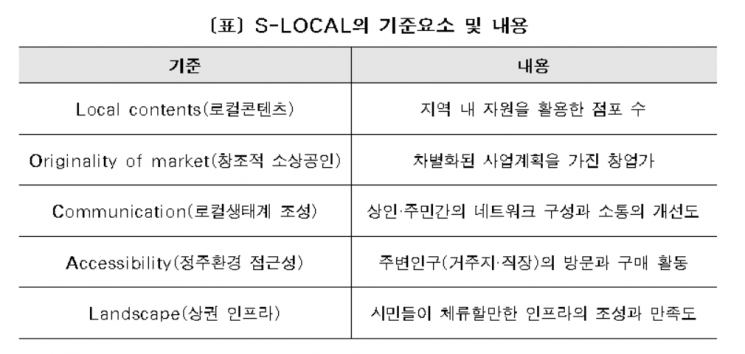
Additionally, to continuously expand the achievements of the local brand commercial district fostering project, an independent monitoring system reflecting the characteristics of local brand commercial districts, called the "Seoul-type Local Brand Commercial District Evaluation Model (S-LOCAL)," was developed. The S-LOCAL model selected evaluation factors that local brand commercial districts, differentiated from general alley commercial districts, should maintain and strengthen: local content, creative small business owners, local ecosystem formation, commercial district accessibility, and commercial district infrastructure.
Based on the S-LOCAL model, the Foundation proposed diagnosing commercial districts to identify their potential and weaknesses, setting Key Performance Indicators (KPIs) according to individual commercial district conditions, and establishing revitalization strategies that maximize strengths and complement weaknesses.
Based on these research results, the Foundation presented the core policy directions for Seoul City's local brand commercial district fostering project to create commercial districts where citizens want to stay and small business owners want to operate: ▲ strengthening the capabilities of small business owners as active agents of commercial district revitalization rather than mere support targets, ▲ enhancing mutual bonds between citizens and small business owners, and ▲ securing continuous commercial district diagnosis, monitoring, administrative support, and institutional foundations.
Jucheol Su, Chairman of the Seoul Credit Guarantee Foundation, said, "Through this research, we have prepared measures to systematically carry out Seoul City's local brand commercial district revitalization project." He added, "Amid the prolonged COVID-19 pandemic and the triple crisis of high interest rates, high prices, and high exchange rates, which have made the economic situation increasingly difficult for small business owners, we will continue to support self-employed and small business owners to conduct more stable business activities through commercial district revitalization projects."
Kang Incheol, Seoul City Commercial District Revitalization Officer, said, "Last year, we took steps to foster attractive alley commercial districts into representative commercial districts of Seoul, and it is significant that this study proposed the Seoul-type Local Brand Commercial District Evaluation Model reflecting diverse voices from the field." He added, "This year, the commercial districts, Seoul City, autonomous districts, and Seoul Credit Guarantee Foundation will jointly promote the second phase of the local brand commercial district fostering project, actively incorporating these research results into commercial district revitalization policies to revive alley commercial districts facing difficulties."
© The Asia Business Daily(www.asiae.co.kr). All rights reserved.

















