Ministry of Land, Infrastructure and Transport Establishes 'Railway Safety Enhancement Measures'
[Asia Economy Reporter Noh Kyung-jo] The Korea Railroad Corporation (KORAIL) work system will revert from a 4-team 2-shift system to a 3-team 2-shift system. Mid-level and new employees will be evenly distributed in stations with heavy workloads, and manpower-centered tasks will be converted to a smart maintenance system.
The Ministry of Land, Infrastructure and Transport announced on the 17th that it has established a "Railroad Safety Enhancement Plan" to prevent the recent surge in recurring railroad accidents and drastically reduce accidents.
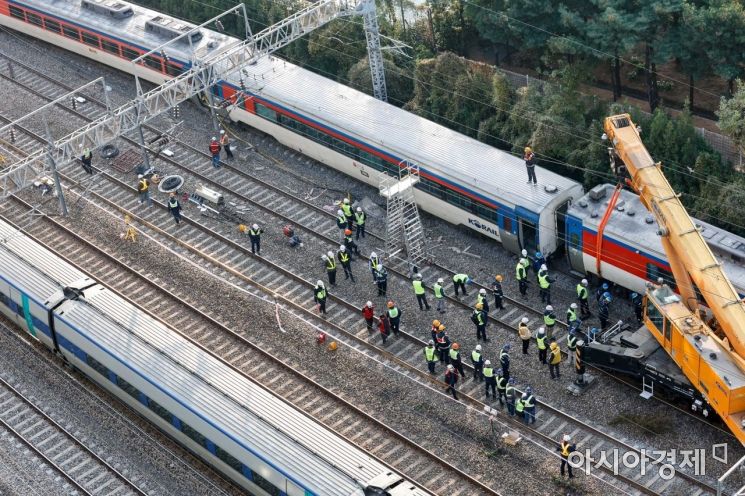 The railway near Yeongdeungpo Station in Seoul where the Mugunghwa train derailment accident occurred. / Photo by Jinhyung Kang aymsdream@
Looking at railroad accidents that occurred last year, KTX and others derailed three times, and four KORAIL workers died. There was also an incident where a subway train on Seoul Metropolitan Subway Line 1 stopped for two hours on the Hangang Bridge. As public anxiety about railroad safety grew, strong countermeasures were demanded.
Accordingly, the Ministry of Land, Infrastructure and Transport prepared measures through meetings with railroad safety experts and plans to announce detailed contents of the top 10 major tasks later. Key tasks include inspection and improvement of the safety management system, automation of vehicle arrangement, and securing track work time.
The ministry previously issued a corrective order to KORAIL to revert to the 3-team 2-shift work system. To change to the 4-team 2-shift system, procedures such as safety evaluations must be followed and approval from the ministry obtained. KORAIL has been piloting the 4-team 2-shift system since January 2020, with an adoption rate of 91-92%, effectively switching the work system. However, resistance from the KORAIL labor union against reverting to the 3-team 2-shift system is expected to cause difficulties.
At busy stations such as Obong Station, mid-level and new employees will be evenly assigned, and middle managers will be placed in charge of field responsibilities such as deputy stationmasters and station service team leaders. Additionally, new metropolitan railroad drivers will operate trains only after becoming familiar with the field such as tracks, passing through the role of subway conductors who open and close doors.
Additional work time will be secured as "basic 3 hours 30 minutes + α," considering field conditions such as difficulty and equipment movement time. Inspections requiring accuracy, such as checking microcracks in track switch rails, will be conducted during daytime. A "track grading system" that differentiates inspection and maintenance standards based on train operation speed and density (pass-through tonnage) will also be introduced next year.
In the second half of this year, a "Smart Maintenance Master Plan" will be established to automate overall manpower-centered tasks. The number of ultrasonic inspection vehicles (from 1 to 3) and inspection devices (from 70 to 85) that detect internal track defects early will be expanded, and advanced equipment such as rail grinders (2 units) and grinding machines (18 units), which can extend track usage by up to 33% through rail grinding, will be procured by 2025.
Strengthening the real-name system for maintenance, creating an operational history database (DB) covering all stages of railroad facilities, and other measures will also be promoted. Closed-circuit television (CCTV) will be installed to restrict drivers' mobile phone use in the driver's cabin, and further alternatives will be derived by comprehensively reviewing cases from other fields such as aviation and shipping, as well as overseas examples through research projects.
The ministry plans to discuss with the Ministry of Economy and Finance and KORAIL the establishment of a safety vice president at KORAIL to integrate and operate an independent safety organization. Additionally, control functions will be integrated and emergency response capabilities strengthened. To this end, control functions scattered across 109 stations will be centralized by 2027 when the second control center operates. A pilot will be introduced at Jecheon Station to verify control functions during emergencies and gradually transfer them.
Oh Myung-so, the 2nd Vice Minister of the Ministry of Land, Infrastructure and Transport, said, "We will continuously monitor the implementation status to ensure that this railroad safety enhancement plan takes root in the field," adding, "We will do our best to prevent railroad safety accidents that threaten the lives and safety of the public."
© The Asia Business Daily(www.asiae.co.kr). All rights reserved.

















