The Busiest Congestion on the 22nd-23rd Due to Homecoming and Return Trips
Traffic Volume Surges During the Holiday Period... Beware of Traffic Accidents
[Asia Economy Reporter Yoon Seul-gi] As the Lunar New Year holiday approaches, a total of 26.48 million people are expected to participate in the homecoming rush during the holiday period. Most are predicted to travel by passenger car, and since traffic volume will surge during the holiday, increasing the risk of accidents, caution is necessary.
According to the Korea Transport Institute, a total of 26.48 million people, averaging 5.3 million per day, are expected to travel during this Lunar New Year holiday. Although the holiday period is one day shorter than last year’s Lunar New Year, the number of travelers is estimated to increase by 2.1%, and the average daily number of travelers by 22.7%, due to the recovery of daily life after COVID-19.
The most congested days will be the Lunar New Year day itself, the 22nd, and the afternoon hours (2?3 p.m.) on the 23rd, when homebound and returning travelers converge.
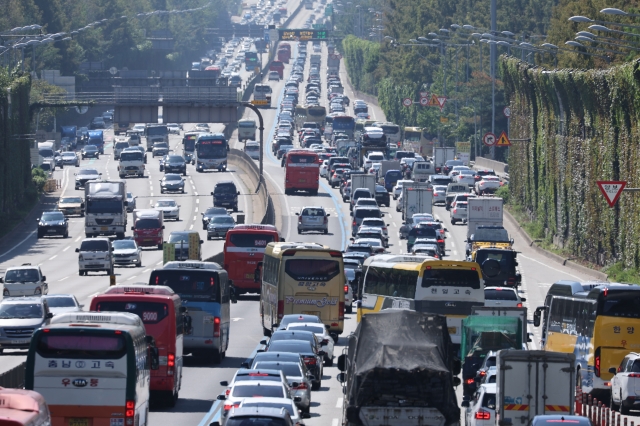 On the 8th, a day before the Chuseok holiday in September last year, vehicles heading southbound on the Gyeongbu Expressway near Jamwon IC in Seocho-gu, Seoul, were experiencing traffic congestion. Photo by Yonhap News
Most people are expected to choose passenger cars (91.7%) as their mode of transportation, followed by buses (3.8%), railways (3.0%), and air travel (1.1%). The average daily number of vehicles using highways is estimated at about 5.19 million, which is a 23.9% increase compared to last year and a 21% increase compared to the weekends of last December.
When traveling home by passenger car, the maximum highway travel times are ▲Seoul to Daejeon: 5 hours ▲Seoul to Busan: 8 hours 40 minutes ▲Seoul to Gwangju: 7 hours 40 minutes ▲Seoul to Mokpo: 8 hours 30 minutes ▲Seoul to Gangneung: 5 hours 20 minutes. For returning trips, the times are ▲Daejeon to Seoul: 4 hours 15 minutes ▲Busan to Seoul: 8 hours 15 minutes ▲Gwangju to Seoul: 6 hours 35 minutes ▲Mokpo to Seoul: 6 hours 55 minutes ▲Gangneung to Seoul: 4 hours 30 minutes.
As daily traffic volume increases during the Lunar New Year holiday, safety precautions are also necessary. On the 17th, the Ministry of the Interior and Safety analyzed the Road Traffic Authority’s Traffic Accident Analysis System (TAAS) and found that the period with the highest number of traffic accidents around the Lunar New Year holiday is the day before the holiday begins, with 748 accidents occurring?about 1.3 times the recent five-year daily average of 589. The peak time for accidents was around 6 p.m.
Winter roads require particular caution. Black ice, which forms when rain or melted snow refreezes on the road, and road icing increase the risk of traffic accidents. It is safer to reduce speed when driving on bridges, underpasses, tunnel entrances and exits, slopes, and shaded roads. During the holiday period, the proportion of traffic accidents and casualties caused by drunk driving also rises compared to usual, so even one drink should be enough reason not to get behind the wheel.
Meanwhile, to facilitate smooth travel for homebound and returning travelers, the government will waive toll fees for all vehicles using highways for four days starting from the 21st. Additionally, to ensure safe and convenient travel for the public, the government has designated the five days from the 20th to the 24th as the “Lunar New Year Holiday Special Traffic Measures Period” and will implement a joint government special traffic plan.
© The Asia Business Daily(www.asiae.co.kr). All rights reserved.
![Clutching a Stolen Dior Bag, Saying "I Hate Being Poor but Real"... The Grotesque Con of a "Human Knockoff" [Slate]](https://cwcontent.asiae.co.kr/asiaresize/183/2026021902243444107_1771435474.jpg)
















