BOJ's Record Bond Purchases Amid Interest Rate Hikes
Market Mostly Expects Current Policy to Continue
Fiscal Burden May Lead to Wider Interest Rate Fluctuations
Outgoing Kuroda May Take Bold Step to Scrap YCC
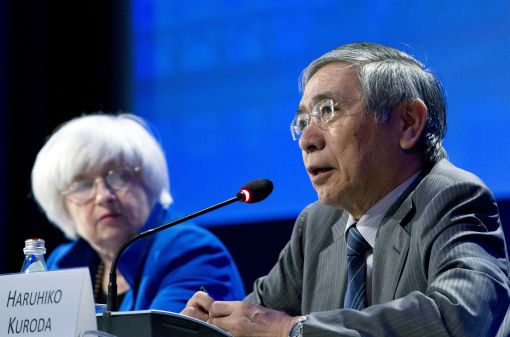 Haruhiko Kuroda, Governor of the Bank of Japan (BOJ) (photo right).
[Asia Economy Reporter Lee Ji-eun] Japan's 10-year government bond yield has surpassed the Bank of Japan's (BOJ) long-term interest rate tolerance level of 0.5% for three consecutive trading days, drawing investors' attention to the direction of Japan's monetary policy meeting held from the 17th. While most experts expect the current stance to be maintained, there are also forecasts that the BOJ might increase the interest rate fluctuation range or completely abandon unlimited government bond purchases, as it did last month.
According to the Nihon Keizai Shimbun, the 10-year government bond yield in the Japanese bond market briefly surged to 0.507 during the day. The BOJ's allowed fluctuation range for long-term interest rates is 0.5%, but this was exceeded. The BOJ decided at last month's monetary policy meeting to raise the allowable fluctuation range for the 10-year bond yield from ±0.25% to ±0.5%.
Although a month has passed since the BOJ's decision, the market is betting on the possibility of changes in Japan's monetary policy. At that time, BOJ Governor Haruhiko Kuroda said the measure was taken to correct distortions in the bond market and dismissed the possibility of tightening. However, the Japanese bond market is moving contrary to his words. Foreign investors are heavily short-selling government bonds, judging that Japan's financial policy is likely to shift toward a tightening stance in the future. Currently, the market is uncertain whether the BOJ can maintain its Yield Curve Control (YCC) policy, which involves large-scale government bond purchases to keep interest rates at a certain level.
As the authorities' and market's outlooks diverge, the BOJ's interest rate defense has lost effectiveness. When the 10-year government bond yield soared due to foreign investors' short-selling, the BOJ purchased government bonds worth 5.083 trillion yen (approximately 48 trillion won) on the 13th to defend the interest rate. This is the largest amount ever injected by the BOJ in a single day. Nihon Keizai reported that the total amount the BOJ spent on government bond purchases in January reached 17 trillion yen, surpassing the 16.2038 trillion yen spent in June. However, despite the BOJ's aggressive purchases, the 10-year government bond yield remained above the 0.5% level on the 17th.
◆Inflation Target Not Reached... Status Quo Expected
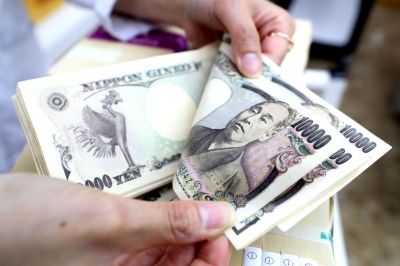
However, most experts expect that the direction of Japan's monetary policy announced on the 18th will not deviate significantly from the existing stance. According to a Bloomberg survey conducted on the 13th targeting 43 economists, 42 experts answered that the BOJ would not revise its policy at this monetary policy meeting. Additionally, 38% of the experts predicted that any policy change would likely occur in April, when Governor Kuroda's term ends.
What they are watching closely is the inflation rate. Although the nationwide consumer price index rose by 2.7% in November last year, marking the largest increase in 40 years and 11 months, unless the inflation rate consistently stays in the 2% range, changes in monetary policy or the abolition of the YCC policy are still considered distant prospects.
Matsuzawa Naka, Senior Macro Strategy Analyst at Nomura Securities, stated, "Reaching a sustainable inflation rate in the 2% range means that there is no longer a need for negative interest rate policy. However, it is almost impossible to adjust monetary policy now to reach this level."
Nihon Keizai also cited an anonymous source related to the BOJ, saying, "The core consumer price index is expected to be between 1.6% and 2% this year, and it will likely rise to nearly 2% only in the 2024 fiscal year." Furthermore, there is analysis that the Japanese financial market has not yet fully absorbed the effects of the partial monetary policy adjustment made last month, so the BOJ is expected to maintain a wait-and-see stance.
◆BOJ Holds Over 50% of Government Bonds, May Increase Long-term Interest Rate Fluctuation Range
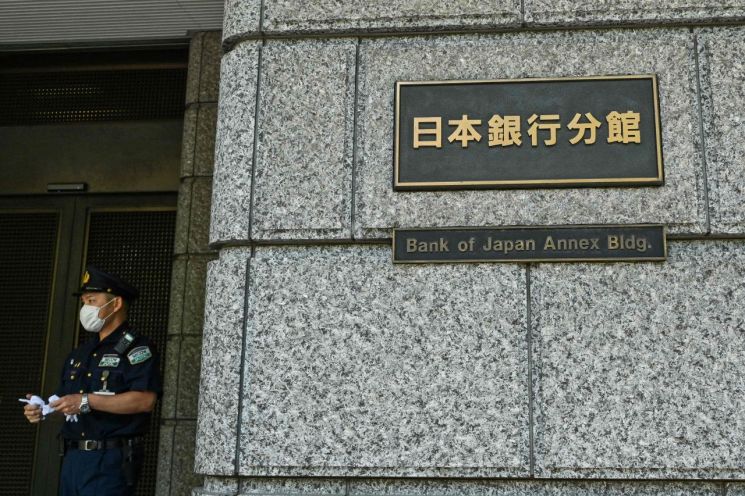
However, the fact that the BOJ is purchasing government bonds without limit to defend interest rates is a concern. Currently, the BOJ holds about half of all issued government bonds, and there is analysis that it may partially revise the YCC policy to reduce the burden arising from this.
The funds paid by the Bank of Japan to financial institutions for government bond purchases have accumulated in current accounts that financial institutions hold at the BOJ, reaching a staggering 470 trillion yen (approximately 4590 trillion won). The Asahi Shimbun warned, "If interest rates rise by 1%, the principal and interest on government bonds that the BOJ must pay to financial institutions in 2025 will increase by 3.7 trillion yen (approximately 36 trillion won) compared to current estimates."
Accordingly, economists predict that the BOJ may raise the allowable fluctuation range of the 10-year government bond yield to 0.75% or even 1% at this monetary policy meeting to alleviate the burden caused by the increase in government bond holdings.
◆Outgoing Governor Kuroda... Possibility of Strong Move to Abolish YCC
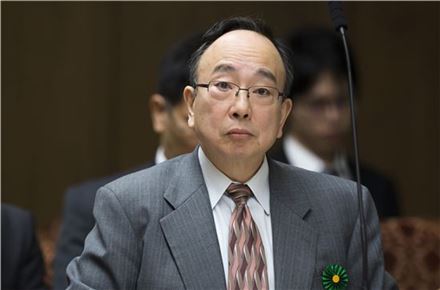 Masayoshi Amamiya, BOJ Deputy Governor, who is being mentioned as the next Governor.
Besides these forecasts, there is also speculation that the BOJ might take a bold step to completely abolish the YCC policy. Governor Kuroda, who is about to retire, may take responsibility to ease the burden on his successor.
Murashima Kichi, Economist at Citigroup, explained, "If the successor governor is to freely operate monetary policy from April, it might be advantageous for Governor Kuroda to make a significant decision."
Priya Misra, Investment Strategist at TD Securities, also emphasized, "With the opening of Pandora's box due to the BOJ's monetary policy revision, the global financial environment is undergoing significant changes, making it very difficult for the BOJ to suppress interest rate hikes. The market needs to raise the upper limit of the 10-year bond yield fluctuation range to 1% until Governor Kuroda retires."
© The Asia Business Daily(www.asiae.co.kr). All rights reserved.
!["The Woman Who Threw Herself into the Water Clutching a Stolen Dior Bag"...A Grotesque Success Story That Shakes the Korean Psyche [Slate]](https://cwcontent.asiae.co.kr/asiaresize/183/2026021902243444107_1771435474.jpg)

















