Ahead of Official Statistics Release
Experts in Population and Economy Forecast Last Year's 'Net Decline'
Unified Call for Social Security System Reform
[Asia Economy Beijing=Special Correspondent Kim Hyunjung] It has been projected that China's population peaked and entered a full-fledged decline last year. As low birth rates and aging progress rapidly, voices are calling for the overhaul of social security systems such as the pension system.
On the 17th, Chinese local economic media Jiyeol Jaegyeong cited remarks from experts in population and economic fields, reporting that China's population has passed its peak and entered a net decline era last year. China's population increased by 480,000 in 2021, reaching about 1.413 billion at its peak, after which the number of deaths began to exceed births. The National Bureau of Statistics of China is scheduled to announce the official population figures at the national economic operation press conference held on the same day.
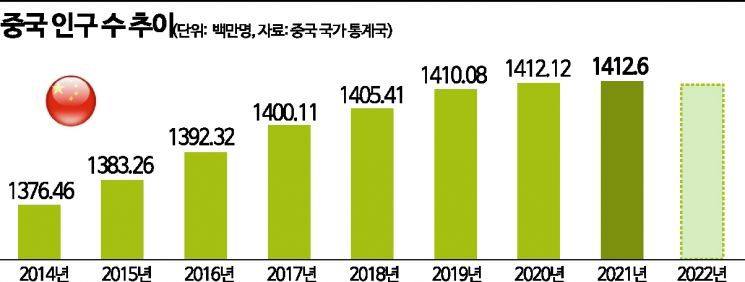
According to the report, Cai Fang, a prominent Chinese demographer and former vice president of the Chinese Academy of Social Sciences, recently stated at the launch event of the China Pension Development Report 2022 that China's total population likely passed its peak last year. Professor Chen Wei of the Population Development Research Center at Renmin University also predicted that China's population growth and aging trends indicate that negative population growth began last year and will accelerate step by step. It was already recorded that in 2021, 13 provinces including Jiangsu, Hubei, Hunan, and Shanxi experienced a natural population growth rate turning negative. Professor Chen said, "In recent years, social concepts regarding marriage have changed significantly, and the spread of COVID-19 has led to a decline in birth rates," adding, "As a result, the net population decline has arrived 5 to 10 years earlier than previously forecast."
Earlier, Chinese demographer He Yafu predicted that the number of newborns in China would fall below 10 million for the sixth consecutive year last year, marking the lowest level since the founding of the People's Republic of China in 1949. Dr. He also analyzed that during the pandemic, most people hesitated to marry and conceive, and the zero-COVID policy reduced government support for childcare costs.
Calls for active government policy responses to negative population growth are also increasing. Former Vice President Cai argued, "China's stage of economic development and demographic transition have entered a new era," emphasizing, "Faster and more severe aging requires adjustments to social security services such as pensions and elderly care." He added, "In the future, the shortage of pension resources will become more prominent," and "Consumption may also suppress China's economic growth, posing new challenges to Chinese society."
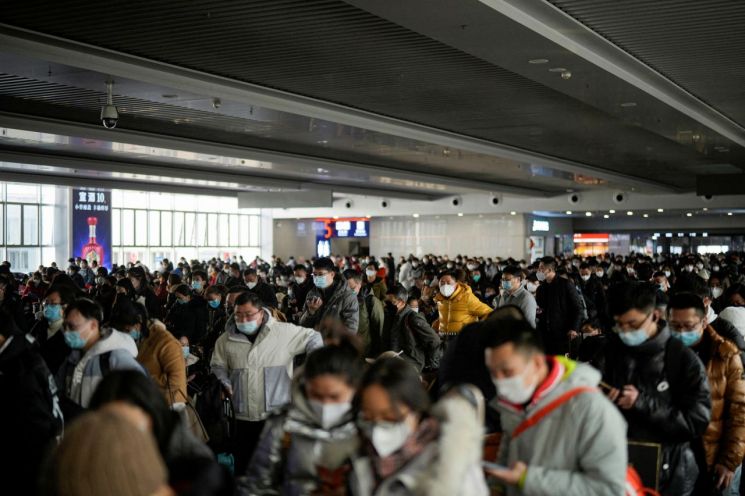
According to data from the National Bureau of Statistics, China's working-age population aged 16 to 59 peaked at 925 million in 2011 and has been declining since 2012. As of the end of 2021, the working-age population was 882 million, accounting for 62.5% of the total population. During the same period, rapid aging caused the national dependency ratio of elderly people aged 65 and over to exceed 20% for the first time in 2021 (20.8%). This means five young people must support one elderly person.
Associate Professor Sun Yongyong of the Graduate School of Administration at Central China Normal University emphasized, "The core measure is to reform the pension insurance system in advance," adding, "It is necessary to strengthen the financial foundation, expand the coverage of corporate pensions, and hasten the establishment of a personal pension system." He particularly explained, "The most serious current problem is the sustainability of the pension system," and stressed the need for managing income and expenditure and expanding reserves. Tang Jisong, vice president of the China Social Insurance Society, argued, "Nationwide integration of basic old-age insurance should be implemented, and the retirement age should be gradually delayed," urging, "The low (7%) old-age insurance enrollment rate must be raised, and companies should consider more active participation."
© The Asia Business Daily(www.asiae.co.kr). All rights reserved.


















