Enforcement of the Amendment to the Enforcement Decree and Rules of the Act on Transportation Vulnerable Persons
Seated Type to be Introduced in 2027... Excluding Intercity Buses
[Asia Economy Reporter Noh Kyung-jo] Starting from the 19th, when replacing aging city and village buses, as well as rural buses, low-floor buses that are convenient for transportation-vulnerable individuals must be mandatorily introduced.
The Ministry of Land, Infrastructure and Transport announced on the 17th that the revised Enforcement Decree and Enforcement Rules of the "Act on the Promotion of Mobility Convenience for Transportation-Vulnerable Persons" (Transportation-Vulnerable Act), which stipulate the mandatory introduction of low-floor buses and exception approval procedures when replacing or scrapping route buses, will be enforced from the 19th of this month.
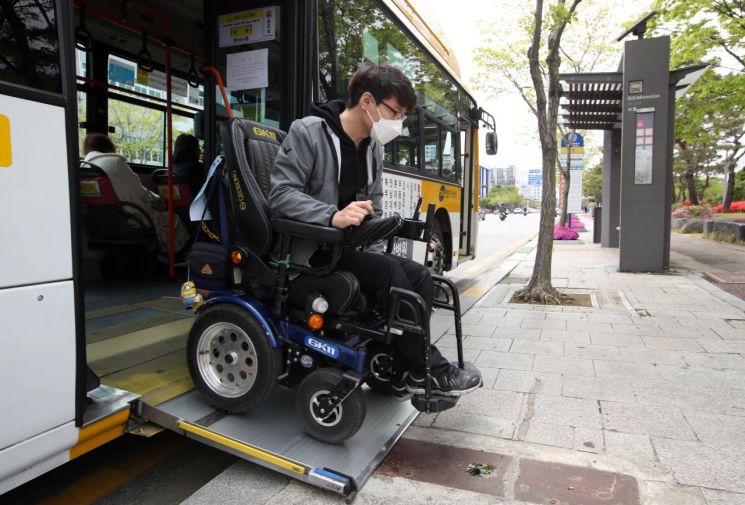
The revision defines the types of route buses that must introduce low-floor buses. These types include city and village buses, and rural buses. All route buses under the Passenger Transport Service Act, except for intercity buses (express, direct, and general types), must mandatorily introduce low-floor buses.
Intercity buses are required by the Passenger Transport Service Act to install cargo compartments underneath, so transportation support for vulnerable persons is provided through buses equipped with wheelchair boarding facilities (lifts). Among city and rural buses, the seated type is currently under development through national research and development (R&D), and its introduction will be mandatory from January 1, 2027.
The revision also includes criteria and procedures for recognizing exceptions to the introduction of low-floor buses. Exception approval is possible when ▲the height of road facilities such as bridges installed on the route is lower than that of low-floor buses ▲the road slope changes sharply causing friction under the low-floor bus ▲or other reasons related to road facilities or structures make it difficult to operate low-floor buses on the route.
Bus transport operators can apply for exception approval for low-floor bus introduction to the transportation administrative agency (local government) for each route. The transportation administrative agency receiving the application must decide on the exception within 40 days after consulting with corporations and organizations related to transportation-vulnerable persons and transportation experts.
Post-management procedures related to this are also prepared in the revision. Specifically, when approving an exception for low-floor bus introduction, the transportation administrative agency can notify the road management authority of the exception route and reasons, and request improvements to road facilities. Related agencies must comply with the request unless there are special circumstances.
Additionally, the transportation administrative agency must post and disclose the previous year's exception routes for low-floor bus introduction, reasons, and improvement plans on their official website by the end of January each year and submit them to the Ministry of Land, Infrastructure and Transport.
Kim Soo-sang, Director of the Transportation and Logistics Office at the Ministry of Land, Infrastructure and Transport, said, "With the mandatory introduction of low-floor buses, the introduction rate of low-floor buses in city buses nationwide will increase from about 30% in 2021 to 62% in 2026. The government will strengthen cooperation with local governments by securing and distributing sufficient subsidies for the smooth introduction of low-floor buses and actively promote the development of seated-type low-floor bus vehicles."
© The Asia Business Daily(www.asiae.co.kr). All rights reserved.

















