Targeting 44 Ministries... 'Subsidy Inspection Team' to be Formed This Month
Subsidies Soared Under Moon Administration... Increased by 42.7 Trillion Won in 6 Years
Amendment to Subsidy Act Also Planned... Accounting Audit Targets to Triple
[Asia Economy Sejong=Reporter Lee Jun-hyung] The government is establishing a ‘Subsidy Execution Inspection Task Force’ across all ministries. This decision comes from the judgment that the subsidy management system needs to be strengthened as the amount of national treasury subsidies significantly increased during the previous administration. The first subsidy inspection results from each ministry’s task force are expected to be revealed as early as March.
According to a comprehensive report from our coverage on the 17th, the Ministry of Economy and Finance held a kick-off meeting on the 6th to form the ‘Joint Subsidy Execution Inspection Task Force’ involving related ministries. The 44 ministries attending the meeting decided to individually form and operate their own subsidy execution inspection task forces within this month. Each ministry will organize a task force of about 5 to 6 members centered around their Planning and Coordination Office and report subsidy inspection results quarterly to the joint task force.
Joint Task Force Inspection Meeting in March
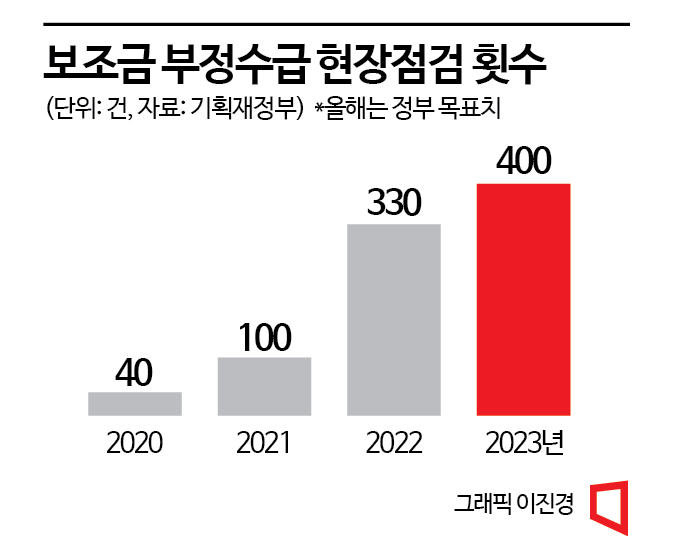
The Ministry of Economy and Finance plans to hold the first joint task force inspection meeting at the end of March. The joint task force will comprehensively review cases of fraudulent subsidy claims detected by each ministry’s task force. The number of on-site joint subsidy inspections led by the Ministry of Economy and Finance will increase from 330 cases last year to 400 cases this year. These inspections focus on monitoring subsidy execution information and intensively investigating projects showing signs of fraudulent claims. Two years ago, in 2021, on-site inspections were only about 100 cases annually.
The government’s decision to individually establish subsidy execution inspection task forces in all ministries stems from the judgment that the existing subsidy management system was inadequate. Initially, all procedures related to subsidy execution were handled solely by the relevant ministry’s project department, but this created blind spots in subsidy management such as detecting and recovering fraudulent claims. A government official explained, “There was a lack of self-inspection efforts at the ministry level for subsidy execution,” adding, “(Especially) project departments conducted self-inspections for only one or two days, mostly to handle cases detected by whistleblowers or audit institutions afterward.”
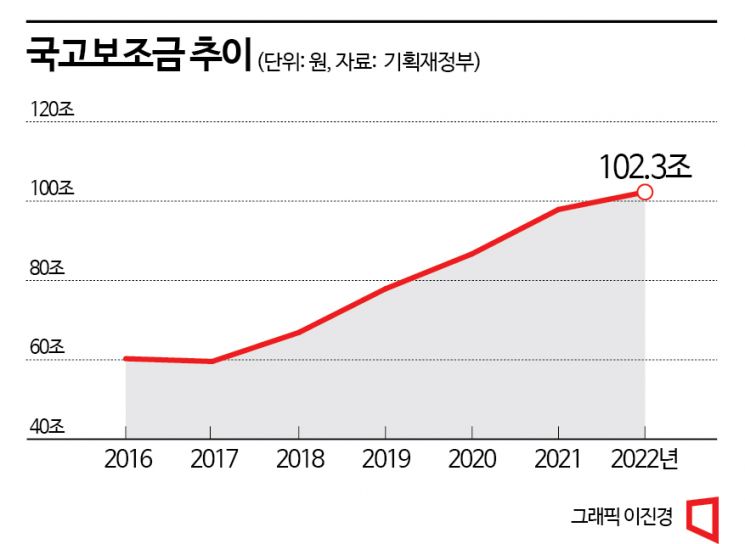
The rapid increase in subsidy scale during the previous administration is the fundamental reason why the subsidy management system is undergoing reform. According to the Ministry of Economy and Finance, the amount of subsidies paid surged about 71.6% from 59.6 trillion won in 2017, when the Moon Jae-in administration began, to 102.3 trillion won last year. During the five years of the Moon Jae-in administration, subsidies paid to non-profit private organizations such as civic groups alone amounted to approximately 22.5 trillion won.
Repeated Controversies over Fraudulent Claims
As the subsidy scale increased sharply, controversies over fraudulent claims also grew. Cases where subsidies were used for political purposes rather than the original project goals were repeatedly exposed. According to an investigation by the Presidential Office, the amount of subsidies detected as fraud during the five years of the Moon Jae-in administration reached 235.2 billion won. In this regard, President Yoon Suk-yeol instructed a complete overhaul of the subsidy management system at the end of last year, stating, “If taxpayers’ money was used for their exclusive interest cartels, the public will not tolerate it.”
This is why the Ministry of Economy and Finance has even moved to amend the Subsidy Act. The ministry plans to support the passage of the amendment to the Subsidy Management Act, originally proposed by People Power Party lawmaker Song Eon-seok in 2020. The main point of the amendment is to lower the threshold amount for external verification of subsidy recipients, aiming for the next extraordinary session of the National Assembly.
If the bill passes as planned by the Ministry of Economy and Finance, the number of subsidy recipients subject to mandatory accounting audits is expected to nearly triple. The amendment includes lowering the annual total subsidy amount requiring submission of audit reports from the current 1 billion won to 300 million won. As of 2019, private entities receiving subsidies of 300 million won or more annually include 2,007 non-profit corporations and 1,871 for-profit corporations, about 2.8 times more than the 1,394 entities receiving 1 billion won or more.
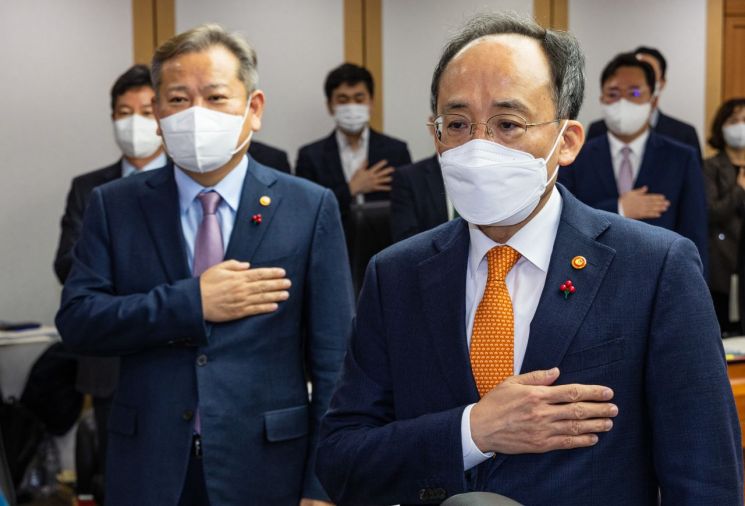 Economic Deputy Prime Minister and Minister of the Interior and Safety Saluting the National Flag
(Seoul=Yonhap News) Photo by Hwang Kwang-mo = On the morning of the 13th, Chu Kyung-ho, Economic Deputy Prime Minister and Minister of Economy and Finance (front), and Lee Sang-min, Minister of the Interior and Safety, attended the 2023 Central-Local Policy Council and Expanded Metropolitan and Provincial Economic Council held at the Government Seoul Office in Jongno-gu, Seoul, saluting the national flag. 2023.1.13
hkmpooh@yna.co.kr
(End)
<Copyright(c) Yonhap News Agency, Unauthorized reproduction and redistribution prohibited>
© The Asia Business Daily(www.asiae.co.kr). All rights reserved.



















