Cool Japan Support Fund Runs Deficit for 10 Years
Started Under Abe Administration, Localization Policy Failure
[Asia Economy Reporter Jeon Jin-young] The Japanese government's 'Cool Japan' policy, which was promoted by benchmarking Korea's Hallyu success, is reportedly facing an existential crisis due to poor performance. Although it has been promoted for the past 10 years to showcase Japan's 'cool' appeal to the world, the cumulative deficit has exceeded 1 trillion Korean won, drawing cold reactions even within Japan.
On the 16th, Nihon Keizai Shimbun (Nikkei) reported that the cumulative deficit of the public-private partnership fund supporting Cool Japan has reached 106.6 billion yen (1.031 trillion won), stating that the Cool Japan policy has failed to produce significant results and is effectively on the brink of extinction.
Cool Japan was a policy promoted with the launch of the second Abe Shinzo administration in December 2012. Its purpose was to promote Japanese animation, food, tourism, and more to the world, similar to Hallyu. Former Prime Minister Abe emphasized in his first policy speech, "Let's make Cool Japan a business to proudly showcase to the world."
Although the term 'Cool Korea' is not popularly used in Korea, Japanese media say that Cool Japan was inspired by Cool Korea. It refers to the process in the 1990s when the Korean government and private sector jointly led the Hallyu wave. Nikkei explained, mentioning Cool Korea, "In Korea, through the popularity of actors in movies and dramas, fashion and cosmetics have been introduced, ultimately leading to an enhancement of the national image."

Uncool Performance... Consecutive Investment Failures
The Japanese government created a fund to support Cool Japan with 10.7 billion yen (103.4 billion won) from the state and 30.9 billion yen (298.8 billion won) from private companies. However, the fund's performance is alarming. According to a Japanese online economic media outlet, as of November last year, 130.9 billion yen (1.266 trillion won) was invested in 56 projects, but most of them failed.
A representative failure case is 'Isetan The Japan Store.' It was the opening of the Japanese department store Isetan in Kuala Lumpur, the capital of Malaysia, at the end of 2016. The fund invested 970 million yen (9.38 billion won), and Mitsukoshi Isetan Holdings' local subsidiary invested 1.01 billion yen (9.768 billion won) to open the store, but deficits only expanded, and after a year and a half, the fund sold all shares and withdrew from the local market. Nikkei analyzed, "The cause was pricing far removed from local living costs and product assortment." The sale price has not been disclosed, but there is speculation it was about half of the invested amount.
The Japanese Ministry of Economy, Trade and Industry also entered the film planning and development business, aiming to produce movies that would enter Hollywood using Japanese intellectual property (IP). They formed a public-private fund and planned to develop seven films, but so far not a single film has been released, and they continue to operate at a deficit every year.
In response, the Japanese Ministry of Finance notified last summer that "if results do not improve, consolidation will be considered," and according to the Tokyo Shimbun, meetings related to Cool Japan have not been held since September last year. However, the Cool Japan fund announced, "The organization is supposed to consider integration and abolition with other institutions as a response policy when results do not improve, but at this point, there are no plans for consolidation. We will steadily work on developing overseas demand that highlights the charm of Japanese lifestyle culture."
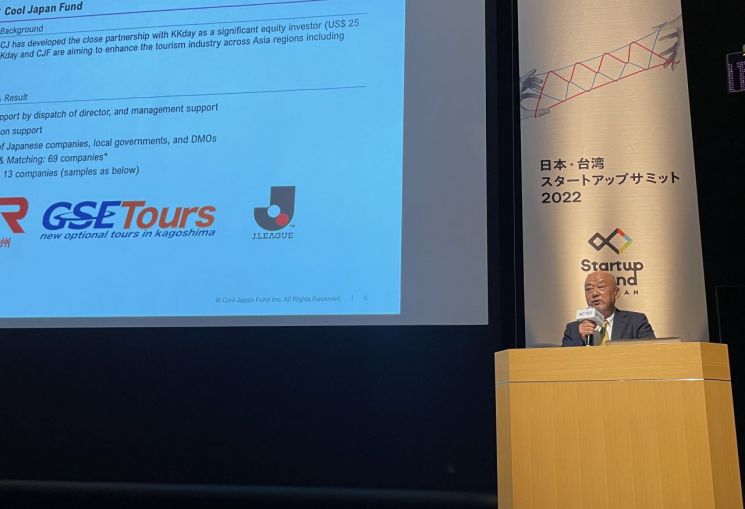 Kawasaki Kenichi, CEO of Cool Japan Fund, speaking at the 'Japan-Taiwan Startup Summit' in July last year. (Photo by Cool Japan official Twitter)
Self-reflection in Japan: 'Why is it different from Hallyu?'
Japanese media pointed to 'policy ambiguity' and 'arrogance about Japan' as reasons for Cool Japan's failure. Nikkei stated, "There is no consistent strategy in the Cool Japan fund's investment destinations. It has become ambiguous in nature as it focuses not only on cultural industries but also on food ingredient development and overseas distribution of Japanese products," and added, "Korea used a sophisticated strategy by spreading movies and music to promote actors and idols, attracting tourists, and ultimately enhancing the national image."
It continued, "In the UK and Korea, there was humility that it is difficult to conquer the world with what they currently have, so they focused on inviting talented leaders from abroad and assembling human resources. Japan has the mindset of 'Japan already has great things, just not well known.' Thinking that consumers will gather simply by promoting Japan is arrogance," it criticized.
Earlier, a Nikkei editorial pointed out that "In the film business, Korea basically leaves investment to the private sector, and the government succeeded by nurturing talent through opening film schools and organizing film databases," and "Korea is also skilled at cross-sectoral linkage, such as utilizing the international popularity of actors and idols to attract tourists," suggesting that cultural projects should be entrusted to the private sector rather than government-led.
However, some voices say it is premature to judge since global exchanges have been halted due to COVID-19. Professor Izuru Makihara of the Advanced Science and Technology Research Center at the University of Tokyo told the Tokyo Shimbun, "Due to the impact of COVID-19, it may not have reached the level of Hallyu, but there have been changes such as Japanese animation being recognized worldwide," and added, "However, it is necessary to verify whether the current policy structure is good as it is. The Abe administration promoted the policy strategically, but the current Kishida administration does not have the capacity to push it forward."
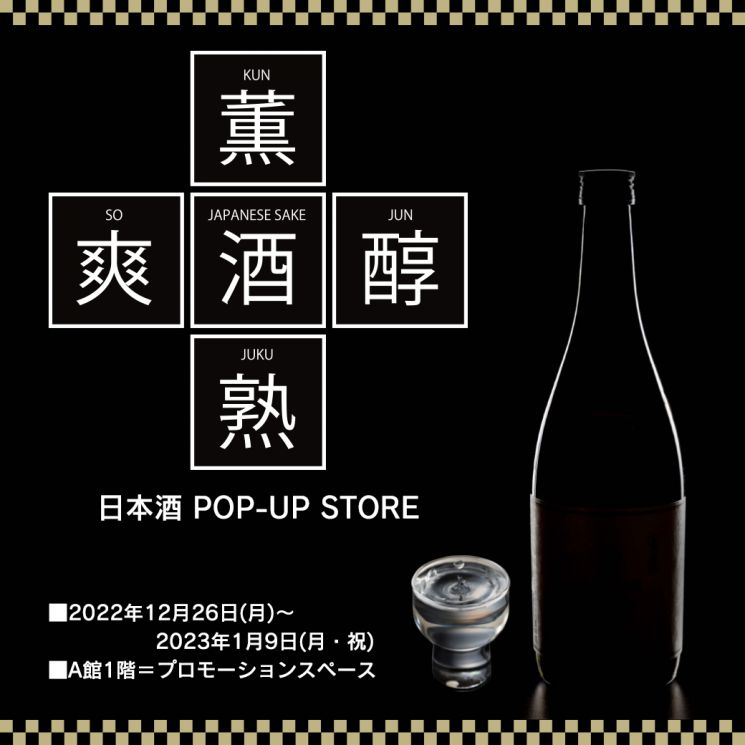 Poster for the Japanese Sake Pop-up Store held as part of the Cool Japan Fund support project. (Photo by Cool Japan official Twitter)
© The Asia Business Daily(www.asiae.co.kr). All rights reserved.
![Clutching a Stolen Dior Bag, Saying "I Hate Being Poor but Real"... The Grotesque Con of a "Human Knockoff" [Slate]](https://cwcontent.asiae.co.kr/asiaresize/183/2026021902243444107_1771435474.jpg)


















