Kyeongsilryeon Regional Medical Disparity Report
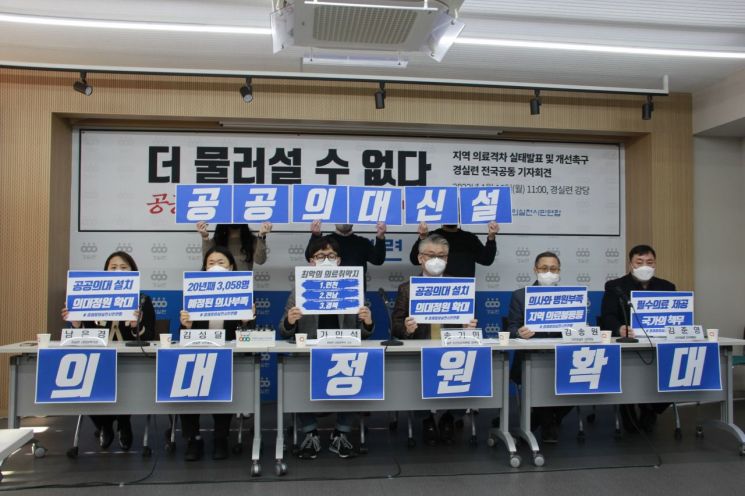 The Citizens' Coalition for Economic Justice held a press conference on the 16th to announce the current status of regional medical disparities and urge improvements, demanding the establishment of public medical schools and the expansion of medical school quotas.
 [Photo by Kyungsilryeon]
[Asia Economy Reporter Lee Gwan-ju] Incheon, Jeonnam, and Gyeongbuk were identified as the 'worst medically vulnerable areas.' This is the result of an investigation by the Citizens' Coalition for Economic Justice into the status of large general hospitals by region, the number of preventable deaths, the number of doctors, and the installation rate of public hospitals.
On the morning of the 16th, the Citizens' Coalition for Economic Justice held a press conference at an auditorium in Jongno-gu, Seoul, to announce the results of the 'Regional Medical Disparity Survey.'
The coalition examined the number of doctors at responsible medical institutions, the installation rate of responsible public hospitals, and the preventable mortality rate by city and province across 17 metropolitan local governments. As a result, the average number of doctors per 1,000 people in general hospitals with more than 300 beds was 0.79. By region, Jeonnam had the lowest at 0.47, followed by Chungnam at 0.49, Chungbuk at 0.54, and Gyeongbuk at 0.55. Seoul, with the highest number of doctors, had 1.59, showing a gap of about three times.
The preventable mortality rate per 100,000 people, which refers to deaths that could have been avoided with timely treatment, was highest in Chungbuk at 50.56, followed by Incheon (48.58), Gangwon (48.14), and Jeonnam (47.46). Additionally, Gwangju, Daejeon, Ulsan, and Sejong have no public hospitals with more than 300 beds, and Gangwon (17%) and Incheon (25%) also have low public hospital installation rates.
Based on this, the coalition judged Incheon, Jeonnam, and Gyeongbuk as the 'worst medically vulnerable areas,' with high preventable mortality rates and both doctor numbers and public hospital installation rates below the national average. The coalition explained, "All three regions have island or mountainous areas or lack national medical schools and affiliated hospitals, resulting in inadequate provision of appropriate public medical services."
The Citizens' Coalition for Economic Justice urged the prompt resolution of infrastructure shortages, including essential and public medical personnel, to address regional medical disparities and gaps, and called for the immediate establishment of public medical schools and expansion of medical school quotas. The coalition stated, "We will carry out a medical autonomy movement in solidarity with residents, organizations, and local governments who agree on securing a regionally self-sufficient medical system."
© The Asia Business Daily(www.asiae.co.kr). All rights reserved.

















