April 9th, Complex 14, 74㎡ Contracted for 1.02 Billion Won
House Prices Continue to Fall Despite Reconstruction Benefits
Decision on Extension of Land Transaction Permission Zone in April
[Asia Economy Reporter Onyu Lim] The first actual transaction price of the new year has been recorded at the Mokdong New Town apartments in Yangcheon-gu, Seoul, a land transaction permission zone. Despite the redevelopment safety inspection criteria being revised and the project confirmed, prices plunged by 400 million KRW in just four months. Although the government has eased various loan and tax regulations to alleviate the severe transaction freeze, the downward trend in major redevelopment complexes shows no signs of abating.
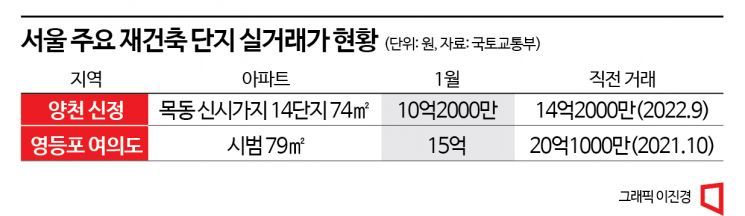
According to the Ministry of Land, Infrastructure and Transport's real transaction price disclosure system on the 16th, a 74㎡ (exclusive area) unit in Mokdong New Town Complex 14 changed hands for 1.02 billion KRW on the 9th. This is the first registered actual transaction this year in the Mokdong New Town apartments, which Seoul City designated as a land transaction permission zone due to concerns over speculative overheating. To conduct real estate transactions in a land transaction permission zone, approval from the local district office chief is required.
The actual transaction price of this contract is 400 million KRW less than the previous transaction price of 1.42 billion KRW in September last year. It dropped nearly 30% at once. Compared to the highest transaction price of 1.68 billion KRW in October 2021, it fell by 620 million KRW.
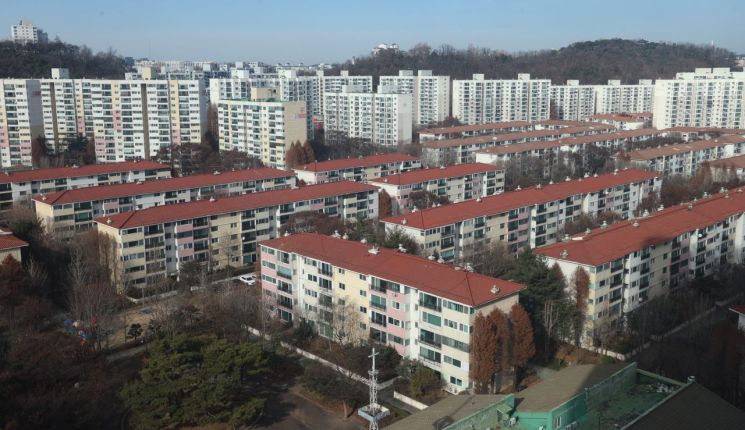
Mokdong New Town Complex 14 was confirmed as a redevelopment project on the 9th, moving from conditional redevelopment status due to the government's rationalization of safety inspection regulations, which has caused a greater shock in the market. With redevelopment confirmed, the project can immediately proceed with designation as a maintenance zone and establishment of a union, initiating full-scale project procedures. Moreover, Yangcheon-gu has seen its loan-to-value ratio (LTV) increase from 50% to 70% following the government's lifting of regulatory zones.
A representative from A Real Estate Office in Sinjeong-dong said, "Although more people are calling to inquire about market prices, it is very difficult to dispose of existing homes, and gap investments are impossible due to the land transaction permission system, so transactions are not easily completed. While urgent sale properties may be exhausted since redevelopment is confirmed, such properties are not abundant."
The redevelopment market atmosphere, which is not easily reversed, is also evident in Yeouido, another land transaction permission zone. A 79㎡ unit in the Shibeom Apartments in Yeouido-dong, Yeongdeungpo-gu, Seoul, was sold for 1.5 billion KRW on the 9th. This is 510 million KRW lower than the previous and highest transaction price of 2.01 billion KRW in October 2021. This apartment was also overlooked in the auction market. A 118㎡ unit in Shibeom Apartments was put up for auction at 2.016 billion KRW in November last year but failed to sell. A re-auction will be held on the 18th with a minimum price of 1.6128 billion KRW, about 400 million KRW lower than the previous actual transaction price of 2 billion KRW in December 2021.
Although the government recently lifted many regulatory zones in Seoul and is encouraging transaction activation through comprehensive deregulation, the high-interest rate environment continues to suppress buying momentum in the real estate market. In particular, major redevelopment complexes such as Mokdong, Apgujeong, and Yeouido face a significant barrier in the form of land transaction permission zones, causing a severe transaction freeze. In these zones, sales with existing lease contracts are not allowed, and mandatory actual residence for two years is required.
The designation period for land transaction permission zones in major redevelopment complexes is until April 27. If Seoul City decides to extend the designation, it must hold an urban planning committee meeting in mid-April to propose the extension. Conversely, if the zone is to be lifted, no proposal is necessary, and the regulation will be automatically lifted upon expiration.
Although the real estate transaction freeze is severe, since land transaction permission zones are virtually the only means to block speculative demand inflow, Seoul City's dilemma is expected to deepen. Yang Ji-young, head of Yang Ji-young R&C Research Institute, said, "Even if the land transaction permission zone is lifted, the market landscape will not completely change under the high-interest rate situation, but for Seoul City, it would be burdensome to remove the only safeguard that blocks speculative demand inflow." Park Won-gap, senior real estate expert at KB Kookmin Bank, said, "If house prices continue to fall, in order to prevent a market hard landing, discussions could be held not only on lifting the permission zone but also on reducing its size."
© The Asia Business Daily(www.asiae.co.kr). All rights reserved.
![Clutching a Stolen Dior Bag, Saying "I Hate Being Poor but Real"... The Grotesque Con of a "Human Knockoff" [Slate]](https://cwcontent.asiae.co.kr/asiaresize/183/2026021902243444107_1771435474.jpg)

















