KOFIX Announcement on the 16th... Expected to Fall from 4.3%
If Deposit Interest Rates Drop, KOFIX Falls and Variable Mortgage Rates Decrease
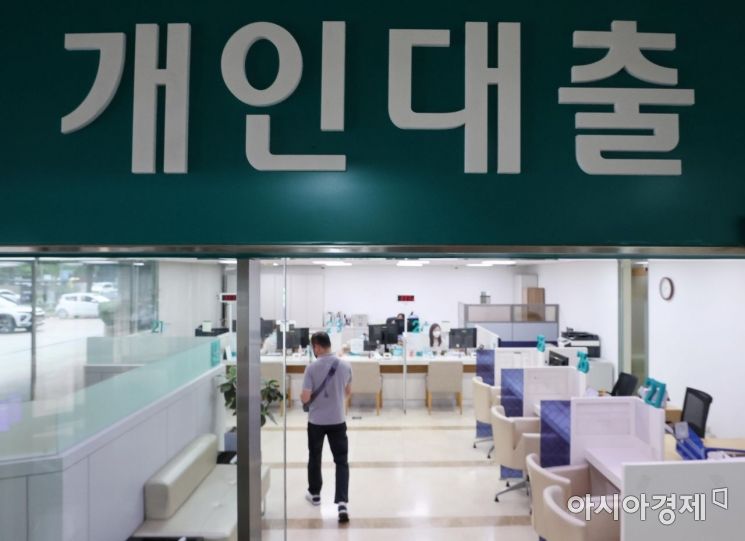 As the U.S. central bank, the Federal Reserve (Fed), hinted at additional interest rate hikes, attention is increasing on whether the Bank of Korea's Monetary Policy Committee will raise rates at its meeting scheduled for the 25th. The photo shows a loan counter at a commercial bank in downtown Seoul on the 19th. Photo by Hyunmin Kim kimhyun81@
[Asia Economy Reporter Sim Nayoung] From the 17th, variable interest rates on mortgage loans at commercial banks are expected to decrease. This is because the COFIX (Cost of Funds Index), the benchmark for determining loan interest rates, is anticipated to decline for the first time in over a year. Additionally, with banks lowering their added margins, the upper limit of mortgage loan rates at commercial banks, which once rose to 8%, is expected to drop back to the 7% or even 6% range in some cases.
The financial sector expects the COFIX (based on December last year), announced on the 16th, to slightly decrease compared to the previous month. Currently, the variable mortgage loan rates at the five major banks (KB Kookmin, Shinhan, Hana, Woori, NongHyup) range from 4.71% to 7.41%. Depending on COFIX movements, these rates may be adjusted downward starting from the 17th. A representative from the Korea Federation of Banks stated, "The decline in deposit interest rates following the drop in market interest rates since early December is first reflected in COFIX, which is expected to influence changes in mortgage loan interest rates."
COFIX (Cost of Funds Index) is the weighted average interest rate of funds raised by eight domestic banks through deposits, savings, and bank bonds. As funding costs fluctuate, COFIX moves in the same direction, impacting loan interest rates. Last year, as the Bank of Korea raised the base interest rate, deposit and bank bond rates also rose continuously, causing COFIX to surge sharply (from 1.69% in January to 4.34% in December). Except for a dip in February, it had been rising consecutively.
However, since December last year, deposit and savings interest rates have started to decline again, increasing the likelihood of a shift in COFIX trends this month. The fixed deposit interest rates at commercial banks, which had risen close to 5% in November, have now fallen to the high 3% range. One major reason is the financial authorities' intervention to curb deposit competition by stating that "commercial banks are aggressively attracting funds," leading to downward adjustments in deposit rates. Additionally, the decline in bank bond rates, which serve as the basis for calculating deposit and savings interest rates, began at the end of last year, contributing to the drop in deposit rates.
A representative from a commercial bank said, "Even the Financial Supervisory Service is pressuring banks to lower loan interest rates," adding, "Banks are currently refraining from raising loan rates to the extent that they are lowering their added margins." Following Woori Bank's reduction of its added margin by up to 0.9 percentage points on the 13th, NH NongHyup will lower its variable mortgage loan rates by up to 0.8 percentage points starting from the 20th of this month.
© The Asia Business Daily(www.asiae.co.kr). All rights reserved.

















