[Asia Economy New York=Special Correspondent Joselgina] Will the '60/40 (60% stocks, 40% bonds) portfolio,' long regarded as the Wall Street standard for diversification, work this year? The debate over this investment strategy, which recorded significant losses last year, continues on Wall Street into the new year. While Goldman Sachs and JP Morgan are raising their voices that it is time to pay attention to the 60/40 portfolio again, BlackRock and DoubleLine Capital have drawn a line, calling it a "no longer effective strategy."

The Wall Street Journal (WSJ) reported on the 15th (local time) that the debate over the 60/40 portfolio among major asset management firms and investment banks such as BlackRock and Goldman Sachs has recently split into pro and con camps.
This portfolio, which allocates 60% to stocks and 40% to bonds, has traditionally been evaluated as an investment method that seeks both profitability and stability even during periods of high market volatility by utilizing the fact that stock and bond prices typically move in opposite directions. Bonds, which have a low correlation with stocks during periods of poor stock returns, act as a safety net to offset losses.
However, last year the 60/40 portfolio recorded a dismal return of around -17%, raising questions about its usefulness as an investment tool. This was due to the simultaneous sharp declines in both stock and bond markets caused by the Federal Reserve's aggressive interest rate hikes throughout the year. WSJ noted, "The 60/40 portfolio experienced its worst year on record last year because the safety net role of bonds was not confirmed," adding, "This has led to ongoing debates on Wall Street between the BlackRock and Goldman Sachs camps."
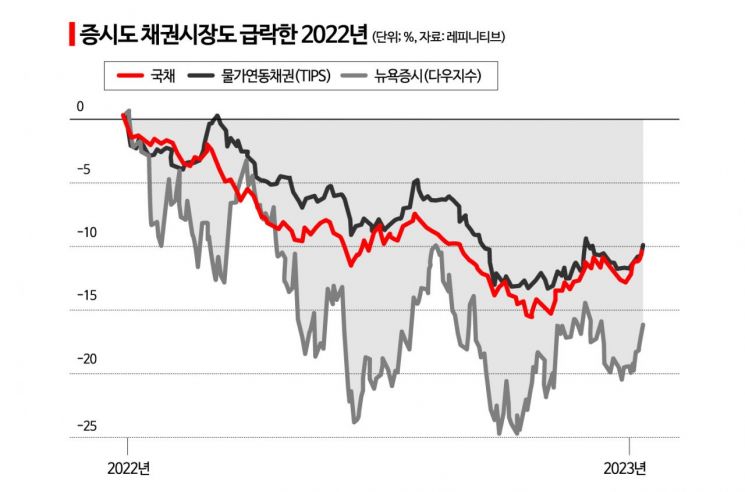
Goldman Sachs is a representative investment bank that argues the 60/40 portfolio remains a valid fundamental approach. Charmin Mosavar-Ramani, head of the firm's investment strategy group, pointed out that "(the simultaneous sharp decline in stock and bond markets) has happened in the past and will happen in the future," but emphasized, "it is a rare occurrence." She explained that last year, large losses were inevitable with any strategy, and that the 60/40 portfolio is expected to perform well this year. MarketWatch reported that years in which both stocks and bonds recorded negative annual returns are rare, occurring only a few times such as in 1931 and 1969.
Vanguard, the world's second-largest asset manager, also expects the 60/40 portfolio, which underperformed last year, to show results this year. Roger Aliaga-Diaz, a portfolio manager, described last year's situation as a "simple deviation" and advised not to worry about the 60/40 portfolio. David Kelly, JP Morgan's chief global strategist, also evaluated that "now is the time when the 60/40 portfolio becomes more promising." They foresee a simultaneous rally in stock and bond markets as soaring inflation shows signs of slowing and the Fed's rate hikes are expected to end in the first half of this year. Especially since both stock and bond prices fell sharply last year, the expected returns are also high. JP Morgan has raised the expected returns from 4.3% to 7.2% over the next 10 to 15 years for this portfolio.
However, voices claiming that the 60/40 portfolio is no longer useful remain strong. BlackRock, the world's largest asset manager, advises a fundamental portfolio change, recommending a shift from 60% stocks and 40% bonds to 40% stocks and 60% bonds. Jeffrey Gundlach, CEO of DoubleLine Capital, also recently suggested in an interview a combination of a 40/60 portfolio along with high-yield bonds, corporate bonds, and emerging market bonds.
These camps express growing concerns about stocks and bonds moving in the same direction. They also analyze that investors have shifted focus from economic growth to inflation pressures, leading to a pattern of rising bond yields. Given expectations of persistent high inflation due to deglobalization and various spending expansions, they argue that investors' portfolios need to change. Dan Kuhn, chief investment officer at TFC Financial Management, stated, "For the past 20 years, bonds have served as a safety net for the stock market, and the 60/40 portfolio worked very well," but added, "going forward, it is not a portfolio that can be trusted as much as in the past."
© The Asia Business Daily(www.asiae.co.kr). All rights reserved.
![Clutching a Stolen Dior Bag, Saying "I Hate Being Poor but Real"... The Grotesque Con of a "Human Knockoff" [Slate]](https://cwcontent.asiae.co.kr/asiaresize/183/2026021902243444107_1771435474.jpg)

















