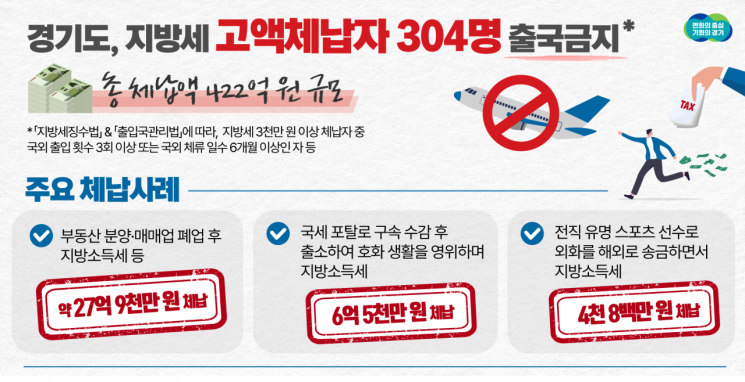
 Gyeonggi Province has banned 304 high-amount local tax delinquents from leaving the country. Graphic provided by Gyeonggi Provincial Government
[Asia Economy (Suwon) = Reporter Lee Young-gyu] Gyeonggi Province has requested the Ministry of Justice to impose travel bans on 304 chronic and malicious tax delinquents who owe more than 30 million KRW in local taxes and are suspected of hiding assets overseas or fleeing abroad. The total amount owed by these individuals is 42.2 billion KRW, and they will be prohibited from leaving the country for up to six months.
Since July last year, the province, in cooperation with 31 cities and counties within the province, conducted a comprehensive investigation of 8,190 local tax delinquents owing more than 30 million KRW. The investigation covered possession of valid passports, foreign currency transactions, immigration records, and living conditions, resulting in the final travel ban list.
According to the Local Tax Collection Act and the Immigration Control Act, the governor may request a travel ban (six months for nationals, three months for foreigners) on those who owe more than 30 million KRW in local taxes without justifiable reasons and who have traveled abroad three or more times or stayed abroad for six months or longer, upon request from the mayor or county head.
In a key case, Delinquent A, a former famous athlete who owed 48 million KRW in local income tax, was included on the travel ban list after repeatedly breaking installment payment promises and transferring foreign currency overseas four times while traveling abroad.
Delinquent B, who was engaged in real estate sales and leasing but closed the business, has owed approximately 2.79 billion KRW in local income tax since 2013. B’s spouse and children have been residing overseas for more than three years, and there is evidence that three officetels were sold before tax imposition. To prevent fleeing abroad, B was placed on the travel ban list.
Delinquent C, who owes 650 million KRW in local income tax, was imprisoned for a long period due to tax evasion. After release, C claimed financial hardship. However, a search of the residence uncovered 40 million KRW in cash and precious metals, and it was confirmed that a housekeeper was employed. Furthermore, all family members except the delinquent frequently traveled abroad and lived luxuriously, leading to a travel ban.
Ryu Young-yong, Director of the Tax Justice Division of the province, stated, "During these difficult economic times, we will strictly track down delinquents who neglect their tax obligations while enjoying affluent lifestyles to ensure that the majority of diligent taxpayers do not feel deprived. Since freedom of travel is part of the constitutional freedom of residence and movement, we will conduct fair legal and administrative reviews for those subject to lifting the ban to prevent unjust infringement of fundamental rights."
Meanwhile, as overseas travel demand is expected to surge following the easing of COVID-19 restrictions, the province plans to actively expand travel bans on delinquents who travel abroad or send their children to study overseas despite having the ability to pay. Additionally, for those who have already left the country, the province will conduct regular monitoring and impose swift sanctions immediately upon their return.
© The Asia Business Daily(www.asiae.co.kr). All rights reserved.
![Clutching a Stolen Dior Bag, Saying "I Hate Being Poor but Real"... The Grotesque Con of a "Human Knockoff" [Slate]](https://cwcontent.asiae.co.kr/asiaresize/183/2026021902243444107_1771435474.jpg)
















