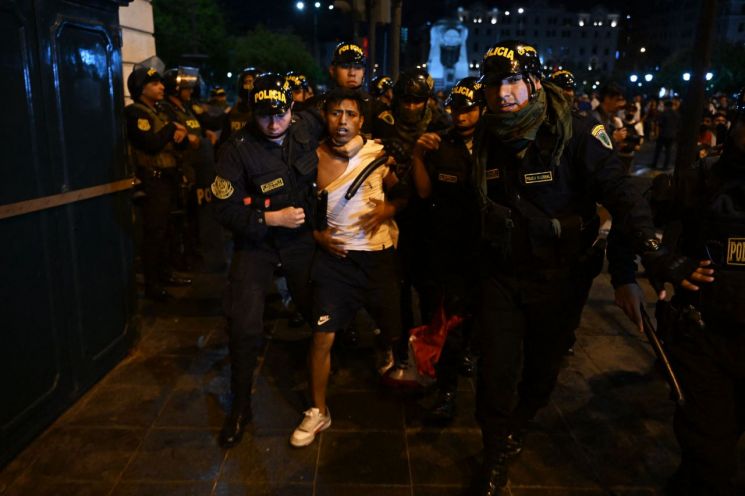
 On the 12th (local time), during an anti-government protest held in Lima, the capital of Peru, a participant is being detained by the police. [Image source=Yonhap News]
[Asia Economy Reporter Lee Ji-eun] As anti-government protests triggered by the impeachment of former Peruvian President Pedro Castillo spread nationwide in Peru, a state of emergency was declared on the 14th (local time) in four regions, including the capital Lima.
According to major foreign media such as the UK's The Guardian, the Peruvian government declared a state of emergency in four locations: the capital Lima, Puno, Callao, and Cusco.
Accordingly, assemblies and citizens' movements will be restricted for 30 days in these areas, and military intervention to maintain order will be permitted.
Earlier, on the 14th of last month, the Peruvian government had also declared a nationwide state of emergency for one month to quell protests against the impeachment of former President Castillo. After one month, the previously imposed state of emergency was lifted, but it was reimposed in four areas, including Lima, where protests continued intensely.
Peru has been experiencing political turmoil since former President Castillo was impeached by Congress on the 7th of last month on charges of bribery and planning to establish an emergency government. Castillo, a former rural elementary school teacher, won the 2021 presidential election by presenting himself as a 'common people's president' distant from the elite class. However, after corruption allegations involving himself and his family surfaced, he was impeached by Congress and immediately arrested. He is currently detained under a court order in Peru, while his family has fled to Mexico.
After the impeachment, Vice President Dina Boluarte assumed the presidency, but anti-government protesters in Peru have been demonstrating for a month, demanding the resignation of the current president, early general elections, and the release of former President Castillo. Major foreign media explained that "although former President Castillo faces corruption charges, Peruvians harbor greater dissatisfaction with the established elite politicians," and that the protests have prolonged with the support of the impoverished rural population.
In response, President Boluarte attempted to appease public sentiment by moving up the presidential and general elections, originally scheduled for 2026, to April, but this has been insufficient to quell the protests. On the 9th, thousands of protesters clashed with authorities after attacking an airport in Juliaca, a city in southeastern Peru, armed with weapons and gunpowder. Major foreign media report that 42 people have died and 531 have been injured in the protests.
© The Asia Business Daily(www.asiae.co.kr). All rights reserved.

















