Conducted at Namyang Research Institute Safety Test Building
Added Second-Row Dummy for Future IIHS Evaluation
No Significant Issues in Test Results
Regret Over No Side and Rear Tests
"Conducted Internal Evaluation on Battery Fire"
[Asia Economy Reporter Oh Gyumin] “5, 4, 3, 2, 1.”
At 10 a.m. on the 12th, a countdown began at the Hyundai Motor Group Namyang Research Center Safety Test Building located in Hwaseong-si, Gyeonggi Province. A loud warning light sounded as the Ioniq 5 swiftly passed right in front of us. “Bang.” Despite having earplugs in, the collision sound was clearly audible. As the airbags deployed, a pungent smell and some smoke rose. This was due to the gunpowder in the airbags after the collision. Researchers approached the car. All four doors opened wide.
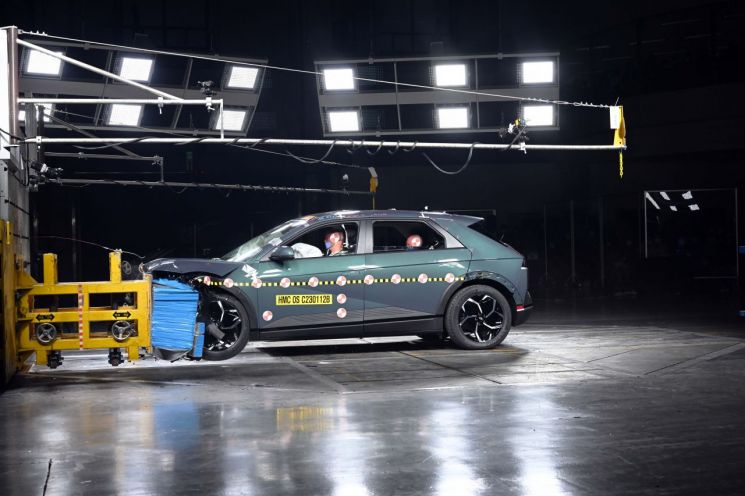
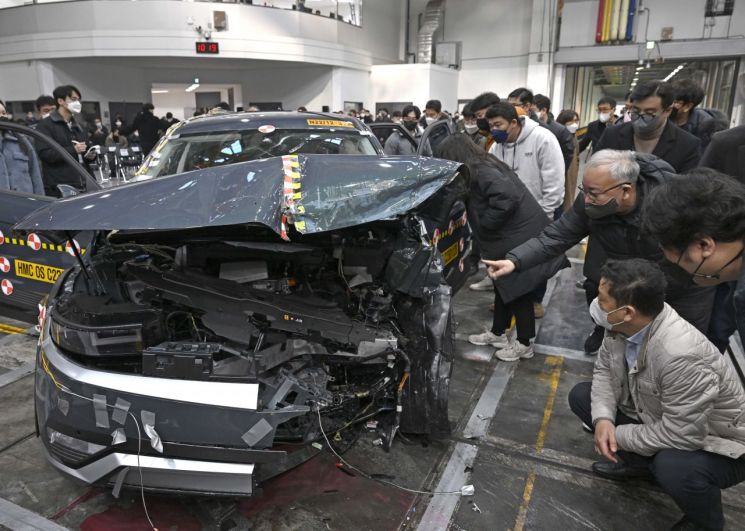
We approached the front of the crashed vehicle. The front part of the driver’s seat was damaged, and the hood was bent. Pink liquid was leaking out. A Hyundai Motor official said, “We need to check later whether it is washer fluid or coolant.” The chassis protecting the lower part of the vehicle where the battery is located was slightly detached. Other than that, no other abnormal signs were observed.
Hyundai Motor Group revealed the Ioniq 5 crash safety evaluation site on the 12th. After the accident, the passenger compartment did not deform, and the crash test dummy showed no abnormalities. The lower part of the vehicle where the battery is located was also safe. It is known that the company spent about 200 billion KRW on crash safety development last year alone, introducing 20 new vehicles.
The evaluation was conducted at the crash site inside the Safety Test Building. Passing through a room filled with dozens of dummies, we arrived at the crash site, which had three roads about 50 meters long centered on a central wall. It resembled an airplane hangar. The Safety Test Building was completed in December 2005 and covers a total area of 40,000㎡ (about 12,100 pyeong). The crash site alone is 2,900㎡ (about 877 pyeong). It has a 100-ton movable crash wall and three tracks capable of omnidirectional crashes. It can test vehicles at speeds up to 100 km/h and weights up to 5 tons.
This crash demonstration is the same as the U.S. Insurance Institute for Highway Safety (IIHS) vehicle rating, considered the most stringent crash evaluation in the world. The Ioniq 5 collided with a wall simulating a real vehicle at 64 km/h, causing 40% damage to the front of the driver’s seat. A female passenger dummy was also added to the rear seat behind the driver.
The crash results showed that the Ioniq 5’s passenger compartment remained safe and the dummy sustained no serious injuries. There was no electrolyte leakage or fire caused by damage to the high-voltage battery. However, analysis of the dummy injury scores and vehicle behavior related to the test results requires some time and could not be confirmed immediately.
Hyundai Motor Group earned a total of 26 vehicles with the IIHS highest rating TSP+ (Top Safety Pick Plus) and the excellent rating TSP (Top Safety Pick) last year. This is one less than Volkswagen and Audi’s 27 vehicles. However, excluding duplicate evaluations of the same model, Hyundai Motor Group ranked first.
To achieve this, the company designs vehicles identically for both domestic and export markets regarding safety, and conducts more than 100 tests per model at each development stage before vehicle launch, including frontal, offset (partial frontal), vehicle-to-vehicle, side, and rear tests that replicate actual accidents. Before crash tests, virtual crash simulations are performed over 3,000 times on average per model. In terms of cost, about 10 billion KRW is spent per vehicle on crash safety development. Last year, Hyundai Motor released 20 new vehicles as of their launch dates. In other words, they ‘spent’ about 200 billion KRW last year alone.
However, only the offset evaluation was conducted in this crash demonstration. For electric vehicles, side crash tests that can impact the lower part where the battery is located are important due to the risk of battery fires. Regarding this, a Hyundai Motor official stated, “In addition to the vehicle rating evaluation, separate tests related to fire risk are conducted.”
They also said that design measures are being established to prepare for battery fires while parked or charging. They added that technology development is underway to enhance crash safety in ultra-high-speed situations exceeding 100 km/h.
© The Asia Business Daily(www.asiae.co.kr). All rights reserved.
![Clutching a Stolen Dior Bag, Saying "I Hate Being Poor but Real"... The Grotesque Con of a "Human Knockoff" [Slate]](https://cwcontent.asiae.co.kr/asiaresize/183/2026021902243444107_1771435474.jpg)


















