"South Korea Must Continue to Properly Handle and Manage"
[Asia Economy Reporter Oh Gyumin] China has commented on THAAD (Terminal High Altitude Area Defense) in South Korea. Analysts suggest this may be a 'cautionary move' amid the Korea-China conflict over entry visa restrictions.
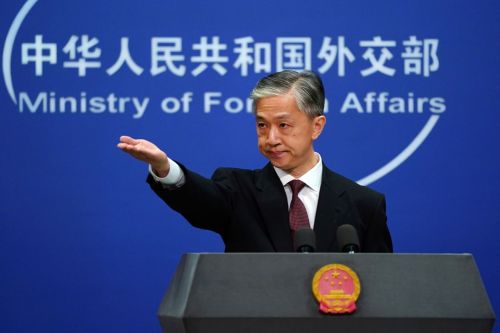
On the 13th, Wang Wenbin, spokesperson for the Chinese Ministry of Foreign Affairs, responded at a regular briefing to a Chinese journalist's question requesting comment on South Korean media reports that the official deployment process of THAAD in South Korea would be completed by March this year. He said, "China is closely monitoring South Korea's THAAD-related developments and maintaining close communication with the South Korean side at various levels."
He added, "We hope South Korea will continue to properly handle and manage this issue based on the joint understanding reached at the foreign ministers' meeting held in Qingdao last August, so that it does not become an obstacle to the development of bilateral relations."
The 'joint understanding' refers to the announcement by both sides that Foreign Minister Park Jin and then State Councilor and Foreign Minister Wang Yi (currently a member of the Communist Party Central Political Bureau) agreed during their talks that the THAAD issue should not become an obstacle to the development of relations.
On the 10th, Jeon Ha-gyu, spokesperson for the South Korean Ministry of National Defense, stated, "The draft environmental impact assessment report for the Seongju THAAD base is currently being prepared, and thereafter, according to laws and procedures, there will be a draft review and residents' briefing." South Korean media reported that the procedures planned by the Ministry of National Defense for the formal deployment of THAAD, which is currently in a temporary operational state, are expected to be completed as early as March.
After the foreign ministers' meeting in August last year, the Chinese government claimed during a foreign ministry spokesperson briefing that South Korea had expressed the past 'Three No's' policy (no additional THAAD deployment, no participation in the U.S. missile defense system, and no participation in the South Korea-U.S.-Japan military alliance) and the 'One Han' (restriction on the operation of the existing deployed THAAD), which sparked controversy.
Meanwhile, on the same day, Wu Xi, Director-General of the Consular Department of the Chinese Ministry of Foreign Affairs, stated at a briefing held by the State Council's joint COVID-19 prevention and control task force that the visa suspension was a measure to protect the rights and interests of Chinese citizens in response to retaliatory regulations imposed by South Korea and Japan. Director Wu said, "We naturally cannot accept that a few countries, disregarding science and facts, have adopted entry restrictions against China," adding, "No country in the world would allow discriminatory policies against its own nation."
He continued, "The purpose of the reciprocal measures China has taken against these countries is to safeguard the legitimate rights and interests of Chinese citizens and to normalize personnel exchanges between countries," and asserted, "We hope the relevant countries will promptly cancel discriminatory measures against China and secure normal personnel exchanges to promote the positive development of bilateral relations."
© The Asia Business Daily(www.asiae.co.kr). All rights reserved.
![Clutching a Stolen Dior Bag, Saying "I Hate Being Poor but Real"... The Grotesque Con of a "Human Knockoff" [Slate]](https://cwcontent.asiae.co.kr/asiaresize/183/2026021902243444107_1771435474.jpg)
















