Lee Jae-myung Unveils Constitutional Amendment Card
Political Circles and Public Opinion Remain Cold
52% of People Say Two-Party System Must Change
[Asia Economy reporters Naju-seok, Geum Bo-ryeong, Park Jun-i] "The Democratic Party aims to submit its own constitutional amendment proposal by March this year. Let's derive the amendment proposal through sufficient deliberation and hold a national referendum simultaneously with next year's general election."
Lee Jae-myung, leader of the Democratic Party of Korea, has brought out the "constitutional amendment" card. Following National Assembly Speaker Kim Jin-pyo, Lee also launched a "constitutional amendment drive." As President Yoon Suk-yeol mentioned the introduction of a large multi-member constituency system early this year, making electoral district reform the hottest topic in politics, it is drawing attention whether a bipartisan group of senior and newly elected lawmakers from both ruling and opposition parties, formed for "political reform," can achieve results.
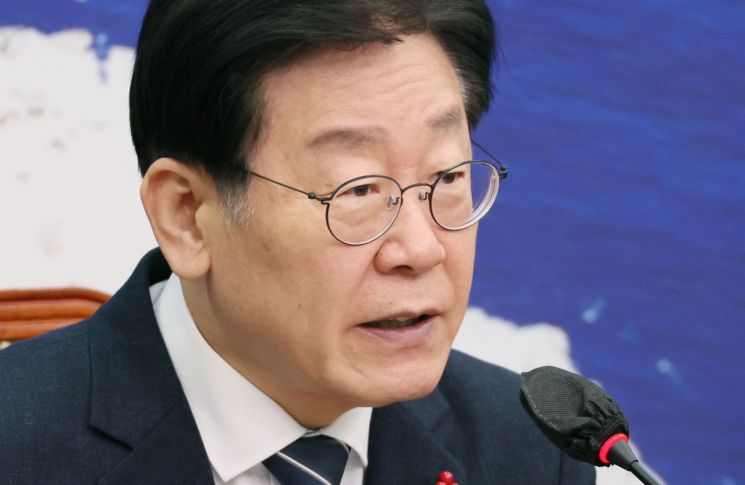
According to political circles on the 13th, Lee presented a constitutional amendment proposal centered on the introduction of a "four-year presidential term with a single re-election" and a "runoff voting system" at a New Year's press conference the day before. This was the constitutional amendment plan he revealed during last year's presidential election, brought up again at his first press conference held 138 days after his inauguration. It appears that Lee received the constitutional amendment card just one day after Speaker Kim Jin-pyo proposed on the 11th to start discussions on a "national integration-type constitutional amendment." Speaker Kim also launched a constitutional amendment advisory committee on the 9th, igniting the constitutional amendment debate.
However, it will be difficult for the constitutional amendment discussion to gain momentum. The presidential office immediately drew a line by saying the constitutional amendment proposal raised by Lee is a "matter for parliamentary discussion," and the ruling party views Lee, who is under suspicion of receiving donations for Seongnam FC, as using the constitutional amendment card to shift the political situation. Joo Ho-young, floor leader of the People Power Party, said to reporters after the party's floor strategy meeting that "the constitutional amendment advisory special committee under the Speaker will discuss various issues including the power structure, but proposing to amend only the four-year presidential term with a single re-election has no impact."
For this reason, political reform discussions are expected to focus on electoral district reform. The day before, 52 lawmakers from both ruling and opposition parties, who were conducting a "bipartisan political reform continuous discussion," declared their joining of the "bipartisan political reform lawmakers' group" proposed by senior lawmakers from both sides. They said, "In the new year, we must relinquish the winner-takes-all vested interests and present new politics to the people," and "We must reform the election law within the legal deadline and achieve true political reform that transcends party lines and creates interests for the Republic of Korea and its people." Jo Hae-jin, a People Power Party lawmaker who proposed the bipartisan lawmakers' group, said, "Constitutional amendment requires bipartisan consensus, which will not be easy. For now, we will focus on discussions about electoral district reform."
There is also strong public desire for electoral district reform. According to a public opinion poll released by Media Tomato on the same day, 52.3% of respondents said that the current de facto two-party system structure should be changed to a multi-party system, exceeding half. The opinion that "the two-party system is correct" was 27.7%, and 20.0% were unsure. Regarding the cause of the two-party system, 47.6% agreed that the single-member district system should be reformed. Those who disagreed were 33.9%, and 18.5% were unsure, indicating that considering the understanding of the system, the opinion to change the single-member district system, where one lawmaker is elected per district, is the most prevalent. The single-member district system has been criticized for strengthening the two-party system and exacerbating political polarization.
However, the introduction of the large multi-member constituency system proposed by President Yoon early this year faces many hurdles. The ruling party remains silent to avoid opposing President Yoon's will, but the opposition parties have voiced public opposition. Jeong Cheong-rae, a senior member of the Democratic Party, criticized at the party's supreme council meeting in the morning, saying, "It is a system that is absolutely advantageous to well-known veteran lawmakers and permanently entrenches vested interests who want to be lifelong lawmakers." Among the 13 bills on the Public Official Election Act submitted to the National Assembly's Political Reform Special Committee, only three relate to the large multi-member constituency system. Notably, this year, several election law amendment bills have included provisions to significantly increase the number of proportional representation lawmakers.
© The Asia Business Daily(www.asiae.co.kr). All rights reserved.
![Clutching a Stolen Dior Bag, Saying "I Hate Being Poor but Real"... The Grotesque Con of a "Human Knockoff" [Slate]](https://cwcontent.asiae.co.kr/asiaresize/183/2026021902243444107_1771435474.jpg)











