13 Years Ago, Han-nara Party Leadership Election Public Support Rate No.1
Na Kyung-won’s Leadership Race Debut Marked by Turmoil
Reasons for Deepening Concerns Over People Power Party Leadership Election Candidacy
[Asia Economy Reporter Ryu Jeong-min] The ruling party's situation surrounding the People Power Party's leadership election is a scene rarely seen in politics since the 2000s. There is a tense standoff between the person involved and the Presidential Office over former lawmaker Na Kyung-won's candidacy, who is leading the party member opinion polls. It is an unusual scene that the Presidential Office openly reveals its desire for her not to run, and equally unusual that this intention is not accepted.
Former lawmaker Na announced she would submit an 'official resignation letter' after the Presidential Office refused to accept her resignation from the position of Vice Chairperson of the Low Fertility and Aging Society Committee. This is a clash between political language and administrative language. It is rare for the status of a minister-level senior official to become such a subject of public debate.
The controversy began with the Presidential Office's reaction to Na's expression of her intention to resign. When it was reported in the media that Na had expressed her intention to resign as Vice Chairperson, the Presidential Office stated, "We are not aware of it." This can be interpreted as meaning that while someone expressed their intention to resign, no one has officially received it.
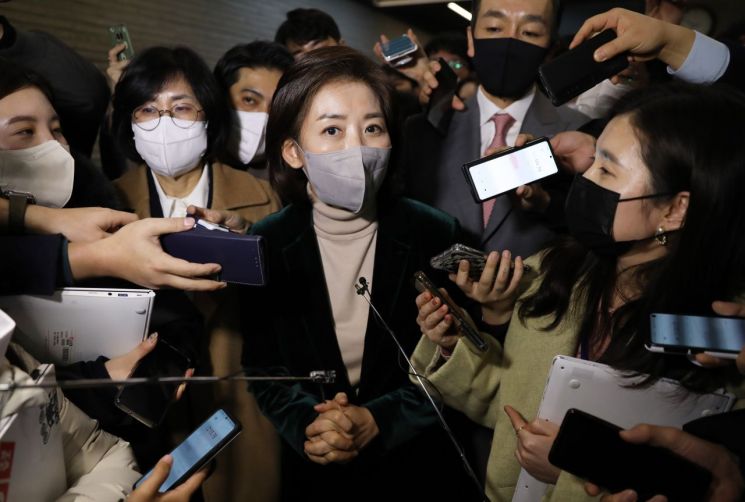 Former People Power Party lawmaker Na Kyung-won, who is contemplating whether to run in the party convention, is answering questions from reporters after attending the People Power Party Seoul Metropolitan Party's New Year's greeting event held at the People Power Party Central Party Office in Yeouido, Seoul, on the afternoon of the 11th.
 [Image source=Yonhap News]
The controversy subsided only after Na revealed that she had communicated her intention to resign via phone and text messages. Ultimately, Na conveyed a political message that she would step down, but the Presidential Office interpreted it as administrative language. It could be understood as a request not to verbally announce resignation but to submit a formal resignation letter.
Na is a presidential candidate-level politician with considerable political weight within the ruling party. When such a figure expresses an intention to resign, administrative procedures like submitting a resignation letter are generally considered secondary. However, the Presidential Office showed a stance of not accepting her resignation. There are claims that this is based on the President's trust in Na, but few take this at face value.
The Presidential Office's response implies that it does not want Na to run. The impression that the Presidential Office is interfering in the ruling party's leadership election carries political burdens. Unlike the 1980s and 1990s when the President also served as the ruling party's leader, it is now natural for party affairs to be handled within the party. So why does the Presidential Office take the political risk of discouraging Na's candidacy?
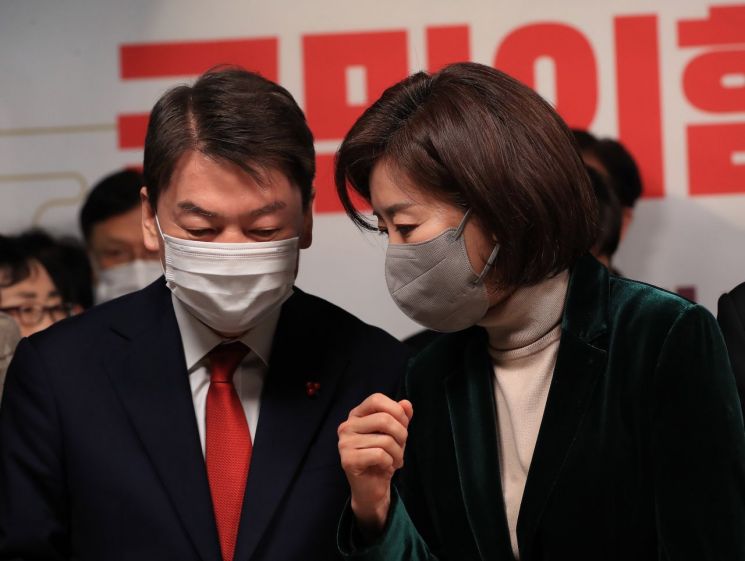 Former People Power Party lawmaker Na Kyung-won and Assemblyman Ahn Cheol-soo are talking at the People Power Party Seoul Metropolitan Party's New Year's meeting held at the People Power Party Central Party Office in Yeouido, Seoul, on the afternoon of the 11th.
 [Image source=Yonhap News]
The common interpretation is that there is concern that Na's candidacy could lead to unexpected results.
In fact, politician Na Kyung-won made a strong impression from her debut and was called the 'leadership election idol.' This happened at the July 14, 2010, Hannara Party leadership election. At that time, the election system selected the top five Supreme Council members, and the first-place winner became the party leader. Na Kyung-won ranked third overall and became a Supreme Council member.
The ranking was determined by combining delegate votes and opinion polls. Interestingly, Na was ranked first in the public opinion poll among the general public, securing 23.9%.
The person elected as party leader in that election was candidate Ahn Sang-soo. Candidate Hong Joon-pyo ranked second. However, in terms of national support, Na Kyung-won surpassed both Ahn Sang-soo and Hong Joon-pyo.
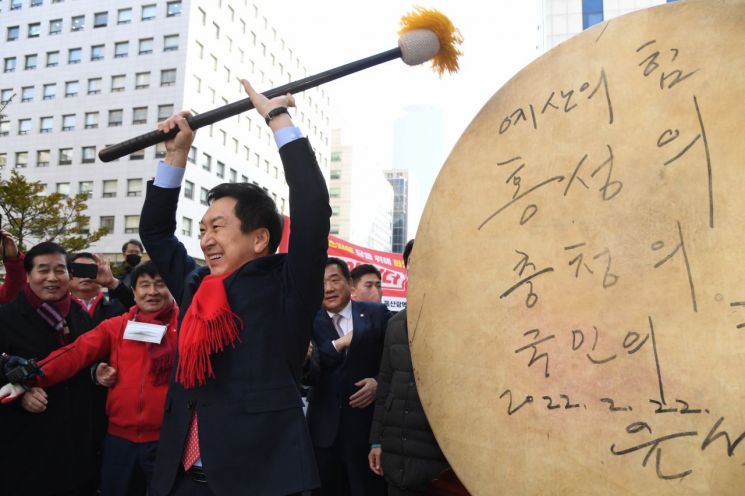 People Power Party leadership candidate Kim Ki-hyun is addressing North Korea at the opening ceremony of his "Winning Camp" in Yeouido, Seoul on the 9th. [Image source=Yonhap News]
Na already demonstrated her true value at the leadership election 13 years ago. Her strengths include high name recognition and extensive election experience. Having participated in many leadership elections, she is a familiar politician to party members. If Na actually chooses to run, the outcome of the People Power Party leadership election could become unpredictable.
However, Na's candidacy could be seen as defying the Presidential Office, potentially leading to a backlash. If she insists on running, the ruling party's moves to check her could become a variable.
On the 13th, Jeong Bong-ju, Director of the Democratic Party's Education Training Institute, said in an interview with CBS Radio's Kim Hyun-jung News Show, "If a personal investigation is launched against Na Kyung-won, she will suffer embarrassment on many fronts," predicting that the repercussions of her forced candidacy would not be trivial.
© The Asia Business Daily(www.asiae.co.kr). All rights reserved.
![Clutching a Stolen Dior Bag, Saying "I Hate Being Poor but Real"... The Grotesque Con of a "Human Knockoff" [Slate]](https://cwcontent.asiae.co.kr/asiaresize/183/2026021902243444107_1771435474.jpg)


















