[Asia Economy Reporter Jo Yoo-jin] The Wall Street Journal (WSJ) pointed out on the 12th (local time) that South Korea's independent nuclear armament theory, publicly mentioned by President Yoon Suk-yeol, risks destabilizing nuclear disarmament efforts and further escalating tensions between the South and North. The White House also reaffirmed the principle of denuclearization of the Korean Peninsula in this regard and made it clear that the direction the U.S. and South Korea are heading toward is strengthening extended deterrence.
In an article from Seoul on the same day, the newspaper reported that President Yoon is the first leader in decades since Park Chung-hee to publicly mention independent nuclear weapons development and the deployment of U.S. nuclear weapons in South Korea.
According to documents declassified in 2008, Park Chung-hee, the dictator who ruled South Korea for nearly 20 years (including his time as chairman of the Supreme Council for National Reconstruction) until his assassination in 1979, attempted to develop nuclear weapons but abandoned the plan due to U.S. opposition.
On the 11th, during the Ministry of National Defense's annual work report, President Yoon said, "If the (North Korean nuclear) problem worsens, we might deploy tactical nuclear weapons in South Korea or possess our own nuclear weapons."
This public mention of 'independent nuclear armament' by the president contradicts the U.S. policy of complete denuclearization of the Korean Peninsula and has sparked interpretations that it could shake the foundation of South Korea's security under the U.S. nuclear umbrella, causing significant repercussions.
In response, the presidential office stated, "The fundamental principle of adhering to the Nuclear Non-Proliferation Treaty (NPT) regime remains unchanged," adding, "It was an expression of determination to protect the people even in the worst-case scenario." A key official from the presidential office elaborated, saying, "There was a premise of 'if the North Korean nuclear threat intensifies or if North Korea's provocations become more serious.'"
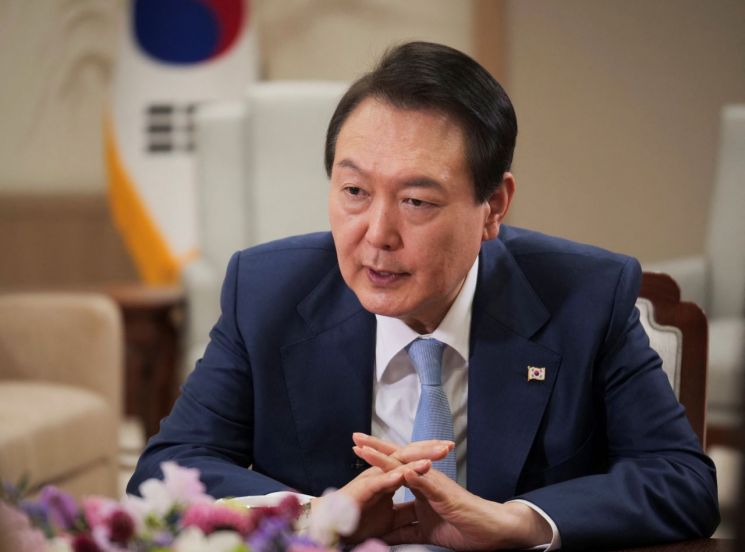
The WSJ noted that the U.S. has not officially responded to President Yoon's remarks and emphasized that President Joe Biden said he is not discussing joint nuclear exercises with South Korea. This directly contradicts President Yoon's claim in a domestic media interview that "South Korea and the U.S. are discussing operating U.S. nuclear forces under the concept of joint planning and joint exercises."
The WSJ reported that North Korea's recent indiscriminate series of provocations have sparked debates in South Korea about independent nuclear weapons development and that South Korea is urging involvement in the operation of U.S. nuclear assets, including joint nuclear exercises.
It also noted that as tensions on the Korean Peninsula rise due to North Korea's successive provocations, public support for nuclear weapons development is growing within South Korea. According to a poll conducted by the Chicago Council on Global Affairs (CCGA), the percentage of respondents supporting nuclear armament jumped from 55% in 2018 to 70% last year.
The White House reaffirmed the principle of denuclearization of the Korean Peninsula in relation to President Yoon's mention of the possibility of independent nuclear armament and also made clear that the direction the U.S. and South Korea are heading toward is strengthening extended deterrence. John Kirby, White House National Security Council (NSC) Coordinator for Strategic Communications, said at a briefing, "President Biden has committed to the complete denuclearization of the Korean Peninsula, and that remains unchanged," adding, "The U.S. and South Korea are jointly discussing expanding extended deterrence, and we will proceed in this direction."
Coordinator Kirby added that at the summit scheduled for the 13th between President Biden and Japanese Prime Minister Fumio Kishida, "We will strengthen trilateral exercises involving the U.S., Japan, and South Korea, including not only U.S.-Japan military exercises but also ballistic missile, anti-submarine, and maritime drills with South Korea."
Patrick Ryder, spokesperson for the Department of Defense, also stated, "The U.S. policy still focuses on the complete denuclearization of the Korean Peninsula," adding, "We cooperate with regional allies South Korea and Japan to protect security and prevent attacks from countries like North Korea."
© The Asia Business Daily(www.asiae.co.kr). All rights reserved.
![Clutching a Stolen Dior Bag, Saying "I Hate Being Poor but Real"... The Grotesque Con of a "Human Knockoff" [Slate]](https://cwcontent.asiae.co.kr/asiaresize/183/2026021902243444107_1771435474.jpg)











